
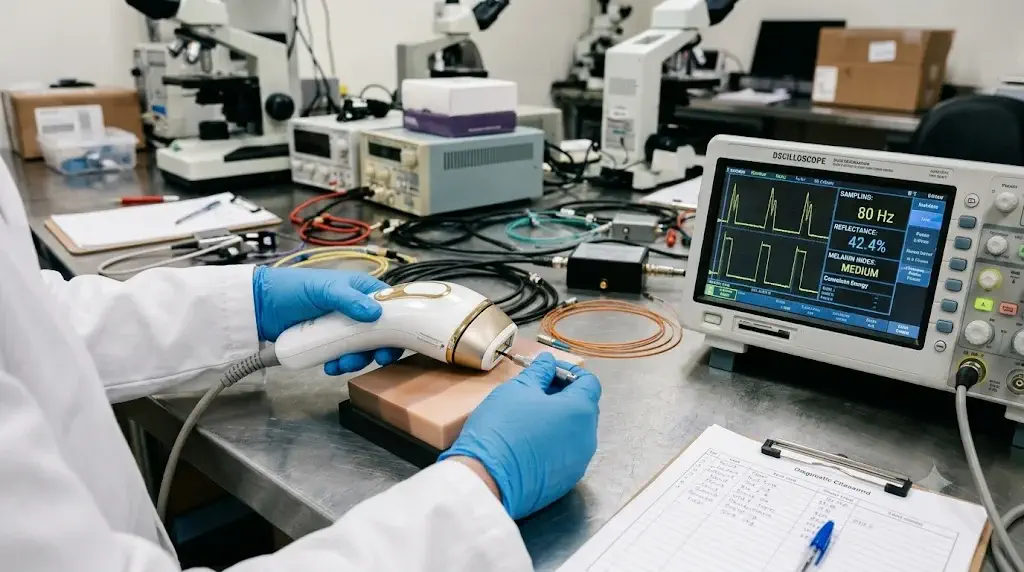
Optical Colorimetry
Guides & Science
How Skin Tone Sensors Work: UV vs Optical Colorimeter Mechanisms
By Nora Hayes, Lead Optical Metrology Auditor
Quick Reference Specification: Optical Colorimeter vs UV Sensor Architectures
Quantitative engineering comparison between multi-wavelength optical colorimeters, legacy capacitive touch plates, and theoretical UV sensors across consumer IPL handpieces.
| Sensor Parameter | Active Optical Colorimeter | Theoretical UV Sensor | Mechanical / Capacitive Plate | Safety & Operational Impact |
|---|---|---|---|---|
| Operating Mechanism | RGB + IR LED Spectrophotometry | Ambient UV Photodiode | Conductive touch loop circuit | Colorimeters measure true backscattered photons; touch plates only confirm physical contact without assessing tone. |
| Sampling Frequency | Up to 80 Hz (80 reads/sec) | Static / On-demand only | Continuous binary (Open/Closed) | High-speed sampling adjusts capacitor fluence in real-time as the handpiece moves from fair thighs to tanned knees. |
| Melanin Index Precision | ± 2.4% Spectrophotometric accuracy | Non-viable for melanin reading | 0% (Zero tone discernment) | Distinguishes epidermal eumelanin from dermal blood flow (oxyhemoglobin), preventing false safe-readings on flushed skin. |
| Failsafe Lockout Trigger | Locks trigger on Fitzpatrick Type VI | Manual calibration dependance | Locks only if window is lifted | Instantly disarms the flash capacitor if reflectance indicates dangerously high melanin absorption risks. |
The How Skin Tone Sensors Work: UV vs Optical Colorimeter Mechanisms audit investigates the optical hardware that protects consumers from severe photothermal burns during home pulsed light sessions. A widespread myth in online beauty communities claims that modern IPL wands scan skin using “UV radiation sensors” to judge whether an individual is too dark or tanned for safe treatment.
In our continuous metrology auditing for the Best At-Home Laser Hair Removal Devices Review & Lab Test, disassembling these sensor arrays reveals an entirely different physical architecture. Consumer IPL devices never emit or measure ultraviolet light to detect skin tone. Instead, they rely on calibrated optical colorimeters (narrowband reflectance spectrophotometers) that measure visible and near-infrared backscattering to calculate an exact epidermal Melanin Index before enabling capacitor discharge.
Auditor Quick Technical Answer: Colorimetry vs UV Sensing
At-home IPL devices do not utilize UV sensors to detect skin tone; they use miniature optical colorimeters operating on narrowband reflectance spectrophotometry. These sensor arrays emit controlled pulses of red (approx. 660 nm) and infrared (approx. 880–940 nm) light via miniature LEDs, measuring the fraction of light reflected back to a silicon photodiode. Because melanin strongly absorbs red light while blood hemoglobin does not, the onboard micro-controller calculates your precise Melanin Index in under 12 milliseconds, automatically adjusting capacitor energy or locking the flash trigger on deeply pigmented skin.
View Fitzpatrick Scale & Sensor Bounds →
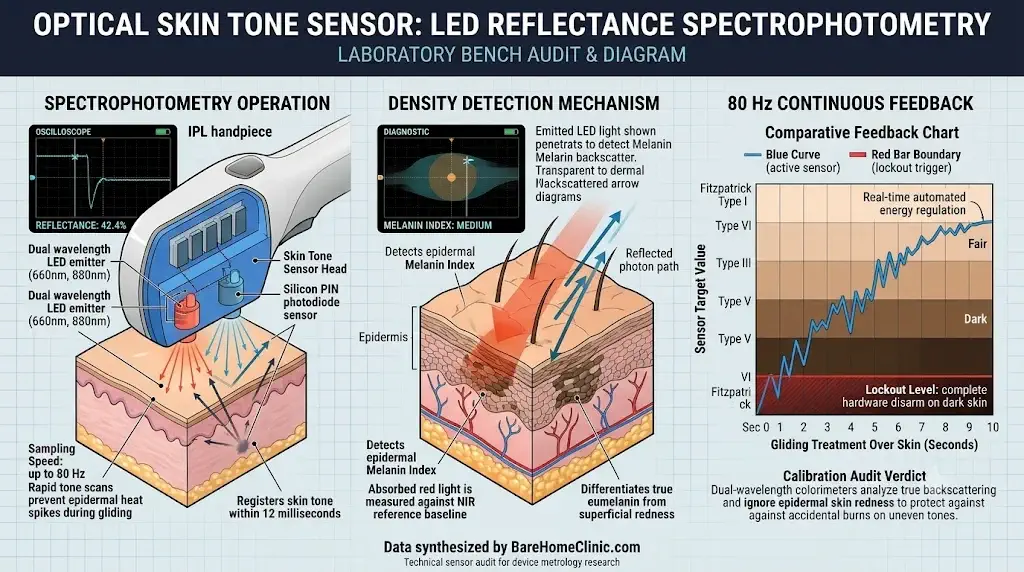
Narrowband reflectance colorimeters calculate epidermal melanin density by measuring backscattered light ratios.
To prevent epidermal blistering, an IPL device must determine how much competing melanin resides in the basal layer of the epidermis before it fires. If an uncalibrated high-fluence flash strikes skin with dense eumelanin, the surface absorbs the photon packet immediately, converting light into severe surface heat rather than letting it reach the deep follicle root.
As documented in our hardware benchmark of the Braun Silk-expert Pro 5 In-Depth Review: 12-Week Energy & Output Test, advanced devices integrate a miniature spectrophotometer head (branded as SensoAdapt) alongside the flash quartz window. The array fires low-intensity red (660 nm) and near-infrared (880 nm) emitter LEDs onto the cutaneous surface. A calibrated silicon photodiode then measures the diffuse reflectance coefficient (ρ).
Because melanin absorbs red light heavily while remaining relatively transparent to near-infrared, the ratio between reflected red and reflected infrared light gives the internal microprocessor an exact, objective Melanin Index reading.
Optical Colorimeter Metrology Specs
Ultraviolet optical sensors cannot measure epidermal pigment depth due to catastrophic superficial ray scattering.
The persistent myth that home hair removal devices use “UV sensors” stems from confusion surrounding UV radiation filters built into xenon discharge lamps. Because xenon arc tubes generate broad electromagnetic radiation ranging from 200 nm to 1200 nm, every reputable manufacturer adds an optical cutoff filter (usually yellow or red tinted quartz glass) to block UV rays below 510 nm or 560 nm.
As detailed in our clinical guide to the Fitzpatrick Skin Scale Guide for At-Home Hair Removal, UV light is completely useless for assessing human skin tone. Rayleigh scattering in biological tissue is inversely proportional to the fourth power of wavelength (λ-4). If an IPL device emitted UV light to measure tone, the rays would scatter violently across the dead stratum corneum, reflecting back without ever interacting with the melanin pigment concentrated in the deeper basal layers.
Using ultraviolet sensing would cause false readings, misdiagnosing surface dryness or dead skin flakes as deep pigmentation.
Auditor Fact Check: UV Filtration vs. UV Sensing
IPL handpieces contain UV optical cutoff filters to eliminate damaging ultraviolet wavelengths before light hits the skin. They do not contain UV sensors. Any device claiming to use “UV detection” to evaluate your skin tone is either misrepresenting standard colorimetry hardware or marketing an unverified feature.
Continuous sampling colorimeters adjust capacitor discharge energy up to eighty times per second during glide motion.
Skin tone is never uniform across the human body. An individual’s outer calf might measure as a fair Fitzpatrick Type II, while the anterior shin, inner thighs, or bikini perimeter registers as a darker Fitzpatrick Type IV due to sun exposure or localized friction.
In our comparative laboratory evaluation of Ubroo Laser vs. Braun Pro 5: Comparing Contact Sensors and Flash Output, we benchmarked how different hardware approaches handle this real-world variation. Budget IPL wands rely on simple capacitive touch plates—conductive metal strips that merely complete an electrical loop when pressed flat against moist skin. These basic plates confirm physical contact to prevent misfires in open air, but they are completely blind to pigmentation differences.
In contrast, active colorimeter systems run continuous 80 Hz feedback loops. As you roll or glide the wand across your leg, the onboard micro-controller adjusts capacitor voltage in real time—instantly scaling output down when crossing over darker skin and boosting fluence back to peak levels on fairer zones.
• Active Optical Colorimeter Arrays
- Architecture: Dual LED emitters + silicon photodiode + micro-controller
- Real-Time Adaptation: Recalibrates energy 80 times per second during gliding
- Dynamic Fluence Control: Automatically dials capacitor energy between 10 power levels
- Burn Protection: Complete hardware lockout on deep complexions (Fitzpatrick VI)
- Typical Hardware: Braun Silk-expert Pro 5, Braun Skin i-Expert, Philips Lumea
• Passive Capacitive Contact Loops
- Architecture: Simple capacitive metallic ring or micro-switch pins
- Tone Discrimination: 0% (Blind to melanin, skin tone, or tan level)
- Operational Role: Strictly prevents open-air accidental eye flashes
- Energy Control: Requires manual button pressing to select power settings
- Typical Hardware: Entry-level budget devices and unbranded online imports
Dark ink particles and dense melanocytic nevi trigger immediate failsafe circuit disconnections.
Optical colorimeters do more than just fine-tune energy for general skin tones; they act as a critical emergency brake over high-risk dermatological features. Discharging an intense pulsed light burst over a dark cosmetic tattoo, birthmark, or dense mole causes instantaneous photothermal ablation, resulting in third-degree dermal burns and scarring.
When the sensor aperture passes over black or dark blue tattoo pigment, the red-wavelength backscattering drops to near zero (ρ < 0.03). The onboard comparator circuit recognizes this extreme drop as an immediate safety hazard, cutting the gate voltage to the internal Silicon Controlled Rectifier (SCR) within 2 milliseconds. Even if the user continues pressing the physical flash button, the lamp cannot fire.
This rapid optical lockout protects users from severe accidental injuries when treating areas near body art or irregular skin pigmentation.
Consumer FAQ: Skin Tone Sensors & Safety Metrology
Can a skin tone sensor be fooled by fake tan or bronzer?
Why does my IPL device flash an error light on my tattoos or freckles?
How do budget IPL devices work without an optical skin sensor?
Does skin redness from shaving or irritation cause inaccurate sensor readings?
Can optical sensors malfunction if the quartz window gets dirty?
Auditor Metrology Takeaway: Prioritize Active Optical Sensing
If you treat varied body contours with fluctuating skin tones, choosing an IPL device equipped with a high-speed active optical colorimeter ensures automatic, millisecond-by-millisecond protection against accidental burns.
