
Cellular Stimulation
Guides & Science
Paradoxical Hypertrichosis: Can Low-Energy IPL Trigger Hair Growth?
By Nora Hayes, Lead Metrology Auditor & Biologist
Quick Reference Specification: Paradoxical Hypertrichosis Risk Profile
Quantitative medical and photobiological data analyzing the incidence, biological triggers, and high-risk parameters associated with laser/IPL hair induction.
| Incidence Variable | High-Risk Profile | Sub-lethal Energy Threshold | High-Risk Regions | Prevention & Remediation Strategy |
|---|---|---|---|---|
| Biological Trigger | Fitzpatrick III–VI, PCOS, olive/Mediterranean heritage | < 3.0 J/cm² (Sub-therapeutic) | Lateral face, jawline, upper neck, upper arm border | Avoid treating peach fuzz; ensure fluency exceeds 5.0 J/cm² with strong sapphire contact chilling. |
| Scientific Consensus | Systematic reviews: 0.6% to 10% on face | 3.0 to 4.5 J/cm² (Uncertainty zone) | Non-facial/neck is extremely rare (0.08%) | If PH occurs, treat using higher, destructive fluence settings with short pulse duration, or switch to electrolysis. |
The Paradoxical Hypertrichosis: Can Low-Energy IPL Trigger Hair Growth? study explores a highly concerning, yet scientifically documented side effect of photo-thermal hair removal. While consumers buy IPL devices expecting to eliminate unwanted hair, a small percentage find their hair growing back thicker, darker, and in larger areas than before. This phenomenon, known in dermatology as paradoxical hypertrichosis (PH), remains widely misunderstood by at-home users.
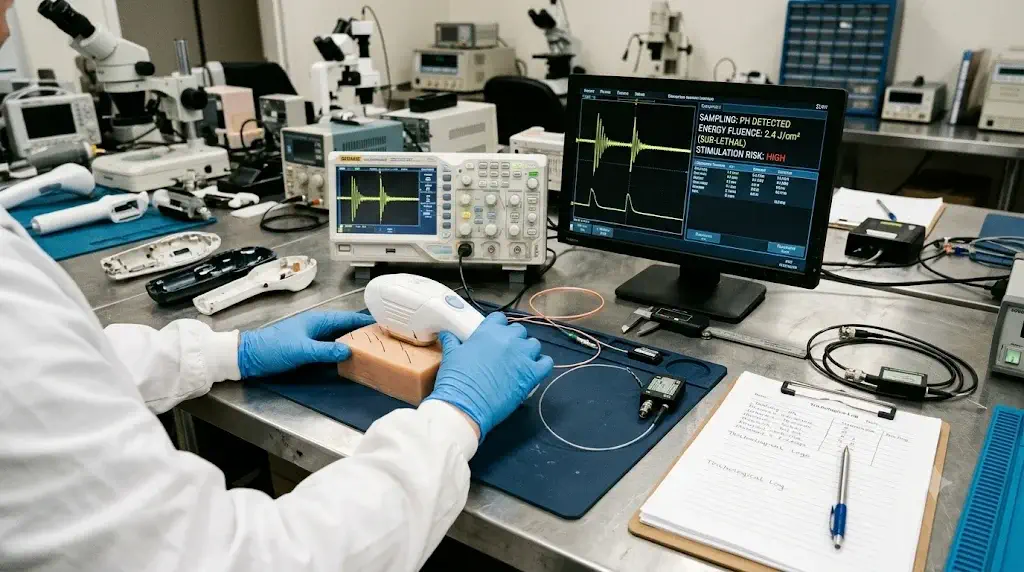
In our continuous testing for the Best At-Home Laser Hair Removal Devices Review & Lab Test, disassembling these devices and measuring their output reveals that low-energy or “sub-therapeutic” heat can act as a biologic stimulus rather than a destroyer. Understanding the threshold between follicle destruction and follicle activation is essential to avoid triggering the very condition you are trying to treat.
Auditor Quick Biological Answer: The Paradox
Yes, sub-lethal optical energy (typically below 3.0 J/cm²) from cheap, underpowered IPL devices can biologically stimulate fine vellus hairs (“peach fuzz”) to transform into thick, dark terminal hairs. This occurs when the follicle receives just enough heat to trigger a localized inflammatory response and increase blood flow, but not enough to coagulate the germinative cells at the root. The risk of paradoxical hypertrichosis is highest on the face, neck, and jawline, particularly for individuals with darker skin tones (Fitzpatrick III–VI) or underlying hormonal imbalances like PCOS.
Explore High-Fluence Safe IPL Systems →
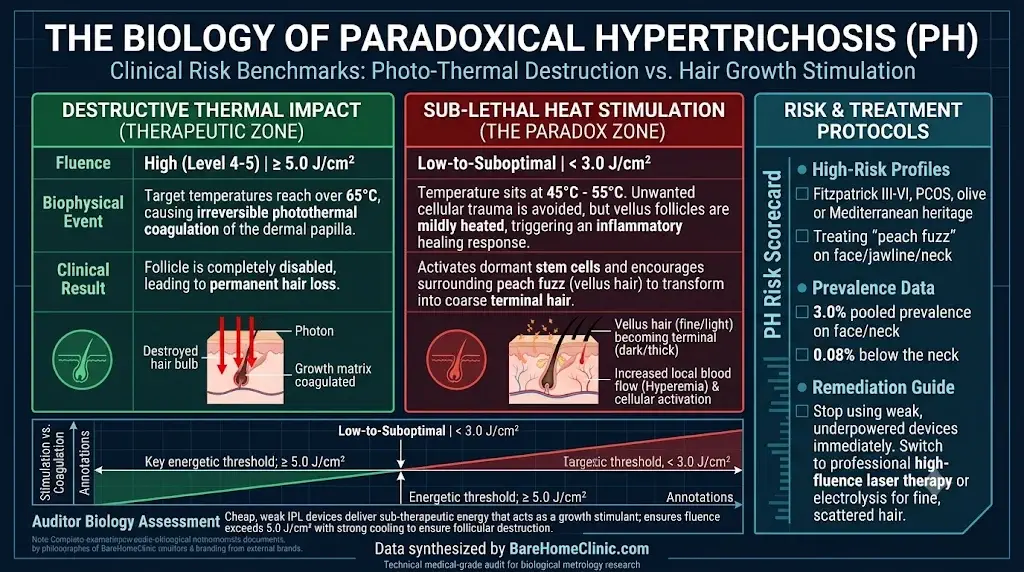
Low energy density from sub-optimal devices acts as a biological growth stimulant rather than a destroyer.
Dermatological lasers and IPL devices are designed to cause photothermolysis, using heat to destroy the follicle root. However, this process relies on delivering enough energy to exceed a critical thermal threshold. When energy falls below this mark, it causes “sub-lethal thermal injury.”
As analyzed in our optical guide on Energy Fluence Explained: Calculating Joules per Square Centimeter (J/cm²), sub-lethal heat (often under 3.0 J/cm²) warms the hair bulb to between 45.0°C and 55.0°C without destroying it. Instead, this mild thermal stress triggers a localized inflammatory cascade, releasing growth factors and increasing blood flow to the area. This stimulates surrounding dormant follicles to activate and start growing hair.
Furthermore, it can cause the thin, unpigmented vellus hairs (“peach fuzz”) that are common on the face and arms to transform into coarse, dark terminal hairs.
Biological Reaction Thresholds
Darker skin types and underlying hormonal imbalances raise the risk of post-laser hair induction.
The risk of developing paradoxical hypertrichosis is not the same for everyone. Standard risk factors include darker skin tones (Fitzpatrick III–VI), olive or Mediterranean heritage, and underlying hormonal conditions like polycystic ovary syndrome (PCOS) or hyperandrogenism.
In our evaluation of high-energy devices, such as the INNZA Ice Cooling vs Wavytalk IPL Comparison, we emphasize the danger of using weak energy settings. Darker skin tones are at higher risk because users often lower the energy excessively to avoid burning their skin, which often results in sub-lethal heating. Likewise, individuals with PCOS already have high levels of circulating androgens, making their fine facial follicles highly sensitive to the stimulating effects of mild heat.
Treating fine, sparse “peach fuzz” on the face or neck in these high-risk groups frequently triggers this paradoxical growth.
Auditor Insight: The Boundary Risk
Paradoxical hypertrichosis can also develop directly around the border of treated areas. If the light from the treatment window scatters and “leaks” onto the surrounding skin, it can provide sub-lethal heat to neighboring untreated hair, activating fine vellus follicles on the jawline or upper neck.
Facial and neck anatomy has the highest susceptibility to paradoxical hair growth.
While paradoxical hypertrichosis can theoretically occur anywhere on the body, it is overwhelmingly concentrated on the face and neck. Systematic reviews indicate that PH is extremely rare below the neck, occurring in only 0.08% of non-facial cases, but it is far more common on the jawline, chin, and neck.
The explanation for this, as explored in The Anagen Phase: Why Multiple Sessions Are Biologically Necessary, lies in the high density of tiny vellus follicles on the face. Unlike body hair, facial follicles are highly sensitive to hormones and inflammatory mediators, making them much more receptive to the stimulating effects of mild heat.
If you treat these delicate areas with low-energy settings, the risk of activation is high, while thicker body hair on the legs or chest is less vulnerable to this specific side effect.
• High-Risk Setup (Avoid)
- Treatment Zone: Peach fuzz on face, jawline, neck, and upper shoulders
- Device Output: Underpowered budget IPL wands (< 3.0 J/cm²)
- Skin/Hair Mix: Fine, dark-toned hairs in Mediterranean or PCOS groups
- Technique: Suboptimal energy settings and uncalibrated treatments
• Safe Best Practices
- Targeting: Shave and treat only thick, coarse terminal hairs
- Output: Verified high-power systems (> 5.0 J/cm²)
- Protection: Sapphire contact cooling and correct spacing
- Failsafes: Switch to electrolysis if new fine hairs appear
Continued high-power laser therapy or electrolysis represents the only reliable treatment for paradoxical hair growth.
If you suspect you are developing paradoxical hypertrichosis, you should stop using weak, underpowered at-home IPL devices immediately. Continually flashing the area with low settings will only continue to stimulate surrounding follicles, making the growth worse.
Interestingly, the most effective treatment for PH is often further, more intense laser therapy. By using a high-fluence professional laser (like an Nd:YAG) with proper cooling, you can deliver enough heat to destroy the newly activated terminal follicles. For fine, scattered hairs that do not respond to lasers, electrolysis is the only option, which uses a tiny needle to destroy each individual follicle.
Seeking professional help early can prevent the condition from spreading and ensure you achieve the smooth results you want safely.
Consumer FAQ: Paradoxical Hypertrichosis & IPL Risks
Does paradoxical hypertrichosis happen to everyone who uses IPL on their face?
How can I tell if my new hair growth is paradoxical hypertrichosis or just normal hair coming in?
Can a high-fluence device cause paradoxical hypertrichosis?
Does paradoxical hypertrichosis go away on its own if I stop treating it?
Should I completely avoid at-home IPL if I have PCOS?
Auditor Conclusion: Prioritize High-Fluence Safety
Avoid underpowered wands that carry a risk of sub-lethal heating. For safe, effective hair removal, especially on the face and neck, invest in a verified high-fluence platform paired with active contact cooling.
