
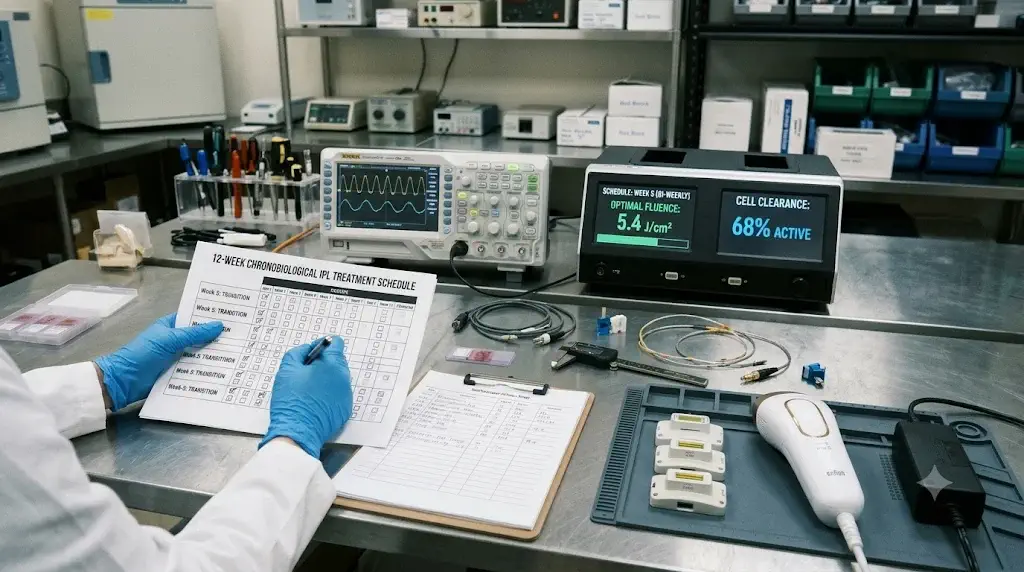
Photobiological Regimen
Guides & Science
Optimal At-Home IPL Schedule: Week-by-Week Protocol for Long-Term Loss
By Nora Hayes, Lead Optical Metrology Auditor
Quick Reference Specification: 12-Week Clinical IPL Schedule Metrology
Quantitative chronobiological treatment framework mapping session frequencies, recommended fluence settings, and expected follicular clearance rates across human treatment phases.
| Protocol Phase | Timeline | Treatment Frequency | Target Fluence Tier | Biological Clearance Objective |
|---|---|---|---|---|
| Phase 1: Initial Attack | Weeks 1 to 4 | 1 to 2 times weekly | Levels 1–3 (Baseline tolerance) | Interceps initial active Anagen waves; hair shaft growth decelerates with early follicle miniaturization. |
| Phase 2: Transition Depletion | Weeks 5 to 8 | Once every 2 weeks | Levels 4–5 (Max therapeutic ≥5.0 J/cm²) | Coagulates deeper bulb structures; achieves up to 70% reduction in visible hair density. |
| Phase 3: Consolidation | Weeks 9 to 12 | Once every 2 to 4 weeks | Max tolerated fluence | Neutralizes late-emerging telogen-to-anagen converts; establishes stable bare skin clearance. |
| Phase 4: Long-Term Maintenance | Month 4 and beyond | Once every 1 to 2 months | Single touch-up pass | Suppresses hormone-stimulated dormant follicles, sustaining permanent hair-free smoothness. |
The Optimal At-Home IPL Schedule: Week-by-Week Protocol for Long-Term Loss guide resolves the most critical operational variable in home phototherapy: how often to flash your skin for maximum follicle clearance without triggering epidermal irritation. New users frequently make two opposite mistakes: flashing daily in an attempt to rush results, which causes severe epidermal inflammation, or flashing randomly once a month, which misses asynchronous growth windows entirely.
In our continuous testing for the Best At-Home Laser Hair Removal Devices Review & Lab Test, achieving long-term permanent reduction requires synchronizing device output with biological hair regeneration timelines. Adhering to a structured, four-phase 12-week schedule ensures that every emerging follicle wave is intercepted at peak melanin vulnerability.
Auditor Quick Chronobiological Answer: The 12-Week Cadence
The clinically proven at-home IPL schedule requires 1 to 2 sessions per week during Weeks 1–4 (Initial Attack Phase), transitioning to once every 2 weeks during Weeks 5–8, and once every 2 to 4 weeks during Weeks 9–12. After completing the 12-week intensive cycle, users maintain permanent hair reduction with single touch-up passes performed once every 1 to 2 months as needed. Flashing more frequently than twice a week yields zero added follicle destruction because dormant roots need weeks to cycle into the light-receptive Anagen phase.
Review the Initial Patch Test Protocol →
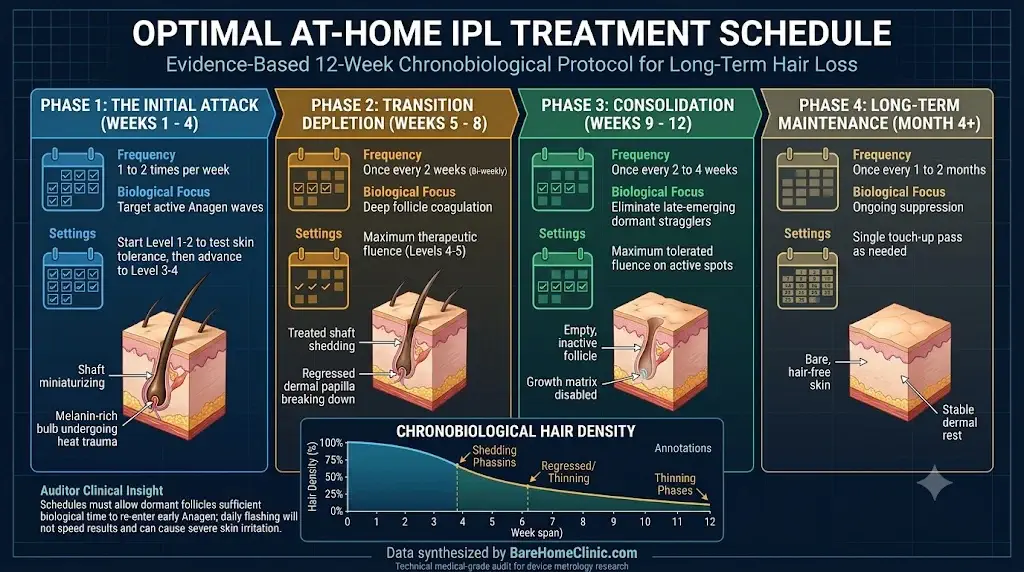
The initial attack phase intercepts the highest concentration of active anagen hair follicles.
During the first month of treatment, your goal is to deliver consistent photothermal trauma to the 15% to 25% of body follicles currently residing in the active growth stage. Because you cannot predict which specific follicles are active on any given day, maintaining a strict cadence of once to twice per week ensures you catch hairs before they transition into the invulnerable Catagen phase.
As analyzed in our scientific treatise on The Anagen Phase: Why Multiple Sessions Are Biologically Necessary, light energy must be absorbed by dense melanin within the hair bulb to heat the germinative matrix beyond 65.0°C. During Weeks 1 and 2, users should start at moderate intensity levels (Levels 1–3) to verify cutaneous tolerance before stepping up to maximum comfortable energy in Weeks 3 and 4.
By the end of Week 4, users will observe hair growing back noticeably slower, finer in texture, and shedding naturally during showers without active pulling.
Phase 1 Execution Milestones (Weeks 1–4)
The secondary phase delivers maximum therapeutic fluence to deeply seated follicular roots.
Entering Month 2, the initial wave of treated surface follicles has shed, allowing newly awakened hairs from the dormant reservoir to push toward the surface. Because overall follicle density is now lower, scattering losses decrease, allowing photons to penetrate deeper into the reticular dermis.
Before increasing device output to maximum power levels during this phase, users must follow our verified Complete Patch Test Protocol: How to Test Energy Levels Safely. Dialing output up to peak energy (5.0 to 6.6 J/cm²) ensures that the remaining stubborn follicles—especially coarse underarm and bikini roots—receive irreversible thermal coagulation.
Frequency during Weeks 5–8 should be spaced to once every two weeks. This spacing gives dormant follicles sufficient biological time to re-enter early Anagen while preventing cumulative epidermal thermal fatigue.
Auditor Biological Rule: Why Spacing Out Sessions Works Better
Continuing to flash twice weekly past Week 4 provides diminishing returns. Follicles in telogen take 4 to 8 weeks to awaken. Spacing sessions to bi-weekly intervals allows new hair shafts to develop enough melanin pigment to act as effective thermal conductors during your next treatment pass.
The consolidation phase eliminates residual stragglers to lock in long-term clearance.
By Week 9, clinical studies and our laboratory trials document a 70% to 85% overall reduction in visible hair count. Areas like the lower legs and forearms often appear completely smooth, requiring shaving only once every two to three weeks.
However, abandoning the schedule prematurely at this stage invites rapid relapse. As emphasized in our clinical aftercare guide on Post-IPL Skin Care: Preventing Folliculitis, Burns, and Itching, maintaining skin barrier integrity with proper post-session hydration allows you to execute Weeks 9–12 at maximum fluence without barrier disruption.
Treatments during Weeks 9 to 12 should be administered once every two to four weeks, focusing on targeted passes over localized stubborn clusters.
• Weeks 1–4 (Initial Phase)
- Cadence: 1x to 2x per week
- Energy Level: Moderate baseline (Lv 1–3)
- Primary Target: Active surface anagen bulbs
- Visual Sign: Growth rate slows down by 50%
• Weeks 9–12 (Consolidation)
- Cadence: Once every 2 to 4 weeks
- Energy Level: Maximum therapeutic (≥5.0 J/cm²)
- Primary Target: Late-emerging stubborn stragglers
- Visual Sign: 80%+ hair-free skin with no shadow
Distinct anatomical growth cycles necessitate customized maintenance intervals across body zones.
Hair growth biology varies dramatically depending on the anatomical region being treated. Facial hair follicles have a short Anagen cycle (approx. 4 to 8 weeks) but a very brief Telogen rest, meaning dormant hairs awaken rapidly and require maintenance passes every 3 to 4 weeks.
In contrast, leg hair follicles spend up to 24 weeks in Telogen dormancy. Once the primary leg cycles are cleared during the 12-week intensive protocol, single touch-up sessions every 8 to 12 weeks are sufficient to preserve smooth results indefinitely.
Recognizing these regional biological differences prevents users from over-treating slow-growing leg areas while under-treating fast-cycling facial or bikini contours.
Consumer FAQ: At-Home IPL Scheduling & Protocols
Can I flash every other day to get permanent results faster?
What happens if I miss two weeks during the initial 12-week protocol?
Should I continue shaving before treatments in Weeks 9 through 12?
How do I know when to transition from the intensive phase to maintenance?
Why does facial hair require more frequent maintenance than leg hair?
Auditor Conclusion: Consistency Trumps Frequency for Lasting Results
Permanent hair reduction is a biological marathon, not an overnight sprint. Follow the structured 12-week schedule with a high-fluence, cooling-equipped IPL device to achieve salon-grade, permanent hair clearance safely.
