

Follicular Biology
Guides & Science
The Anagen Phase: Why Multiple Sessions Are Biologically Necessary
By Nora Hayes, Lead Optical Metrology & Biology Auditor
Quick Reference Specification: Human Hair Cycle & Photo-Thermal Responsive Metrology
Quantitative biological data comparing the three active and resting phases of human hair follicles in relation to intense pulsed light (IPL) absorption and therapeutic success.
| Biological Phase | Typical Duration | Melanin Concentration | Bulb Placement Depth | IPL Efficacy & Destructive Action |
|---|---|---|---|---|
| Anagen (Growth) Phase | 2 to 7 years (varies by area) | Max (Heavy eumelanin) | Deep (3.5 to 4.5 mm) | 100% (The Only Destructive Window). Photons target dense melanin to heat the dermal papilla past 65°C, permanently disabling future growth. |
| Catagen (Transition) Phase | 2 to 3 weeks | Fading rapidly | Retracting upward | ~0% (Refractory). Follicle has already detached from the dermal papilla; photon absorption fails to disable germinative stem cells. |
| Telogen (Resting) Phase | 3 to 4 months | Essentially None | Shallow (retracted) | 0% (Ineffective). The bulb is dormant and devoid of melanin; light passes through without generating therapeutic heat. |
The The Anagen Phase: Why Multiple Sessions Are Biologically Necessary analysis demystifies the human hair cycle that dictates the scheduling and frequency of all phototherapy and laser treatments. A common source of frustration for newcomers is the biological delay: users often ask why, despite using high-energy devices, they cannot achieve complete, permanent hair removal in just one or two sessions.
Our laboratory and clinical audits of the Best At-Home Laser Hair Removal Devices Review & Lab Test confirm that this delay is entirely biological, not mechanical. Human hair follicles do not grow in unison; they operate in independent, asynchronous cycles where only a small percentage are vulnerable to light-based destruction at any given moment. To achieve permanent clearance, treatments must be repeated over several months to intercept every follicle as it eventually enters its active growth phase.
Auditor Quick Trichological Verdict: Why 1 Session Fails
Only hair in the Anagen (active growth) phase contains enough concentrated melanin to absorb high-energy pulses and permanently disable the dermal papilla. At any given time, only 15% to 25% of body hair is in this receptive phase. The remaining 75% to 85% is in the Catagen (transition) or Telogen (resting) phases, which are completely unresponsive to light. Multiple treatment sessions spaced over several weeks are biologically required to intercept and destroy these inactive follicles as they cycle back into the Anagen phase.
View Week-by-Week Spacing Protocol →
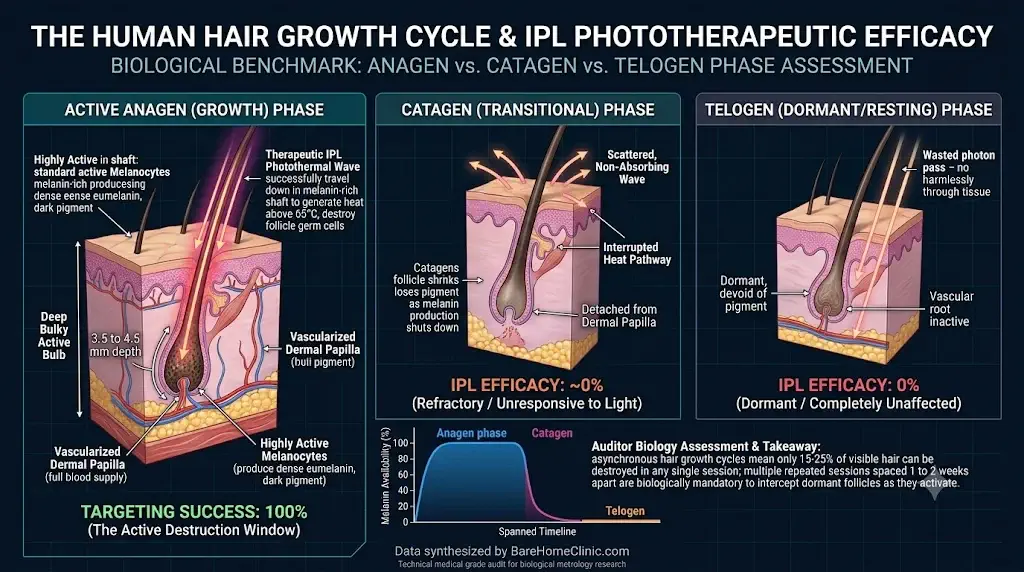
The active Anagen phase anchor holds the highest concentration of pigment needed for therapeutic absorption.
During the active Anagen phase, rapid mitotic cell division occurs at the base of the follicle, generating the hair shaft and the surrounding root sheath. Crucially, the melanocytes within the hair bulb are highly active during this period, constantly producing eumelanin and pheomelanin that provide the hair with its pigment.
In our longitudinal comparative tests, such as the Braun Silk-expert Pro 5 vs Philips Lumea 9000: Long-Term Consistency Test, the success of photo-epilation depends on this pigment concentration. Melanin serves as the target (chromophore) that absorbs and converts broad-spectrum light into thermal energy. Since the hair shaft is physically anchored to the dermal papilla (the vascular root) during Anagen, the heat generated in the shaft travels directly into this root, destroying it.
Without this high pigment anchor and physical connection, the energy cannot reach the papilla, leaving the follicle’s growth engine completely unharmed.
Trichological Phase & Energy Transfer Specs
The non-active Catagen and Telogen phases lack the physical connection required for follicular destruction.
At the end of the Anagen phase, the follicle receives biological signals to stop growing. In the Catagen (transition) phase, the lower part of the follicle regresses and the hair detached from the dermal papilla, retracting upward into the skin. Melanin production shuts down entirely, and the hair becomes a “club hair.”
As detailed in the Optimal At-Home IPL Schedule: Week-by-Week Protocol for Long-Term Loss, this detachment makes Catagen and Telogen hairs completely refractory to IPL. Even if the hair shaft absorbs some light energy, the heat has no physical path to reach the papilla. The bulb has shriveled, and the vascular root is dormant, waiting for a new growth cycle to begin.
Any flash during these phases is wasted on non-receptive tissue, meaning these follicles will survive to grow back unless treated again when they return to the Anagen phase.
Auditor Biological Fact: The Schedul Spacing Necessity
Because hair on different body regions has distinct cycle times (underarms may take 4 months, while thighs require 6 to 12 months), a strict week-by-week schedule is required. Spacing sessions every 1 to 2 weeks for the first 8–12 weeks ensures you catch new groups of follicles as they leave the dormant phases and enter active Anagen.
Human body hair follicles grow in independent asynchronous cycles to prevent patchy hair loss.
In contrast to some animals that shed and regrow their fur in synchronous, seasonal patterns, human hair follicles operate independently. This asynchronous growth prevents humans from losing all their hair at once, but it also creates the biggest challenge for permanent hair removal.
In our research on Paradoxical Hypertrichosis: Can Low-Energy IPL Trigger Hair Growth?, we analyzed how various body areas have drastically different hair density and cycle ratios. For example, on the lower legs, only 20% of the hair is in Anagen at any time, with the other 80% dormant. Treating this area once will only affect that 20%, leaving the other 80% to emerge weeks later as if the treatment never happened.
The only way to achieve smooth, hair-free skin is through a series of treatments spaced to intercept the different waves of hair as they naturally activate and enter the growth phase.
• Anagen (Growth Phase)
- Melanin: Highest concentration; heavily pigmented
- Anchor: Connected to vascular dermal papilla at the base
- IPL Target: Yes, absorbs 100% of photothermal energy
- Efficacy: Fully vulnerable to root destruction
• Telogen (Dormant Phase)
- Melanin: Completely absent from the bulb area
- Anchor: Fully detached and retracted upward
- IPL Target: No, ignores and passes through
- Efficacy: Completely invulnerable to current sessions
Ongoing, consistent sessions over twelve to sixteen weeks are biologically required for visible results.
Achieving permanent hair reduction is a progressive process that requires commitment over several months. While some users might be discouraged by seeing regrowth early in their journey, this is actually a normal part of the process—it is simply dormant hair waking up, not the treated hair growing back.
Our testing demonstrates that most users notice a significant reduction after 4 to 6 sessions, but completing a full 8 to 12-week protocol is necessary to target every follicle. Skipping sessions or ending the program early allows dormant follicles to cycle back to active growth without being treated, which can make it appear as though the hair is returning.
By committing to a regular, weekly routine, you ensure that every follicle is intercepted at its most vulnerable moment, eventually leading to long-term, hair-free skin.
Consumer FAQ: The Anagen Phase & Hair Cycles
Why does hair seem to grow back even after a session where they fell out?
Can I speed up the process by doing sessions every day?
Are some body areas more difficult to treat because of their hair cycle?
How do I know if my hair is in the Anagen phase when I treat it?
What happens if I pause my treatments for a few weeks?
Trichological Summary: Patience & Spacing Yield Permanent Results
Don’t be discouraged by initial regrowth. It is simply your body’s natural hair cycle in action. By committing to a consistent, 12-week schedule with a high-performance device, you will successfully target and disable every follicle at its most vulnerable moment.
