
Follicular Physics
Guides & Science
Why You Must Shave (Not Wax or Pluck) Before Using Your Device
By Nora Hayes, Lead Optical Metrology Auditor
Quick Reference Specification: Pre-IPL Preparation Method Comparison
Quantitative photothermal evaluation comparing blade shaving, mechanical epilation/waxing, plucking, and chemical depilatories before pulsed light exposure.
| Preparation Method | Sub-Surface Melanin Target | Epidermal Burn Risk | Optical Window Hazard | Auditor Technical Evaluation |
|---|---|---|---|---|
| Wet/Dry Blade Shaving | 100% Intact in Dermal Bulb | Zero (flush with stratum corneum) | Zero carbon deposit risk | The Mandatory Clinical Standard. Preserves the intradermal melanin shaft to conduct thermal energy straight down to the germinative papilla. |
| Waxing & Epilating | 0% (Target completely extracted) | Moderate (Follicular trauma) | None | Completely Ineffective. Mechanical extraction removes the melanin chromophore, rendering subsequent light flashes 100% useless for root destruction. |
| Tweezing & Plucking | 0% (Target completely extracted) | Low | None | Completely Ineffective. Destroys the photon absorption pathway. Users must wait 4 to 8 weeks for a new hair root to regenerate before IPL can work. |
| Chemical Depilatory Creams | Varied (Keratin dissolution) | Extreme (Chemical erythema) | Chemical residue vapor | Contraindicated. Thioglycolic salts strip the skin’s protective lipid barrier, turning normal IPL flashes into blistering contact injuries. |
The Why You Must Shave (Not Wax or Pluck) Before Using Your Device audit addresses the single most frequent protocol failure committed by at-home IPL users. Because traditional grooming conditioned consumers to believe that waxing, plucking, or epilating yields longer-lasting smoothness, many instinctively tear hair out by the root before turning on their pulsed light device.
In our continuous testing for the Best At-Home Laser Hair Removal Devices Review & Lab Test, disassembling the physics of selective photothermolysis confirms that plucking or waxing completely sabotages treatment. Intense pulsed light does not target the follicle cavity itself; it targets the melanin inside the submerged hair shaft. If you rip out the hair root, you eliminate the target, rendering every subsequent light flash completely ineffective.
Auditor Quick Technical Verdict: The Shaving Imperative
You must clean-shave with a sharp blade 12 to 24 hours prior to every IPL session because the subsurface hair shaft is the only physical conductor that channels light energy down to destroy the dermal papilla. Waxing, threading, and plucking rip out this melanin-rich conductor, leaving an empty, unresponsive follicle that cannot absorb light. Conversely, leaving visible hair stubble above the skin causes surface hairs to singe and vaporize instantly, resulting in epidermal contact burns, acrid sulfur smoke, and carbonized debris that cracks the handpiece’s optical glass.
View Safe Patch Test Protocols →
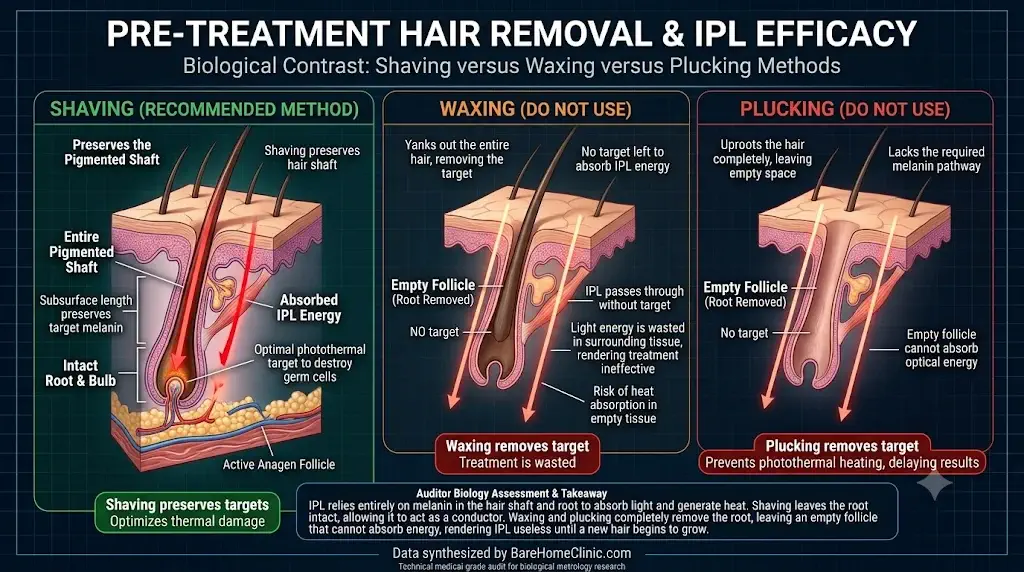
The subsurface melanin shaft serves as an optical waveguide that conducts photothermal energy into the follicle root.
Intense pulsed light relies on the medical principle of selective photothermolysis. In this process, broad-spectrum light penetrates the translucent epidermis to strike melanin molecules concentrated inside the hair shaft. Melanin absorbs these photon packets and rapidly converts light into extreme thermal energy.
As detailed in our biological evaluation of The Anagen Phase: Why Multiple Sessions Are Biologically Necessary, this heat must travel directly down the shaft to reach the germinative cells in the dermal papilla, heating them above 65.0°C to permanently disable regrowth. Shaving cuts the hair flush with the surface while leaving 2.0 to 4.0 mm of intact hair shaft hidden beneath the skin.
This submerged shaft acts as a thermal lightning rod. Without it, incoming light scatters harmlessly through the dermis without heating the follicle base.
Photothermal Conduction Metrology
Mechanical epilation removes the essential chromophore target required for photo-epilation.
Waxing, sugaring, threading, and mechanical epilators grip hairs and pull them out by the root, ripping the entire pigmented shaft clean out of the follicle canal. While this leaves skin hair-free for a few weeks, it also removes the very target that IPL devices need to work.
If you fire an IPL pulse over waxed or plucked skin, the light travels through an empty pore containing zero melanin. As explored in our clinical review on Sun Exposure & Tanning: Pre- and Post-IPL Care Rules, treating non-receptive tissue simply exposes the epidermis to unnecessary thermal stress without disabling any hair roots.
Once an area has been waxed or plucked, you must wait 4 to 6 weeks for new hair shafts to regenerate inside the follicles before IPL treatments can become effective again.
Auditor Fact: The 6-Week Waiting Period
If you recently waxed or epilated your legs or bikini line, do not start IPL right away. You must switch to blade shaving exclusively for a full 4 to 6 weeks. This allows the germinative matrix to produce a new, pigmented hair shaft beneath the surface that can absorb and conduct light energy.
Protruding surface hair causes instant epidermal burns and damages optical flash quartz windows.
Some users make the mistake of leaving 1 to 3 millimeters of visible stubble, believing that “more hair” absorbs more energy. In reality, leaving hair above the skin surface creates severe safety hazards and degrades your device’s hardware.
When high-fluence light strikes exposed hair stubble, the hair absorbs the photon burst instantly at the surface, exploding in a flash of heat that exceeds 200.0°C. This causes three distinct problems: first, it triggers painful epidermal contact burns as superheated hair collapses onto bare skin; second, it generates foul-smelling sulfur smoke; and third, it carbonizes hair debris against the device’s optical quartz window.
Before treating any area, users should complete our verified Complete Patch Test Protocol: How to Test Energy Levels Safely on cleanly shaved skin to confirm proper energy delivery without surface burning.
• Cleanly Shaved Skin (Correct)
- Energy Destination: 100% of energy targets the deep root papilla
- Surface Sensation: Mild warm snap; comfortable treatment
- Skin Safety: Stratum corneum remains intact and unburned
- Window Maintenance: Quartz glass stays clear of carbonized deposits
• Un-Shaved Stubble (Hazardous)
- Energy Destination: Wasted as surface heat on exposed hair
- Surface Sensation: Sharp stinging pain and localized burning
- Skin Safety: High risk of blisters, burns, and post-inflammatory marks
- Window Maintenance: Carbonized debris bakes onto and damages quartz glass
Shaving twelve to twenty-four hours in advance restores the stratum corneum barrier before flashing.
Timing your shave is just as important as the technique itself. Shaving immediately before firing an IPL wand often leads to discomfort. Razor blades scrape away a microscopic layer of the stratum corneum, leaving the skin slightly sensitized and prone to stinging from the pulse heat.
The optimal clinical protocol is to shave 12 to 24 hours before your scheduled session. This window gives your epidermal lipid barrier time to repair and rehydrate, while keeping hair regrowth flush with the skin surface. Avoid dry shaving or using dull, multi-blade razors that cause razor burn and micro-cuts.
Additionally, chemical depilatory creams (like Nair or Veet) should be avoided within 72 hours of an IPL session. These creams use strong alkaline chemicals to dissolve keratin, which compromises the skin barrier and significantly increases the risk of contact burns from IPL pulses.
Consumer FAQ: Shaving & Pre-Treatment Protocols
Can I shave right before using my IPL device, or should I wait?
What happens if I accidentally flash over an area with visible hair stubble?
Can I use an electric foil trimmer instead of a manual razor blade?
Why are hair removal creams not recommended before IPL?
I just waxed my legs. How long must I wait before starting IPL treatments?
Auditor Conclusion: Shave Clean to Maximize Root Destruction
Never pluck, wax, or epilate while using at-home pulsed light. Clean blade shaving 12 to 24 hours prior preserves the essential melanin waveguide that directs energy into the root for permanent hair clearance.
