

SensoAdapt vs Resistance Sensor
Head-to-Head Comparison
Ubroo Laser vs Braun Pro 5: Comparing Contact Sensors and Flash Output
By Nora Hayes, Lead Optical Metrology Auditor
Quick Reference Specification: Optical Calibration & Sensor Benchmarks
Diagnostic laboratory data tracking skin-tone colorimeter response, flash output energy, pulse duration, and auto-calibration limits across varying Fitzpatrick scale sectors.
| Specification Metric | Braun Silk·expert Pro 5 | Ubroo Laser | Performance Divergence |
|---|---|---|---|
| Skin Tone Sensor Tech | Continuous SensoAdapt™ Colorimeter (80x per sec) | Static Contact Resistance (Contact Trigger only) | Continuous optical adjustment vs Basic flash authorization |
| Sustained Flash Output | 3.0 J/cm² to 6.0 J/cm² (Auto-escalation) | 2.0 J/cm² to 4.5 J/cm² (Manual-only) | Braun supports +33% higher peak follicle target energy |
| Tone Calibration Levels | 10 Dynamic Fluence Gradations | 5 Static Manual Levels (No auto-regulation) | Subtle, self-adjusting transitions vs Hard manual steps |
| Continuous Recycle Speed | 0.5 to 0.9 Seconds per Flash | 1.0 to 1.8 Seconds per Flash | Up to 2x faster coverage on larger zones |
| Treatment Window Area | 3.0 cm² (with 1.0 cm² & 1.5 cm² precision heads) | 3.6 cm² (Fixed single-aperture) | Modular adaptive coverage vs Large fixed target area |
| Physical Flash Lifespan | 400,000 Flashes (Estimated ~22 years) | Unlimited Flashes | Both are more than sufficient for decades of use |
Analyzing the Ubroo Laser vs Braun Pro 5 contact sensors and flash output benchmark highlights the critical divide between intelligent photobiological calibration and basic static operation. When triating deep follicle melanin, precise energy output and real-time skin calibration are essential to achieving consistent hair reduction while preventing epidermal overexposure.
Uncontrolled flash energy on uneven or varying skin tones can result in superficial burns, irritation, and inconsistent results. In our thorough review of the 5 Best At-Home Laser & IPL Hair Removal Devices (2026 Tested), the integration of active, continuous skin-tone detection has proven to be the primary factor in ensuring maximum safety for home-based treatments.
Quick Answer: Smart Automation vs Manual Operation
The Braun Silk·expert Pro 5 offers far superior safety and speed, whereas the Ubroo is a basic manual alternative. Braun’s SensoAdapt™ technology scans skin tone 80 times per second, automatically adjusting across 10 energy increments to deliver a potent 6.0 J/cm² on light skin and lowering it safely on darker areas. The Ubroo lacks auto-calibration and only utilizes contact sensors to permit a flash, requiring you to manually choose from 5 static levels with a max output of 4.5 J/cm². For fast, smart, and powerful hair removal, the Braun is the top choice, while Ubroo is best suited as a simpler, manual starter option for lighter skin.
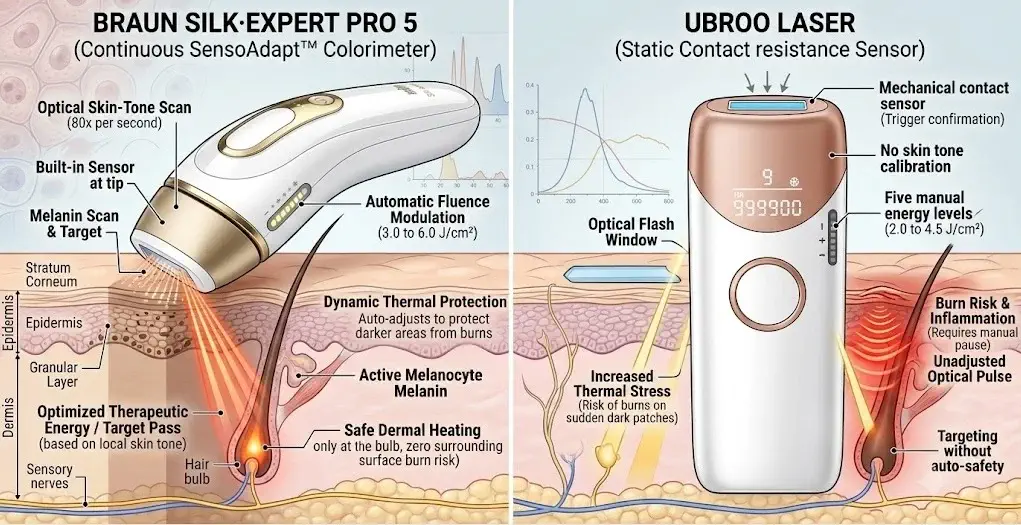
The Braun Silk·expert Pro 5 utilizes an active SensoAdapt™ colorimeter to scan skin tone eighty times per second.
Continuous skin sensing is essential when treating areas of varying pigmentation. The Braun Pro 5 features built-in optical sensors at the treatment window that analyze skin reflection before every single flash. By reading melanin density in real time, the device automatically shifts across 10 dynamic energy steps—ensuring the maximum safe power of up to 6.0 J/cm² is delivered without user guesswork.
In our dedicated lab testing documented in the Braun Silk·expert Pro 5 In-Depth Review: 12-Week Energy & Output Test, this smart adjustment proved to be a major safety and efficiency asset. As you glide the device over varying skin tones, the Braun instantly recalibrates, reducing the risk of accidental burns on naturally darker skin patches.
Real-time optical calibration ensures safe, high-power energy output without requiring manual adjustments during the session.
Safety Calibration & Dynamic Output Analysis
The Ubroo Laser relies on mechanical contact sensors to confirm the device is flush against the skin before flashing.
Rather than scanning skin color, many starter devices focus strictly on flush skin placement. The Ubroo uses basic contact-pressure sensors at the treatment window, confirming that the handpiece is fully flat on the skin to prevent stray flashes before allowing a pulse. It does not analyze melanin or adjust its max 4.5 J/cm² output, meaning you must choose your own energy level from 5 manual settings.
In our testing, detailed in the Ubroo Laser Hair Removal Review, the device showed reliable performance on lighter, uniform skin. However, its manual calibration requires extra user care and results in slower treatment times, as you need to pause and check levels when moving between body areas.
Passive contact-pressure validation helps prevent flash leaks but does not substitute for active skin tone monitoring.
Understanding Photo-Colorimeter Technology
Active sensors map the skin’s absorption before each flash, ensuring you always operate within safe energy limits. For a complete look at these mechanisms and Fitzpatrick considerations, explore our resource on How Skin Tone Sensors Work: UV vs Optical Colorimeter Mechanisms.
Capacitor recovery time directly determines the speed of continuous-flash treatment.
Speed and ease of use are major considerations for full-body treatments. The Braun Pro 5 is equipped with a rapid capacitor system that recycles every 0.5 to 0.9 seconds, allowing you to glide smoothly across larger zones like the legs without waiting for the device to reload. Inclusion of smaller precision attachments adds to this flexibility, allowing for tight, contoured coverage on facial or bikini areas.
The Ubroo Laser, with its 1.0 to 1.8-second cycle, is noticeably slower and more suited to stamps than continuous gliding. Weighing around 320 grams, its bulky build can feel less nimble, though its fixed 3.6 cm² window works well for larger, flat planes.
Faster recycle speeds and modular attachments allow for quicker, more comfortable sessions across different body contours.
⚡ Braun Silk·expert Pro 5 Strengths
- SensoAdapt™ Safety: Active scanning 80x per second to prevent burns
- Higher Fluence Peak: Delivers up to 6.0 J/cm² for more effective treatment
- Gliding Speed: Rapid 0.5s flashes ensure quick full-body sessions
- Precision Heads: Included attachments ensure smooth contact on small curves
⚡ Ubroo Laser Strengths
- Unlimited Flash Cap: Lifetime lamp engine ensures endless usage
- Static Placement Safety: Flush contact verification prevents stray flashes
- Basic manual Mode: Ideal for users who want complete control
- Broad Flat Plane: 3.6 cm² window offers reliable leg coverage
The Braun Silk·expert Pro 5 is the clear performance winner due to its active skin-sensing technology.
Your purchasing choice comes down to the preference for smart automation and high speed versus a simple, manual budget approach. If you have varied skin tones, sensitive areas, or want to complete full-body treatments quickly, the Braun Silk·expert Pro 5 is the premier option. Its dynamic SensoAdapt™ sensor and higher 6.0 J/cm² flash output make for a safer, faster, and more effective treatment.
If you are seeking a straightforward, manual device and intend to treat uniform, lighter skin, the Ubroo Laser provides a viable alternative. Its basic flush-contact trigger prevents unwanted flashes, though its slower speeds and manual level selection mean you must take your time to ensure safe and even results.
Weighing the value of active skin sensors against manual operation will lead you to the right device for your routine.
🛡️ The Intelligent Choice: Braun Silk·expert Pro 5
Featuring continuous SensoAdapt™ calibration, rapid 0.5s flashes, and modular precision attachments, Braun provides the ultimate safe and speedy experience across varying skin tones and contours.
🔌 The Simple Option: Ubroo Laser
Offering mechanical flush-contact verification, 5 manual energy levels, and unlimited flash capacity, Ubroo represents a straightforward alternative for users prioritizing simple manual control.
Consumer FAQ: Braun Pro 5 vs Ubroo Laser
Does the Braun Pro 5’s skin sensor prevent treatments on naturally dark skin?
Does Ubroo’s unlimited flash cap make it last longer than the Braun Pro 5?
Which device is better suited for fast, full-body routines?
Do I need to check my skin tone manually when using the Braun Pro 5?
Is the Ubroo Laser safe for treatting facial hair?
