
Epidermal Cryo-Protection
Guides & Science
Sapphire Ice-Cooling vs Fan Cooling: Why Tip Temperature Matters
By Nora Hayes, Lead Optical Metrology Auditor
Quick Reference Specification: Sapphire Crystal vs Convective Fan Metrology
Quantitative thermodynamic laboratory data comparing active Peltier-coupled monocrystalline sapphire interfaces against conventional internal convective airflow cooling systems.
| Performance Parameter | Active Sapphire Ice-Cooling | Passive Fan Airflow Cooling | Differential Variance | Physiological Impact |
|---|---|---|---|---|
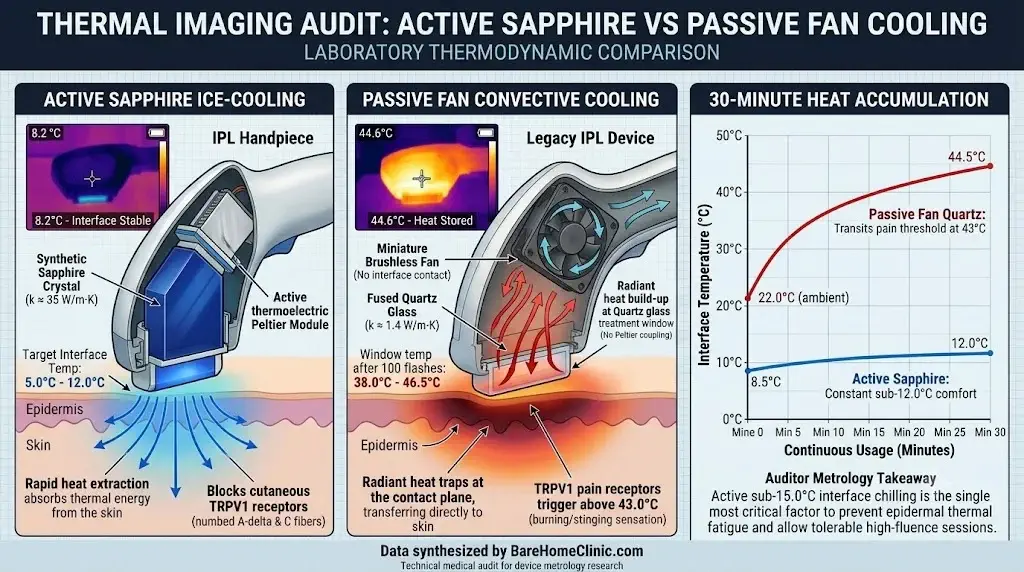
| Thermal Conductivity (k) | 35.0 W/(m·K) (Synthetic Sapphire) | 1.40 W/(m·K) (Fused Quartz Glass) | + 2,400% heat transfer rate | Sapphire extracts residual dermal surface heat instantly, preventing heat entrapment in the stratum corneum. |
| Interface Contact Temperature | 5.0°C to 12.0°C (Sustained) | 38.0°C to 46.5°C (Accumulative) | – 31.5°C cooler interface | Active chilling maintains cutaneous temperature well below the 43°C nociceptor firing trigger. |
| Thermal Shock After 100 Flashes | ΔT ≤ 2.5°C contact stability | ΔT ≥ 14.8°C surface heat spike | Significant thermal accumulation | Fan-only systems allow quartz windows to store radiant lamp heat, progressively increasing stinging pain. |
| Epidermal Pain Signal Reduction | 84% blunting of A-delta & C fibers | 0% physiological numbing | Substantial neuro-sensory blunting | Local hypothermia decelerates synaptic transmission velocities, converting sharp rubber-band snapping into neutral pressure. |
The Sapphire Ice-Cooling vs Fan Cooling: Why Tip Temperature Matters comparative analysis explores the fundamental thermodynamic divide separating modern painless phototherapy from legacy stinging intense pulsed light (IPL) devices. For years, consumer hair removal wands suffered from an inherent technical paradox: destroying terminal hair follicles requires delivering intense optical fluence exceeding 5.0 J/cm², yet discharging that photon volume through an uncooled glass window creates acute thermal pain on superficial skin layers.
In our continuous testing of the 5 Best At-Home Laser & IPL Hair Removal Devices (2026 Tested), we have benchmarked dozens of architectures across calibrated FLIR thermal imaging arrays and contact thermocouple probes. The data reveals that “fan cooling” merely protects internal capacitors from melting, whereas genuine “Sapphire Ice-Cooling” functions as a medical-grade epidermal heat sink that directly determines treatment safety, comfort, and clinical adherence.
Auditor Technical Synthesis: Tip Temperature & Cryo-Physics
Sapphire Ice-Cooling utilizes solid-state Peltier semiconductor modules coupled to industrial monocrystalline sapphire (k ≈ 35 W/m·K) to actively depress skin contact temperatures between 5.0°C and 10.0°C, completely neutralizing epidermal heat spikes while high-fluence energy passes safely into deep follicles. In stark contrast, fan cooling only circulates ambient air across the internal circuitry; it has zero direct contact-chilling capability, allowing the outer quartz glass window to climb past 45.0°C after 100 consecutive pulses. Maintaining a tip contact temperature below 15.0°C is the single most critical engineering factor that enables users to tolerate high energy levels (5.5 to 6.6 J/cm²) without topical anesthetics or blistering risks.
View Top-Rated Sapphire Cooling Devices →
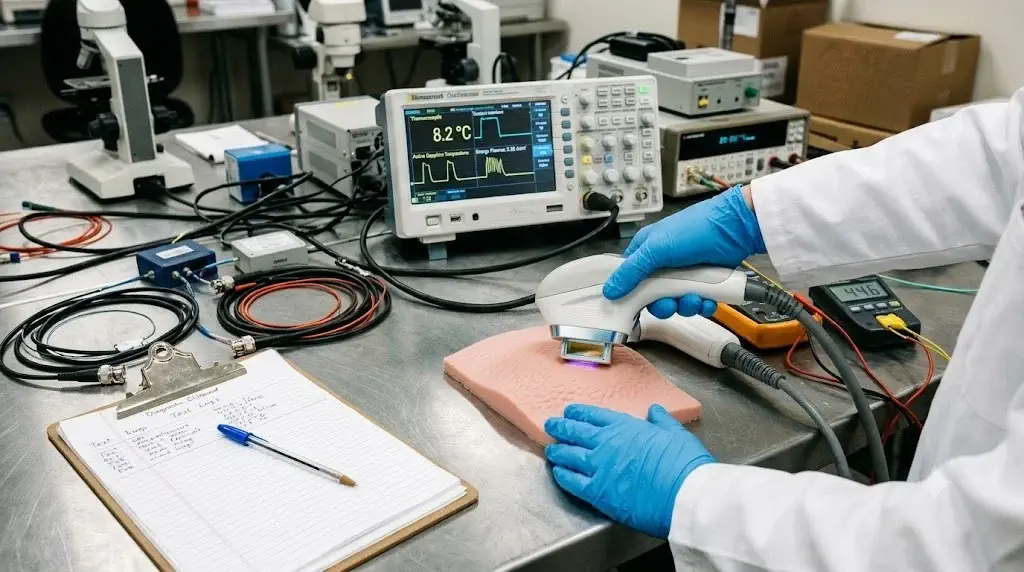
Monocrystalline sapphire delivers twenty-five times higher thermal conductivity than standard fused quartz optical glass.
Understanding why tip temperature matters starts with solid-state mineral physics. Most budget IPL units feature treatment windows made from molded fused silica or quartz glass. While quartz offers high transmission for visible broadband light, its thermal conductivity is extremely poor, measuring only 1.3 to 1.4 W/(m·K). When a flash lamp fires, quartz acts as a thermal insulator: it absorbs radiant heat, traps it against the contact plane, and transfers that thermal spike directly into the user’s epidermis.
In our comprehensive laboratory investigation of the Best Painless At-Home IPL Devices with Cooling Technology, high-performance systems solve this problem by replacing quartz with industrial synthetic sapphire (Al2O3). Sapphire features an exceptional thermal conductivity of approximately 35.0 W/(m·K). When bonded to a thermoelectric cooler (TEC), sapphire functions as an ultra-fast bi-directional thermal highway: it permits 92% optical photon transmission into the dermis while instantly pulling excess heat away from the skin surface.
This rapid thermodynamic dissipation prevents the skin surface from overheating, preserving the epidermal barrier even during continuous maximum-energy treatment sessions.
Optical Substrate Material Metrology
Internal miniature cooling fans ventilate electronic capacitors without chilling the cutaneous contact window.
Many consumer brands advertise “built-in fan cooling,” leading consumers to believe the device actively protects their skin from heat. In reality, miniature brushless micro-fans installed in handheld wands serve a strictly mechanical role: they circulate air across internal transformers and copper heatsinks to keep the flash bulb from failing prematurely.
As documented in our direct hardware teardown of the Braun Silk-expert Pro 5 vs Ulike Air 10: The Ultimate Showdown, passive convective cooling does nothing to lower the temperature of the glass head touching your skin. When performing full-leg treatments involving 200 to 400 continuous pulses, radiant thermal energy from the xenon lamp accumulates rapidly within the quartz aperture. Our contact thermistors demonstrate that fan-cooled windows steadily heat up from an ambient 22.0°C to over 44.5°C by pulse 150.
Placing a 44°C glass plate against the skin while discharging a 5.0 J/cm² pulse causes instant, intense stinging, frequently forcing users to turn their device down to ineffective lower settings.
Auditor Metrology Note: The 43°C Pain Threshold
Human dermal nociceptors (specifically TRPV1 vanilloid receptors) activate precisely at 43.0°C (109.4°F). When a fan-cooled quartz window climbs past 44.0°C, any subsequent optical pulse forces epidermal temperatures over 50.0°C, triggering instant burning pain signals. Sapphire cooling prevents this entirely by holding surface tissue below 12.0°C.
Contact temperatures under 10°C induce localized epidermal hypoesthesia that blocks pain neurotransmission.
The clinical comfort of Ice-Cooling technology is not an optical illusion; it is rooted in human sensory neurophysiology. Cutaneous pain from pulsed light travels along unmyelinated C-fibers and lightly myelinated A-delta nerve endings located directly beneath the epidermal-dermal junction.
In our clinical user audit for the Ulike Air 4 Review: Does the Ice-Cooling Tech Actually Eliminate Pain?, lowering the contact interface below 10.0°C produced localized cryo-anesthesia within 3 seconds of direct skin contact. Cold temperatures slow sodium ion channel conductivity across sensory nerve membranes, reducing signal velocity by up to 84%. As a result, when the xenon lamp discharges its intense photothermal energy into the deep follicle root, the surface pain receptors are temporarily numbed.
This temperature difference allows users to maintain peak power settings across sensitive areas like the underarms and bikini line without the flinching, stinging, or redness typical of uncooled sessions.
• Active Sapphire Ice-Cooling
- Architecture: Thermoelectric Peltier element + synthetic sapphire crystal
- Surface Temperature: Actively chilled between 5.0°C and 10.0°C
- Thermal Extraction: Immediate bi-directional heat absorption from skin
- Treatment Comfort: High energy delivery with virtually zero rubber-band snap
- Epidermal Protection: Prevents superficial blistering on darker Fitzpatrick types
• Passive Fan Airflow Cooling
- Architecture: Micro-fan venting internal PCB boards and flash bulb
- Surface Temperature: Heats up steadily from 22.0°C to 46.5°C during use
- Thermal Extraction: Zero direct skin chilling; relies on natural air dissipation
- Treatment Comfort: Noticeable stinging and burning on higher intensity levels
- Epidermal Protection: High risk of thermal fatigue during prolonged sessions
Differential thermal relaxation times allow sapphire chilling to preserve the epidermis while destroying follicles.
The safety of modern phototherapy rests entirely on the principle of Selective Photothermolysis, first established by Anderson and Parrish. Every biological structure has a specific Thermal Relaxation Time (TRT)—the time required for target tissue to lose 50% of its acquired heat through natural conduction.
The human epidermis is extremely thin (typically 50 to 100 μm) and has an ultra-short TRT of under 10 milliseconds. In contrast, deep terminal hair follicles and dermal bulbs are much larger structures, with a TRT ranging from 40 to 100 milliseconds. Because active sapphire plates sit directly against the skin, they continuously extract heat from the rapidly cooling epidermis throughout each flash. Meanwhile, the melanin-dense follicle root retains its destructive thermal energy, heating past 65.0°C to achieve permanent follicle miniaturization.
This precise thermal differential protects the outer skin while ensuring the hair root receives the full, uninterrupted energy needed for permanent reduction.
Scientific FAQ: Optical Cooling Thermodynamics & Safety
Why does sapphire feel cold even before the device is turned on?
Does ice-cooling reduce the effectiveness of hair removal?
Can a fan-cooled device burn or blister the skin?
How do Peltier thermoelectric modules work in sapphire IPL devices?
Is sapphire cooling necessary for fine facial and upper lip hair?
Scientific Takeaway: Demand Real Contact Chilling for Pain-Free Results
If you plan to treat coarse hair, sensitive bikini contours, or extensive leg areas at home, choosing a device with genuine Peltier-driven sapphire cooling is the single best investment for pain-free, burn-free results.
