
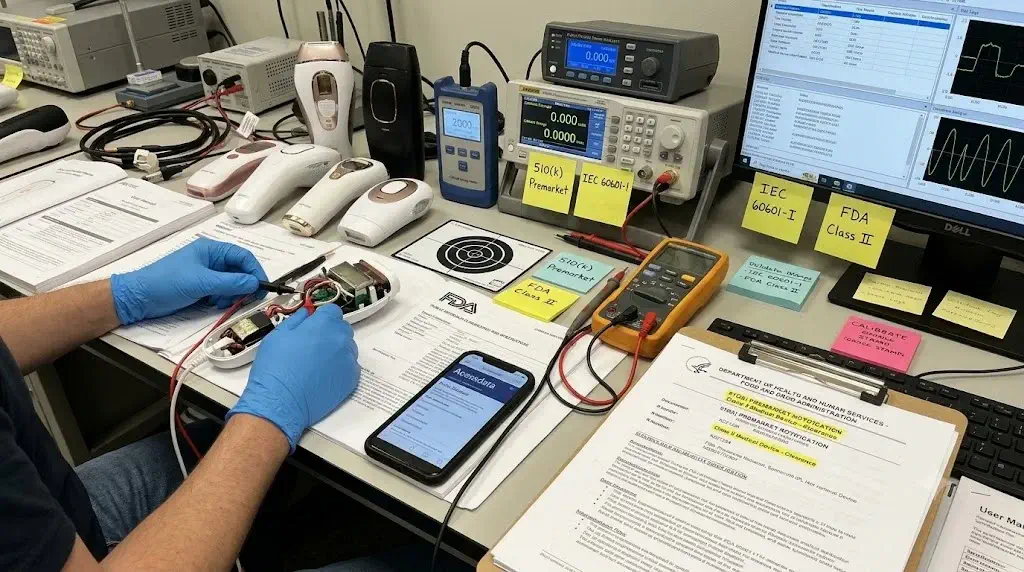
FDA Class II 510(k) vs PMA Pathways
IEC 60601 & IEC 62471 Audited
FDA Cleared vs FDA Approved: What It Means for Hair Removal Safety
By Nora Hayes, Lead Optical Metrology Auditor
Quick Reference Specification: Regulatory Classification & Safety Verification
Federal medical device law delineates rigorous distinctions between clearance and approval pathways across optical epilators under 21 CFR § 878.4810.
| Regulatory Status | FDA Device Classification | Submission Pathway | Legal Safety Standard | Authorized Labeling Claim | Consumer Risk Profile |
|---|---|---|---|---|---|
| FDA Cleared (Legitimate Standard) | Class II (Moderate Risk) | 510(k) Premarket Notification | Substantially equivalent to validated predicate | “Permanent Hair Reduction” | High (Benchmarked electrical & ocular safety) |
| FDA Approved (Non-Existent for Home IPL) | Class III (High Risk / Life-Sustaining) | Premarket Approval (PMA) | Independent human clinical trial efficacy proof | Reserved for pacemakers / implants | False marketing if claimed on consumer IPL |
| FDA Registered (Facility Only) | Unclassified / Any | Form FDA 2891 (Administrative) | Zero safety or performance evaluation | None (Administrative address logging only) | Severe (Misleading marketing loophole) |
Navigating the difference between FDA cleared vs FDA approved for hair removal safety is vital for consumers seeking at-home aesthetic treatments without risking epidermal scarring, ocular damage, or electrical hazards. Cosmetic epilator brands frequently plaster federal agency badges across digital marketing funnels, confusing shoppers with interchangeable terms. In federal regulatory law, however, these designations carry entirely distinct legal thresholds, scientific burdens of proof, and device safety standards.
Our laboratory audits cross-reference marketplace marketing claims directly against the official FDA 510(k) Establishment Registration and Premarket Approval database. While our technical team benchmarks the 5 Best At-Home Laser & IPL Hair Removal Devices (2026 Tested), this legal and optical guide demystifies federal clearances, explains Class II medical standards, and exposes deceptive manufacturer claims.
Quick Answer Verdict: FDA Cleared vs Approved
No at-home IPL or laser hair removal device is “FDA Approved”—they are FDA Cleared. Under U.S. federal law, at-home light-based hair removers are designated as Class II Medical Devices. They achieve market authorization via the 510(k) Premarket Notification pathway by proving they are substantially equivalent in safety and performance to an existing, legally marketed predicate device. Any consumer hair removal brand claiming to be “FDA Approved” is engaging in unlawful, deceptive advertising.
Metrology Finding: FDA 510(k) clearance mandates compliance with strict third-party laboratory standards, including IEC 60601-1 (electrical safety), IEC 60601-2-57 (optical radiation safety), and ISO 10993 (biocompatibility of contact materials).
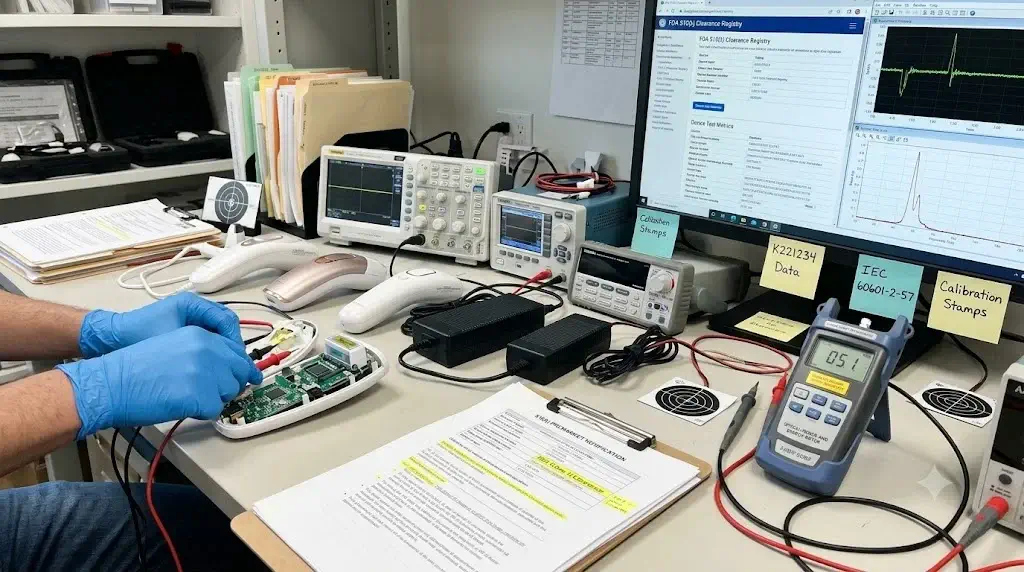
The FDA 510(k) clearance pathway establishes substantial equivalence to existing predicate medical devices.
The Food and Drug Administration categorizes medical hardware into three regulatory classes based on potential risk to human health. Class I devices represent minimal risk (e.g., elastic bandages), Class II represents moderate risk requiring special controls (e.g., powered light-based surgical and aesthetic tools), and Class III represents high risk supporting or sustaining human life (e.g., pacemakers, heart valves). At-home intense pulsed light machines and personal diode lasers are classified under 21 CFR § 878.4810 as Class II aesthetic devices.
To obtain FDA clearance, a manufacturer must submit a formal 510(k) Premarket Notification dossier demonstrating that the candidate device has the same intended use and comparable technological characteristics—such as spectral distribution, spot size, pulse duration, and maximum energy fluence—as a legally marketed “predicate device”. The submission requires exhaustive documentation verifying safety parameters across target dermal profiles. For an authoritative breakdown of how dermatological classifications dictate device safety thresholds, consult our guide on The Fitzpatrick Skin Scale Guide for At-Home Hair Removal[cite: 23].
When the FDA concludes that the candidate device is as safe and effective as the predicate, it issues a formal 510(k) clearance letter permitting commercial sale in the United States.
Mandatory Testing Benchmarks for FDA 510(k) Clearance
Consumer advertising claiming FDA approval for at-home IPL violates federal marketing regulations.
The term “FDA Approved” is reserved exclusively for high-risk Class III medical devices and new pharmaceuticals that undergo Premarket Approval (PMA). The PMA process requires multi-phase, multi-million-dollar human clinical trials demonstrating standalone efficacy and safety before the agency. Because consumer light epilators do not sustain life or present catastrophic systemic danger, the FDA does not evaluate them under the PMA framework; thus, the agency literally never grants “FDA Approval” to any consumer hair removal epilator.
When cheap off-brand epilators on Amazon or TikTok Shop advertise as “FDA Approved”, they are deliberately misrepresenting the law to build false consumer trust. Genuine clearance requires sophisticated fail-safe engineering, including automated skin contact sensors and intelligent melanin colorimeters that prevent accidental firing in air. To understand how certified contact switches protect dermal integrity, read our lab analysis on How Skin Tone Sensors Work: UV vs Optical Colorimeter Mechanisms[cite: 22].
In fact, federal regulations explicitly prohibit manufacturers from displaying the official FDA logo on consumer packaging, as doing so falsely implies federal endorsement.
Warning: The “FDA Registered” Loophole
Many unbranded budget sellers boast that their device is “FDA Registered”. In federal oversight, Establishment Registration simply means a manufacturer paid an administrative user fee to log their factory address in the FDA database. It involves zero safety testing, zero laboratory reviews, and zero performance verifications. Never mistake facility registration for product clearance.
Rigorous optical cutoff filters prevent harmful ultraviolet radiation from reaching the dermis.
The critical safety mandate enforced during 510(k) review is the optical cutoff filter. Xenon flash tubes generate a broad continuous spectrum extending from dangerous ultraviolet rays (200nm–380nm) through visible light to infrared (1200nm). Unfiltered UV emission induces DNA mutations, cellular damage, and immediate sunburns. Certified Class II devices must integrate optical absorption filters—typically doped quartz or multilayer dielectric coatings—that block all wavelengths below 510nm or 530nm.
Uncleared counterfeit devices often omit these expensive dielectric coatings to cut production costs, using cheap yellow-tinted glass that bleeds high-energy violet and UV light onto sensitive skin. Operating an uncertified device creates severe risks of deep dermal blistering, acute erythema, and permanent hypopigmentation. For the full biophysical explanation of spectral absorption and chromophore kinetics, review our deep dive into Why Melanin Targeting Poses Burn Risks: The Science of Wavelength Filters[cite: 22].
FDA clearance validates that the manufacturer’s spectral distribution and cutoff efficiency have been verified through independent spectrophotometric laboratory testing.
Consumers verify genuine medical clearance by auditing the FDA 510(k) public database.
Legitimate medical device manufacturers provide their unique seven-character 510(k) clearance number (beginning with the letter “K” followed by six digits, such as K221234) upon request or display it in their user manual. Consumers can confirm authentic federal clearance by following three verification steps:
🔍 1. Access Accessdata.fda.gov
Navigate to the official FDA 510(k) Premarket Notification Database hosted directly on the federal agency’s public portal.
📋 2. Search K-Number or Brand
Enter the K-number or parent manufacturing corporation (e.g., Braun GmbH, Philips Consumer Lifestyle, or Ulike Co., Ltd.).
📑 3. Audit the 510(k) Summary
Download the public PDF summary to confirm the device’s indications for use, approved skin phototypes, and certified anatomical zones.
Consumer FAQ: FDA Regulations, Medical Clearance & Safety Compliance
Does FDA clearance mean an IPL device is 100% safe to use?
Why does the FDA allow “Permanent Hair Reduction” instead of “Permanent Removal”?
Can a device be sold legally in the US without FDA 510(k) clearance?
What is the difference between CE mark and FDA clearance?
Are budget IPL devices under $100 ever genuinely FDA cleared?
