
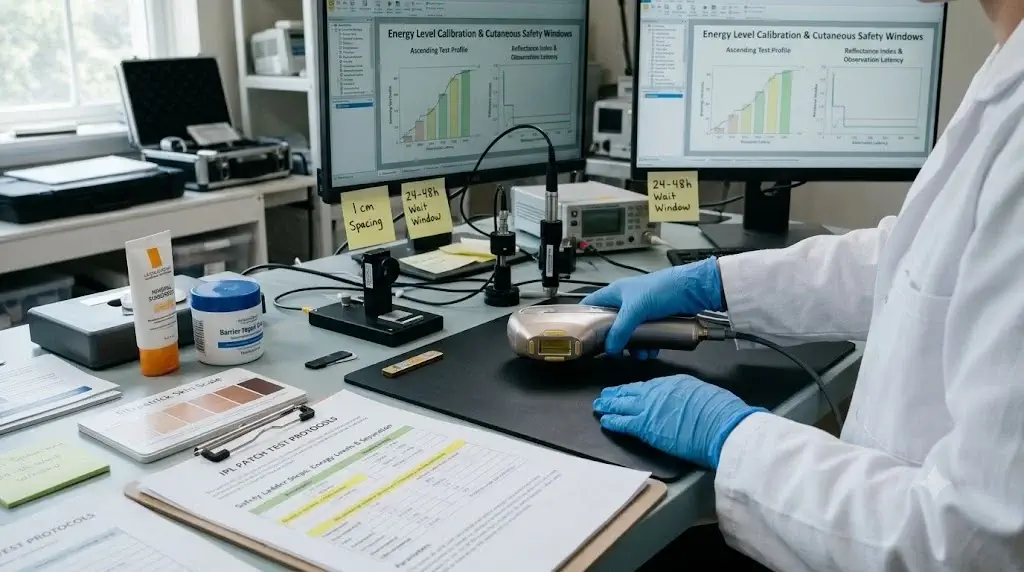
Optical Fluence Ladder Protocol
Cutaneous Safety Standard
Complete Patch Test Protocol: How to Test Energy Levels Safely
By Nora Hayes, Lead Optical Metrology Auditor
Quick Reference Specification: The Clinical IPL Patch Test Framework
Standardized laboratory guidelines define exact test anatomical sites, energy level step-up increments, observation latency windows, and cutaneous clearance criteria.
| Protocol Phase | Standard Parameter | Fitzpatrick IV–VI Variation | Metrological Purpose |
|---|---|---|---|
| Test Site Selection | Target Treatment Zone (Adjacent Flat Plane) | Most Melanated Dermal Sector | Calibrates Local Epidermal Melanin Density |
| Energy Ladder Escalation | Level 1 → Level 2 → Level 3 → Max | Level 1 → Level 2 (Cap at Mid-Range) | Maps Minimum Erythema Dose (MED) |
| Spatial Spot Spacing | 1 cm Separation Between Flash Windows | 1.5 cm Non-Overlapping Spacing | Prevents Subcutaneous Thermal Stacking |
| Observation Latency Window | 24 Hours Post-Flash | 48 Hours Minimum | Captures Delayed Inflammatory Melanogenesis |
| Clearance Decision Matrix | Zero Erythema / Zero Edema at T+24h | Zero Hyperpigmentation at T+48h | Locks Safe Operating Joules per Region |
Executing a complete patch test protocol to test energy levels safely is the single most critical diagnostic procedure before initiating broad-area intense pulsed light therapy. Consumer IPL hardware emits high radiant optical fluence ranging from 3.0 to 6.5 J/cm² across a broad spectral window of 510 to 1200nm. Because epidermal melanin levels vary significantly between body parts—such as the inner thigh versus the outer lower leg—a universal energy setting creates severe risks of partial-thickness thermal injury.
A standardized patch test measures your cutaneous threshold and establishes your Minimum Erythema Dose (MED) without exposing large dermal areas to harm. Before initiating test pulses, cross-reference your baseline dermal tone against The Fitzpatrick Skin Scale Guide for At-Home Hair Removal to identify your clinical risk profile and determine whether your hardware is safe for operation.
Quick Answer Protocol: The 4-Step Clinical Patch Test
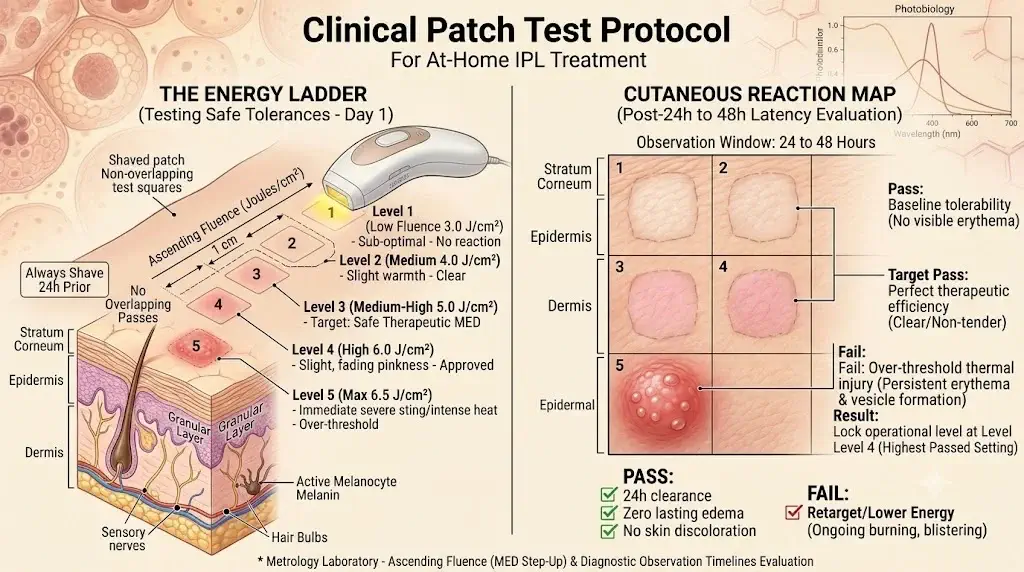
Always test every distinct anatomical zone separately before treating. Shave the test area clean 24 hours prior. Administer single test flashes in an escalating energy ladder (Level 1, then Level 2, up to your target level), spacing each flash window 1 centimeter apart without overlap. Wait a mandatory 24 hours (extend to 48 hours for Fitzpatrick types IV–VI). If the skin exhibits zero blistering, persistent stinging, or dark discoloration, treat the full zone using the highest cleared energy level.
Surface stubble intercepts radiant optical pulses to produce false positive epidermal scorch marks.
A patch test executed over unshaven skin invalidates sensitometry testing. When an intense pulsed light flash encounters hair shafts protruding above the skin surface, that visible keratin burns instantly, reaching temperatures exceeding 100°C. This surface scorch damages the epidermis and leads users to believe their skin cannot tolerate the energy level, when the reaction was caused entirely by burning surface hair.
To obtain accurate diagnostic data, wet-shave the designated test grid with a clean blade 12 to 24 hours prior to the test. Never wax, pluck, or epilate the test site, as mechanical avulsion removes the melanin target from the hair bulb. For the full biophysical explanation of this requirement, review our guide on Why You Must Shave (Not Wax or Pluck) Before Using Your Device. Ensure the skin is completely dry, free of deodorants, moisturizers, or topical chemical residues before discharging pulses.
Executing separate patch tests on each intended treatment zone is essential because facial skin, underarms, and leg tissue possess radically different epidermal thicknesses and melanin profiles.
Pre-Test Diagnostic Verification Standards
Ascending energy ladders identify the highest therapeutic optical fluence without crossing cutaneous damage thresholds.
The clinical objective of at-home IPL is to deliver the maximum tolerable fluence to achieve permanent hair follicle shedding while preserving epidermal basement membrane integrity. Starting immediately at maximum device power exposes unconditioned tissue to acute thermal shock. The step-up energy ladder systematically increments optical output across adjacent test patches to pinpoint your personal therapeutic threshold.
Begin by positioning the flash aperture flush against the skin at Spot A and deliver a single pulse on Level 1 (lowest energy). Shift the device 1 centimeter to Spot B, increase to Level 2, and discharge a second pulse. Repeat this process up through your device’s settings. Once you finalize your cleared operating setting, you can safely deploy it across your planned timeline in the Optimal At-Home IPL Schedule: Week-by-Week Protocol for Long-Term Loss.
Never discharge multiple consecutive pulses onto the exact same test spot, as thermal stacking causes severe epidermal damage even at low nominal energy settings.
Metrology Finding: Thermal Stacking Physics
IPL pulses transfer heat that takes up to 45 seconds to fully dissipate from dermal tissue. Double-pulsing a test square compounds radiant heat, artificially inducing surface erythema and distorting your patch test results.
Delayed cutaneous erythema develops twelve to twenty-four hours following intense pulsed light exposure.
A primary mistake among first-time home IPL users is assessing skin safety immediately after pulsing and proceeding straight to a full treatment. Photobiological tissue reactions operate on a delayed timeline. While minor perifollicular redness (erythema) immediately following a flash is a normal indication of targeted heat transfer, deep cellular burns, micro-blisters, and inflammatory responses can take up to a full day to manifest.
Enforce a strict 24-hour observation period for Fitzpatrick types I through III, and an extended 48-hour window for Fitzpatrick types IV through VI. If you are comparing top-tier machines with differing sensor calibrations, consult our verified laboratory analysis of the 5 Best At-Home Laser & IPL Hair Removal Devices (2026 Tested) to see how automated safety features impact patch test workflows.
Any test spot displaying localized swelling, blistering, or tenderness after 24 hours indicates that the tested energy level exceeds your safe threshold.
• PASS Criteria (Clear for Treatment)
- Zero Persistent Redness: Any mild warmth fades within 2 to 4 hours
- Normal Skin Sensation: No ongoing burning or hypersensitivity
- Intact Stratum Corneum: No flaking, peeling, or crusting
- Clear Pigment: No darkening, white spots, or color alterations
• FAIL Criteria (Drop Energy Down)
- Persistent Erythema: Noticeable redness lasting beyond 24 hours
- Cutaneous Edema: Raised bumps or localized fluid swelling
- Epidermal Vesiculation: Any formation of fluid micro-blisters
- Severe Stinging: Discomfort lingering when touched hours later
Automated skin tone sensors eliminate guesswork by continuously calculating safe energy levels.
Manual patch testing remains mandatory, but devices with integrated real-time colorimeters provide continuous secondary protection during full-body sessions. These smart sensors read skin tone up to 80 times per second, automatically adjusting output or locking the flash if you transition across darker or newly tanned areas. This automated feedback prevents overexposure without requiring you to manually re-test every square inch.
Conversely, devices featuring active contact cooling plates protect sensitive skin by reducing surface temperatures by up to 15°C during discharge. This cooling action prevents superficial heat buildup, making it significantly easier to clear higher energy levels comfortably during your initial patch tests. Pairing rigorous patch testing protocols with intelligent safety hardware ensures optimal long-term results without adverse skin reactions.
Selecting hardware equipped with automated tone calibration or integrated sapphire cooling minimizes human error throughout your treatments.
Best For Automated Tone Calibration: Braun Pro 5
Featuring continuous SensoAdapt™ sensors scanning skin tone 80 times per second, the Braun Silk-expert Pro 5 automatically adjusts its optical output to your measured tone, streamlining the patch testing process while preventing burns.
Best For Comfortable Energy Escalation: Ulike Air 10
Equipped with planar Sapphire Ice-Touch cooling that stabilizes skin temperatures under 15°C, Ulike dampens sensory stinging, allowing users to comfortably step up through energy levels without surface overheating.
Consumer FAQ: Patch Testing At-Home IPL Devices
Why must I wait 24 to 48 hours instead of checking immediately?
Do I need to repeat the patch test if I switch to a different body zone?
What should I do if my skin turns red during the patch test?
Can I patch test if I have recent outdoor sun exposure or fake tan?
Should I patch test on bare skin or can I use cooling gel?
