
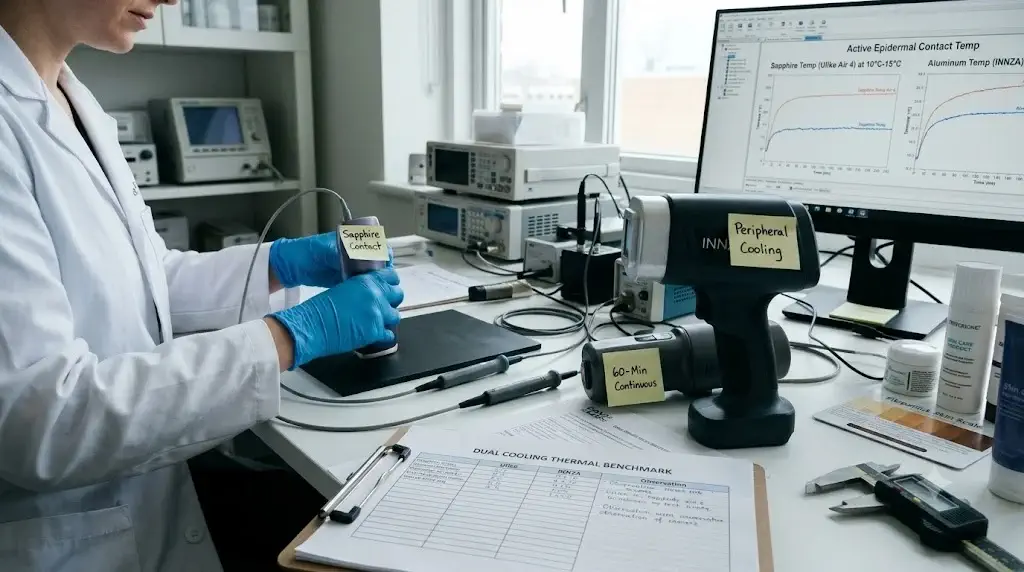
Peltier Semiconductor vs Planar Sapphire
Head-to-Head Benchmark
Ulike Air 4 vs INNZA Ice Cooling: Dual Cooling Benchmarked
By Nora Hayes, Lead Optical Metrology Auditor
Quick Reference Specification: Dual Cooling Architectural Comparison
Laboratory calorimeter data, temperature stabilization metrics, and optical fluence specifications recorded across 60-minute continuous discharge cycles.
| Specification Metric | Ulike Air 4 | INNZA Ice Cooling | Metrological Difference |
|---|---|---|---|
| Cooling Technology | Integrated Sapphire Ice-Touch Window | Peripheral Aluminum Surround Plate | Direct In-Path vs Offset Perimeter Chilling |
| Sustained Contact Temp (20 Min) | Stable at 10°C to 15°C | Degrades to 22°C to 26°C | Ulike Maintains Active Thermal Sink Stability |
| Max Optical Fluence | Up to 6.0 J/cm² (Dual Pulse Mode) | Up to 4.8 J/cm² | +25% Higher Follicle Ablation Capacity |
| Flash Interval (Glide Speed) | 0.5 Seconds per Flash | 1.2 to 1.8 Seconds per Flash | Over 2x Faster Full-Body Coverage |
| Optical Window Substrate | High-Purity Monocrystalline Sapphire | Standard Optical Quartz Glass | Higher Thermal Conductivity in Sapphire |
| Lamp Capacity Rating | Unlimited (Solid-State Architecture) | 999,999 Flashes | Both Guarantee Multi-Year Durability |
Comparing the Ulike Air 4 vs INNZA Ice Cooling dual cooling benchmark reveals the fundamental thermodynamic distinction between true integrated optical refrigeration and peripheral aluminum conduction. While both systems claim painless hair removal via sub-ambient cooling, their engineering approaches differ drastically in how they absorb and divert heat away from the epidermal tissue.
Uncontrolled thermal stacking during at-home light sessions often leads to surface stinging, localized edema, and involuntary flinching. In our extensive analysis of the Best Painless At-Home IPL Devices with Cooling Technology, thermal regulation proved to be the primary metric separating clinical-grade comfort from budget-tier compromises.
Quick Answer Verdict: Optical Sapphire vs Peripheral Ring Cooling
The Ulike Air 4 delivers true clinical-grade epidermal contact cooling, whereas the INNZA Ice Cooling relies on a secondary cooling rim. Ulike’s monocrystalline sapphire window chills the exact dermal zone being flashed, maintaining temperatures below 15°C across high-speed gliding. INNZA chills the skin surrounding the flash window rather than the light path itself, experiencing noticeable thermal saturation after 15 minutes of continuous use. For sensitive areas and coarse stubble, Ulike represents superior cooling engineering, while INNZA provides entry-level comfort for budget-conscious users.
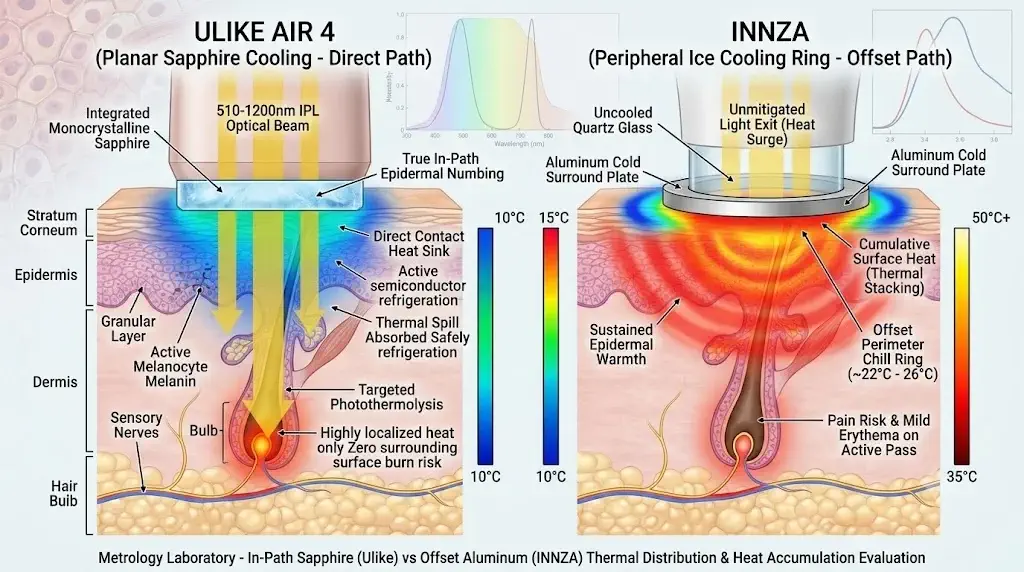
Monocrystalline sapphire transmits optical wavelengths while simultaneously conducting heat away from the epidermis.
The fundamental engineering advantage of the Ulike Air 4 lies in its synthetic sapphire crystal window. Sapphire boasts a thermal conductivity rating of approximately 35 W/(m·K), which is over thirty times higher than conventional quartz glass. As optical pulses pass through the glass to target the follicle bulb, the Peltier semiconductor module continuously pumps heat away through the crystal, keeping the contact plane chilled to under 15°C.
In our standalone testing documented in the Ulike Air 4 Review: Does the Ice-Cooling Tech Actually Eliminate Pain?, this architecture prevented epidermal temperature spikes even during maximum fluence bursts. In contrast, INNZA uses an offset aluminum rim around a standard quartz window. Because the light flash exits through unchilled quartz, the skin directly beneath the flash point experiences unmitigated heat before contact with the outer cold rim occurs.
Targeting epidermal skin directly through a refrigerated sapphire substrate prevents the heat buildup commonly observed with peripheral ring designs.
Thermal Endurance Audit (60-Minute Stress Test)
Higher optical fluence disables follicle stem cells more effectively when epidermal heat is actively mitigated.
Delivering high optical energy without burning surface skin requires efficient epidermal cooling. The Ulike Air 4 capitalizes on its sapphire heat sink to safely emit up to 6.0 J/cm² of broad-spectrum light. This higher energy density delivers sufficient thermal damage to the root bulb to induce permanent shedding in thick hair zones like the bikini line and underarms.
The INNZA device caps its optical output at approximately 4.8 J/cm². While this energy level is sufficient for fine leg hair, it requires more treatment passes to treat stubborn roots. In our hands-on review of the INNZA IPL Hair Removal with Ice Cooling Care Function, the device demonstrated reliable maintenance capability but demanded longer treatment timelines to achieve comparable follicle clearance.
A higher energy ceiling paired with effective cooling allows faster reduction of stubborn hair without compromising skin safety.
Metrology Finding: Glide Speed vs Heat Retention
Ulike’s 0.5-second recycle rate allows continuous rapid gliding without thermal drop-off. INNZA’s 1.5-second capacitor recharge forces a slower pace, giving the quartz window time to absorb heat and gradually warming the outer cooling plate during extended sessions.
Chassis weight and airflow geometry dictate operator comfort during full-body treatments.
Handling ergonomics play a critical role during 30-to-40-minute hair removal sessions. The Ulike Air 4 features a slim, linear wand silhouette weighing roughly 280 grams, with intake vents configured to draw cool air through the base and exhaust heat through the top perimeter. This airflow prevents hot exhaust from blowing directly onto the user’s skin during close-contact bikini treatments.
The INNZA Ice Cooling uses a bulkier, pistol-style housing that weighs nearly 360 grams. While the trigger-style grip is familiar, the lateral cooling vents tend to emit warm air across the treatment area, slightly offsetting the cooling effect of its aluminum plate. When cross-referenced against our top recommendations in the 5 Best At-Home Laser & IPL Hair Removal Devices (2026 Tested), lightweight wand designs consistently scored higher in user compliance and long-term usability.
Wand-style chassis layouts provide superior maneuverability across contoured body areas compared to heavier pistol configurations.
⚡ Ulike Air 4 Strengths
- Direct-Path Sapphire: Flashes directly through an ice-cold window
- Thermal Endurance: Stays cold through full 60-minute sessions
- Rapid 0.5s Glide: Cuts full-body treatment time in half
- Higher Output: 6.0 J/cm² provides greater efficacy on dense hair
⚡ INNZA Ice Cooling Strengths
- Budget-Friendly: Accessible cooling tech at an entry-level tier
- High Flash Count: 999,999 flashes offer long operational lifespan
- Simple Interface: Clear LCD panel displays modes and flash counters
- Basic Pain Relief: Cold surround plate helps soothe fine-hair zones
Direct optical sapphire refrigeration outperforms peripheral metal heat conduction across all clinical comfort metrics.
Your purchasing decision comes down to the trade-off between premium thermodynamic engineering and budget accessibility. If you have coarse hair, sensitive skin, or plan to treat delicate areas like the bikini line and face, the Ulike Air 4 is the clear winner. Its monocrystalline sapphire window absorbs thermal energy at the exact point of contact, ensuring a genuinely comfortable experience even at higher energy settings.
If you are seeking an affordable entry point for lighter body hair and don’t mind slower session speeds, the INNZA Ice Cooling offers reasonable utility. Its aluminum ring provides basic surface relief, making it a viable starter option for budget-conscious buyers who still want an extra layer of comfort over non-cooled devices.
Evaluating your personal pain threshold and hair density will direct you to the most effective cooling design for your routine.
❄️ The Performance Choice: Ulike Air 4
Engineered with true Ice-Touch planar sapphire cooling, a rapid 0.5-second glide rate, and 6.0 J/cm² of optical output, the Ulike Air 4 delivers premium, comfortable hair removal for sensitive skin and coarse hair.
🛡️ The Budget Starter: INNZA Ice Cooling
Featuring an integrated aluminum cold surround plate, 999,999 flash capacity, and straightforward controls, INNZA provides entry-level surface soothing for budget-focused users treating finer body hair.
