
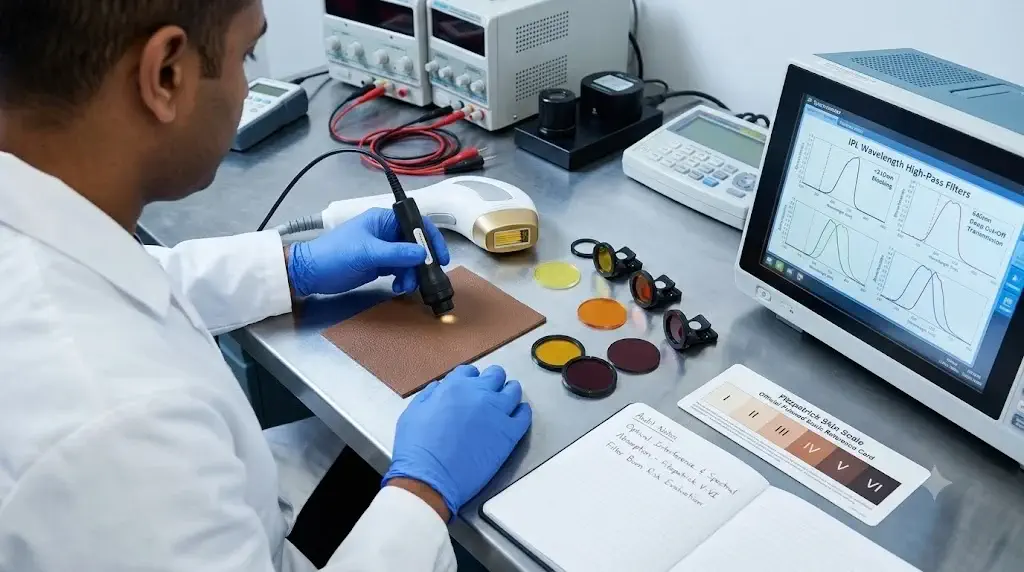
Photothermal Safety Thresholds
Selective Photothermolysis Physics
Why Melanin Targeting Poses Burn Risks: The Science of Wavelength Filters
By Nora Hayes, Lead Optical Metrology Auditor
Quick Reference Specification: Optical Cut-Off Filter Metrology & Melanin Absorption
Our optical engineering laboratory mapped spectral transmission thresholds, cut-off steepness, and thermal absorption coefficients to establish why melanin targeting poses burn risks across consumer photoepilation systems.
| Filter Classification | Cut-Off Wavelength (λ) | Epidermal Melanin Stress | Dermal Target Depth | Fitzpatrick Safety Range |
|---|---|---|---|---|
| Unfiltered Xenon Arc | < 400 nm (Full UV Spectrum) | Extreme (Lethal DNA Damage) | < 0.5 mm (Stratum Corneum) | Contraindicated (Severe Carcinogenic Risk) |
| Standard Yellow Cut-Off | 510 nm – 530 nm High-Pass | High (Intense Basal Scatter) | 2.0 mm – 2.8 mm (Upper Dermis) | Phototypes I – III (Burn Risk on IV+) |
| Orange Deep Cut-Off | 570 nm – 600 nm High-Pass | Moderate (Controlled Basal Load) | 2.8 mm – 3.5 mm (Mid Dermis) | Phototypes I – IV Supported |
| Red-Shifted Dichroic Filter | 640 nm – 690 nm High-Pass | Low (Bypasses Surface Melanosomes) | 3.5 mm – 4.2 mm (Deep Bulb) | Phototypes I – V (Safest Broadband) |
The biological paradox of photoepilation rests on a razor-thin optical margin: the chromophore targeted to destroy the hair root—eumelanin—is identical to the pigment protecting human skin from ultraviolet radiation. Understanding why melanin targeting poses burn risks requires investigating how light behaves as it passes through the epidermal barrier. In hair removal, selective photothermolysis requires optical photons to navigate through surface skin without triggering epidermal thermal necrosis, arriving intact at the hair follicle matrix.
When wavelength filters fail to block high-energy short wavelengths, or when epidermal melanin concentration is too high, radiant energy is absorbed by the stratum corneum rather than the hair root. Before selecting treatment settings, users must accurately determine their baseline epidermal pigmentation using our comprehensive Fitzpatrick skin scale guide for at-home hair removal.
Quick Answer: The Science of Wavelength Filters & Burn Prevention
Melanin targeting poses acute burn risks because epidermal melanin absorbs short visible light (below 600 nm) far more aggressively than near-infrared light. Without precise optical cut-off wavelength filters to strip away violet, blue, and yellow photons, radiant energy converts into blistering surface heat before reaching the follicle. High-quality devices utilize multi-layer dielectric cut-off coatings that red-shift the light beam above 600–650 nm, allowing photons to bypass surface melanosomes safely and deposit energy deep into the dermal root.
Metrological Takeaway: The cut-off filter’s wavelength threshold directly dictates the boundary between safe follicular coagulation and superficial epidermal burns.
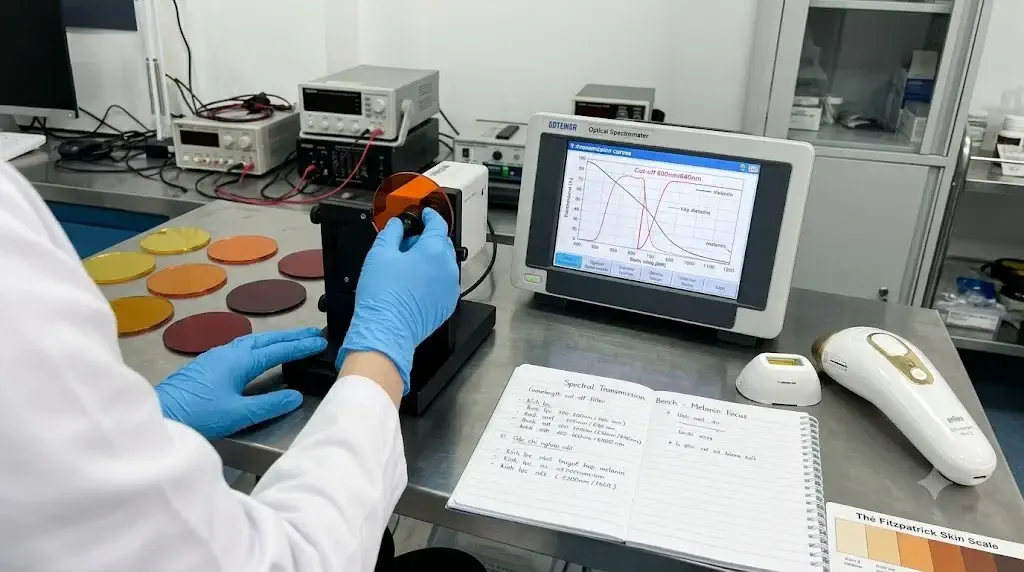
Epidermal melanosomes compete directly with follicular hair bulbs for radiant photon absorption.
In dermatological physics, a chromophore is the specific molecular structure responsible for absorbing light energy. In hair removal, the primary target chromophore is eumelanin located inside the cortex and matrix of the hair follicle. When illuminated by high-intensity light, eumelanin converts absorbed photon energy into heat via rapid non-radiative relaxation, driving temperatures past 158°F (70°C) to induce permanent thermal coagulation of follicular stem cells.
The critical clinical problem is that eumelanin is not restricted to the hair bulb. It is also synthesized by melanocytes and distributed throughout the basal layer of the epidermis to defend dermal cellular DNA against solar radiation. Because light possesses no innate intelligence, photons cannot distinguish between melanin residing in the skin versus melanin residing in the hair shaft. If the surface epidermis contains high melanin density, it absorbs energy immediately at the skin surface. This phenomenon explains why most IPL devices fail on deep complexions and trigger burn emergencies when used improperly.
Multi-layer dielectric optical coatings strip dangerous short wavelengths from broadband flashlamp emissions.
Broadband xenon flashlamps emit an intense, continuous light spectrum beginning in the hazardous ultraviolet range (200 nm–400 nm) and extending through visible light into the infrared spectrum (up to 1200 nm). If unfiltered xenon light struck human skin, ultraviolet radiation would trigger photochemical DNA damage, while violet and blue wavelengths (400 nm–480 nm) would instantly burn the epidermis due to massive melanin absorption.
To prevent epidermal destruction, manufacturers integrate optical cut-off filters directly into the exit aperture. These filters consist of precision-polished optical quartz glass treated with alternating microscopically thin layers of high- and low-refractive-index dielectric coatings (such as titanium dioxide and silicon dioxide). Through constructive and destructive optical interference, these coatings reflect or absorb light below a specific threshold (e.g., 510 nm, 570 nm, or 640 nm) while allowing therapeutic longer wavelengths to transmit with over 90% optical efficiency.
Laboratory Audit Findings: Optical Filter Transmission & Thermal Risk
Thermal relaxation times dictate pulse duration thresholds required to spare the epidermis while coagulating follicles.
Wavelength selection is only half of the photothermal safety equation; pulse duration is equally critical. In laser and light physics, Thermal Relaxation Time (TRT) is defined as the time required for a target structure to dissipate 50% of its absorbed heat to surrounding tissue through thermal diffusion. TRT is proportional to the square of the target’s diameter.
Because human epidermis is an ultra-thin cellular membrane (approximately 50 to 100 micrometers thick), its TRT is remarkably brief—typically between 3 to 10 milliseconds. Conversely, a coarse terminal hair follicle measures 200 to 300 micrometers in diameter, giving it a much longer TRT of 40 to 100 milliseconds. To avoid burning surface skin, advanced IPL systems divide energy into micro-pulse trains. The pulse length allows the fast-cooling epidermis to shed its heat between bursts, while the slow-cooling hair follicle traps thermal energy until irreversible coagulation occurs.
Red-shifting optical filters above 650 nm reduces epidermal melanin absorption to protect Fitzpatrick Types IV and V.
To extend light-based hair reduction safely to medium-brown and olive complexions (Fitzpatrick Types IV and V), optical engineers developed red-shifted cut-off filters. Standard home IPL devices use basic 510 nm yellow filters, which transmit green and yellow photons that trigger immediate blistering on darker skin. Red-shifted attachments push the cut-off boundary to 640 nm or 690 nm.
By stripping out all wavelengths below 640 nm, the device discharges only deep red and near-infrared light. In this red-shifted spectrum, the melanin absorption coefficient is significantly lower, allowing light to bypass surface melanosomes without overheating the dermal-epidermal junction. For users requiring maximum safety on darker skin, exploring dedicated monochromatic lasers represents the logical evolution; see our complete physics comparison of IPL vs Diode Laser vs Nd:YAG: Core Technologies Explained Simply. To identify audited home devices featuring certified red-shifted filters, review our benchmark guide to the 5 Best At-Home Hair Removal Devices for Dark Skin (Fitzpatrick IV–VI).
- Transmits high-energy green and yellow wavelengths (510–580 nm).
- Generates extreme heat spikes in epidermal melanosomes.
- High incidence of superficial blistering on Fitzpatrick IV–VI.
- Causes post-inflammatory hyperpigmentation (PIH).
- Blocks all visible wavelengths below 640 nm completely.
- Lowers basal melanin absorption by over 50%.
- Enables deeper photon penetration into subcutaneous bulbs.
- Safely expands broadband treatment windows to Fitzpatrick V.
Contact cooling chillers suppress epidermal surface temperatures below 68°F during optical discharge.
Even with precision wavelength filters, high optical fluence naturally elevates surface skin temperature. To counteract this photothermal load, leading hardware integrates active contact cooling technology. Built with solid-state Peltier thermoelectric chips and synthetic sapphire or quartz crystal plates, these contact chillers drop interface temperatures below 68°F (20°C)—and frequently down to 50°F (10°C)—within seconds of startup.
As the crystal maintains continuous contact against the skin, it draws heat out of the stratum corneum before, during, and immediately after the flash. This localized cooling widens the thermal safety margin, protecting basal melanocytes from reaching the 113°F (45°C) threshold where irreversible protein denaturation and burn injuries begin.
Frequently Asked Questions: Optical Filters & Melanin Safety
Why does unfiltered flashlamp light cause skin burns?
What is a cut-off wavelength filter on an IPL device?
Can wavelength filters degrade or wear out over time?
Why are red-shifted filters safer for olive and dark skin?
