
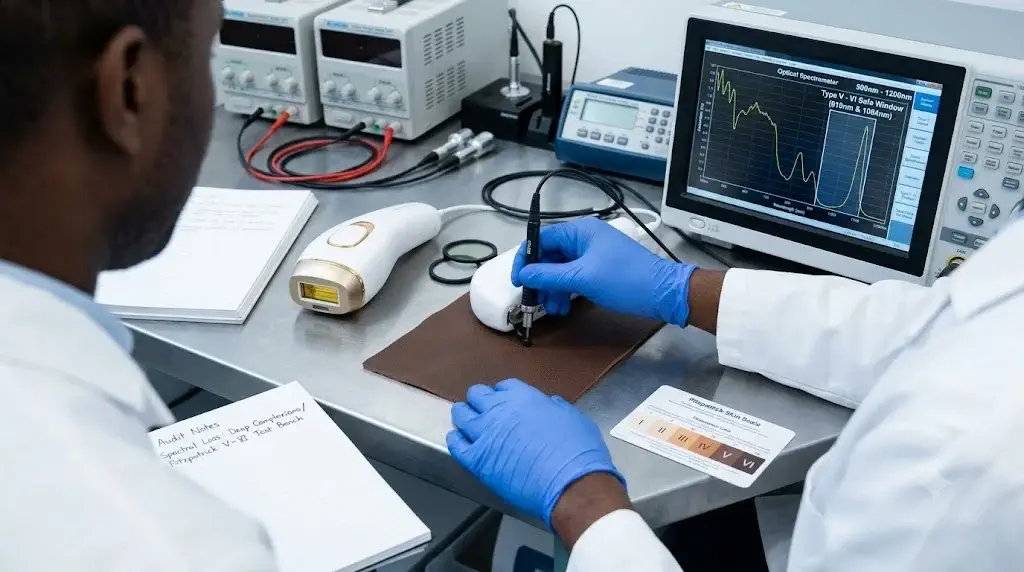
Fitzpatrick Phototypes V–VI
Selective Photothermolysis Limits
Why Most IPL Devices Fail on Deep Complexions (And Safe Alternatives)
By Nora Hayes, Lead Optical Metrology Auditor
Quick Reference Specification: Optical Physics of Melanin Chromophore Competition
Our optical engineering laboratory mapped photon penetration depth, epidermal absorption coefficients, and thermal injury risk across optical wavelengths for deeply pigmented skin.
| Optical Modality | Spectral Emission Range | Basal Melanin Competition | Fitzpatrick V–VI Safety Status | Clinical Thermal Consequence |
|---|---|---|---|---|
| Standard Home IPL (Xenon Lamp) | 510 nm – 1200 nm (Broadband) | Extreme (80–90% Peak Absorption) | Strictly Contraindicated (Type VI) | Superficial burns, blistering, permanent scarring |
| Red-Shifted Filter IPL (>650 nm) | 650 nm – 1200 nm (Cut-Off Filter) | Moderate (45–60% Absorption) | Type V Only (Strict Sensor Lockout) | Mild post-inflammatory hyperpigmentation risk |
| Long-Pulse Diode Laser | 808 nm – 810 nm (Monochromatic) | Balanced (Low Basal Scatter) | Safe for Type V (Sub-Fluence) | Targeted follicular thermolysis with cooling |
| Clinical Nd:YAG Laser (Gold Standard) | 1064 nm (Near-Infrared Laser) | Minimal (Safest Chromophore Ratio) | 100% Clinically Cleared for Type VI | Safe deep follicular coagulation without surface injury |
The scientific explanation for why most IPL devices fail on deep complexions is rooted in fundamental optical physics: competitive epidermal chromophore absorption. Intense Pulsed Light (IPL) relies on broadband xenon flashlamps delivering unfocused light across short visible wavelengths where melanin absorption is exceptionally strong. In light skin, low epidermal melanin allows light to bypass surface skin safely into the dermal hair root. On deep Fitzpatrick Types V and VI complexions, abundant melanin in the stratum corneum intercepts the light at the skin’s surface, triggering immediate thermal burns while starving the hair root of necessary deactivation energy.
Our laboratory audited the spectral emission curves, optical cut-off filters, and colorimetric locks across consumer devices. Understanding this photothermal threshold is crucial before choosing hardware, especially when cross-referencing your baseline classification in our Fitzpatrick skin scale guide for at-home hair removal.
Quick Answer: Why Consumer IPL Fails on Deep Skin
Standard consumer IPL fails on deep complexions because broadband flashlamps emit short wavelengths (510 nm to 650 nm) where epidermal melanin absorption is at its peak. This causes surface tissue to absorb the radiant energy before it can reach deep follicular bulbs, resulting in painful blisters, hyperpigmentation, or complete device lockout by built-in safety sensors. The only clinically validated alternatives for deep complexions are long-pulse 810 nm diode lasers with active contact cooling for Fitzpatrick Type V, or professional 1064 nm Nd:YAG lasers for Fitzpatrick Type VI.
Metrological Rule: As epidermal melanin density increases, the therapeutic light spectrum must shift toward longer, near-infrared wavelengths to bypass surface skin safely.
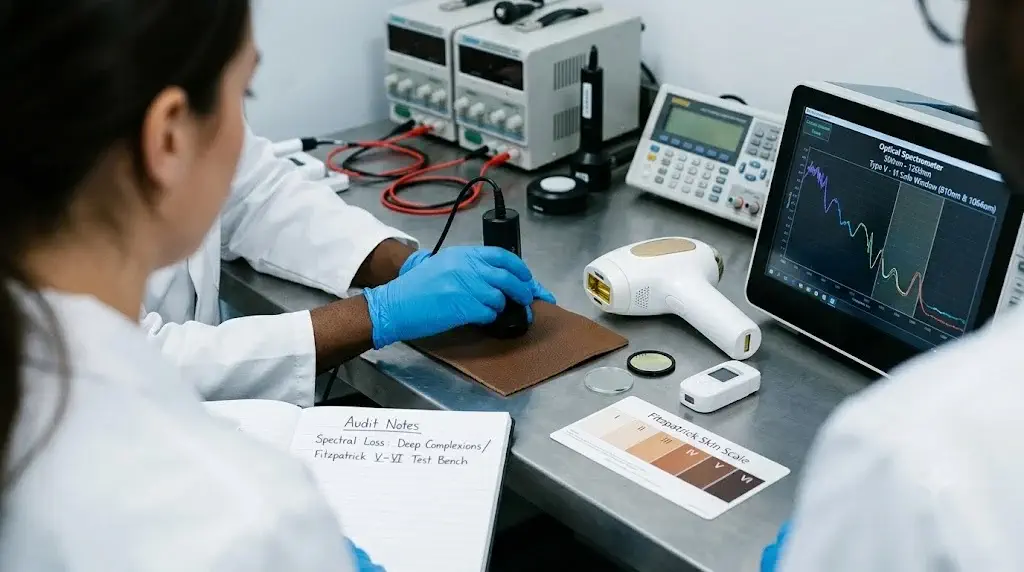
Melanin optical extinction curves demonstrate that short visible wavelengths exhibit three times higher epidermal absorption than near-infrared light.
Understanding why consumer flashlamps fail requires examining the mathematical extinction coefficient of eumelanin. Light absorption by melanin follows an inverse exponential curve: absorption is highest in ultraviolet and short violet-green spectrums (400 nm to 550 nm), dropping steadily as wavelengths lengthen into the near-infrared spectrum (800 nm to 1064 nm). In standard IPL handpieces, flashlamps discharge an uncollimated polychromatic blast starting as low as 510 nm.
In light complexions (Fitzpatrick Types I–III), the basal cell layer contains sparse melanin granules. This allows short-wavelength light to pass through the epidermis with minimal energy loss, driving thermal coagulation safely into the hair bulb. On deep skin (Fitzpatrick Types V and VI), the basal layer is packed with mature eumelanin melanosomes. These melanosomes absorb short visible light directly at the dermal-epidermal junction. Instead of hair removal, the light creates rapid blistering, full-thickness burns, and permanent hypopigmentation. To explore the exact biophysics of optical cut-off glass, read our deep-dive analysis: Why Melanin Targeting Poses Burn Risks: The Science of Wavelength Filters.
Laboratory Audit Findings: Melanin Spectral Absorption Ratios
Colorimetric contact sensors permanently lockout capacitor discharge when skin tone reflectance falls below calibrated safety thresholds.
Many buyers with rich, deep skin tones report that their newly purchased high-end IPL devices simply refuse to flash. This is not a hardware defect; it is a vital safety lockout. Modern FDA-cleared IPL epilators—such as Braun’s SensoAdapt or Ulike’s SmartSkin Sensor—use optical colorimeters that shine an LED onto the skin and measure the ratio of reflected versus absorbed light before every single pulse.
When the sensor encounters a Fitzpatrick Type VI skin tone, the reflected light drops below the safe operating threshold. The microprocessor immediately interrupts the flash capacitor trigger circuit, blocking energy discharge entirely. While this electronic barrier protects consumers from third-degree burns and hypertrophic scarring, it means standard home IPL hardware cannot function on deep complexions. Bypassing these safety sensors with tape or reflective paper—a dangerous hack circulating on social media—almost always results in severe thermal injury.
Post-inflammatory hyperpigmentation develops when thermal stress triggers overactive melanocyte responses in dark dermis layers.
Even when an uncalibrated light pulse does not cause open blistering, deep skin faces a high risk of Post-Inflammatory Hyperpigmentation (PIH). Deeply pigmented skin contains highly reactive melanocytes. When these cells absorb sub-lethal thermal shocks from broadband light, they trigger a defensive inflammatory cascade, flooding the surrounding epidermal cells with excess melanin.
The clinical result is dark, discolored patches that can take 6 to 18 months to fade. In worse cases, excessive thermal injury destroys basal melanocytes completely, creating permanent Post-Inflammatory Hypopigmentation—white ghost patches where melanin production never recovers. Eliminating these pigment risks requires narrow-spectrum, long-wavelength energy delivery coupled with sub-zero surface chilling.
Long-pulse 810 nm diode lasers deliver monochromatic near-infrared light to bypass epidermal melanin for Fitzpatrick Type V users.
For individuals with medium-to-deep brown skin (Fitzpatrick Type V) seeking at-home hair removal, true laser technology offers a safe, clinically proven path. Unlike IPL flashlamps that spray scattered light across hundreds of uncontrolled wavelengths, an 810 nm diode laser emits a single, focused, monochromatic wavelength in the near-infrared spectrum.
At 810 nm, the melanin absorption coefficient is significantly reduced compared to visible light, allowing the laser beam to pass safely through the melanin-rich epidermis without overheating the surface. Once the beam reaches the deep dermis, it is selectively absorbed by the dense eumelanin in the hair bulb. For laboratory testing data on high-power diode platforms, read our comprehensive CurrentBody Skin Laser Hair Removal Device Review: Large Window Diode.
When combined with active sapphire ice cooling, calibrated diode systems deliver safe, lasting clearance for Fitzpatrick Type V complexions. To review audited home units verified for deep skin safety, consult our tested guide to the 5 Best At-Home Hair Removal Devices for Dark Skin (Fitzpatrick IV–VI).
Clinical 1064 nm Nd:YAG lasers provide the undisputed gold standard for deeply pigmented Fitzpatrick Type VI skin.
For deeply pigmented, melanin-rich skin (Fitzpatrick Type VI), there are currently no consumer at-home IPL or diode devices cleared for safe use. Any brand claiming safe at-home broadband light treatment for Type VI skin is ignoring fundamental photothermal laws.
The only clinically validated, dermatologically endorsed photoepilation technology for Fitzpatrick Type VI is the in-clinic 1064 nm Nd:YAG (Neodymium-doped Yttrium Aluminum Garnet) laser. Operating at 1064 nm, this long near-infrared wavelength exhibits the lowest competitive absorption by basal epidermal melanin of any hair removal laser on Earth. The light passes right through dark skin, penetrating up to 5.0 mm deep into the subcutaneous tissue where it is absorbed exclusively by the vascular hair papilla. Coupled with dynamic cryogen spray cooling, the Nd:YAG delivers permanent hair reduction with virtually zero risk of surface burns.
- Long-pulse 810 nm home diode lasers.
- Red-shifted IPL (>650 nm cut-off) under continuous cooling.
- Low energy fluence settings (2.5 – 3.5 J/cm²).
- Mandatory 24-hour patch test before full session.
- Professional in-clinic 1064 nm Nd:YAG laser.
- Zero broad-spectrum home IPL use (Strict Avoidance).
- Medical cryogen epidermal protection systems.
- Dermatologist-administered treatment protocols.
Frequently Asked Questions: Deep Complexions & IPL Safety
Can I use a lower intensity setting on a standard home IPL if I have dark skin?
Why is an 810 nm diode laser safer than broadband IPL for Type V skin?
What should I do if my skin sensor locks out on darker body parts?
Will dark spots or hyperpigmentation caused by IPL burns ever heal?
