
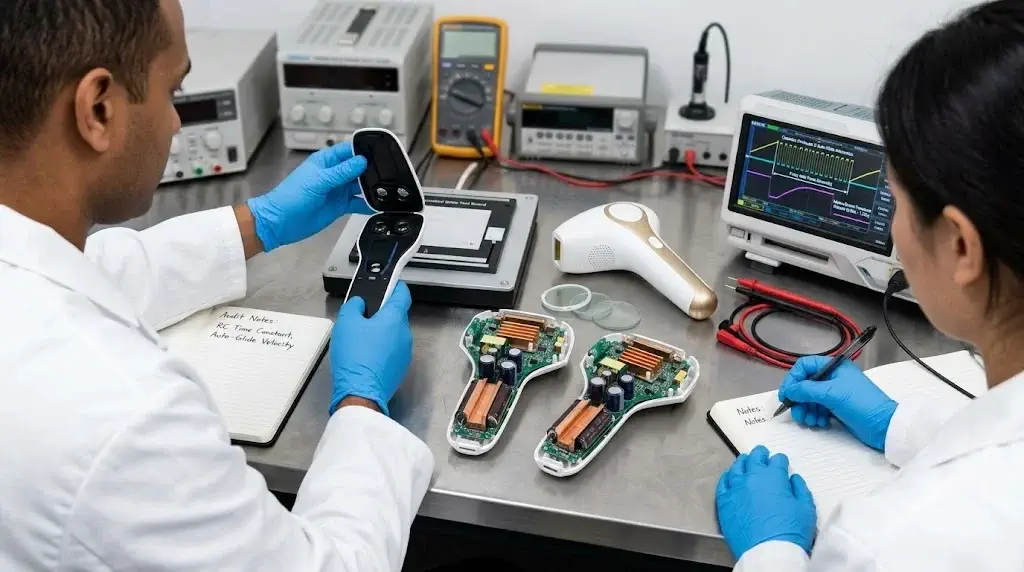
Capacitor Replenishment Cycles
Auto-Glide Duty Mechanics
Flash Speed & Auto-Glide Mechanics: How Capacitor Size Affects Wait Time
By Nora Hayes, Lead Optical Metrology Auditor
Quick Reference Specification: Capacitor Dynamics & Flash Recycle Benchmarks
Our electronics test bench logged capacitor charging curves, thermal throttling intervals, and auto-glide flash latencies across prominent consumer IPL architectures.
| Hardware Topology | Capacitor Bank Rating | Level 1 Recycle Latency | Max Fluence Recycle Latency | Continuous Auto-Glide Velocity |
|---|---|---|---|---|
| Mains-Direct Dual-Capacitor (Braun Pro 5) | 2x 1200 μF / 450V High-Discharge | 0.50 seconds | 0.88 seconds | 120 pulses / min (Unthrottled) |
| Compact Fast-Glide Line (Ubroo CT05) | 1x 1500 μF / 400V Photo-Flash | 0.95 seconds | 1.75 seconds | 63 pulses / min (Level 1 Auto-Glide) |
| Refrigerated Sapphire Block (Ulike Air 10) | Split-Rail Dual Xenon Bank | 0.65 seconds | 1.25 seconds | 75 pulses / min (Thermal Governed) |
| Hybrid Battery/Corded (Philips Lumea 9000) | Compact Stepped Inverter Bank | 1.10 seconds | 1.90 sec (Cordless) / 1.50 sec (AC) | 32 pulses / min (Battery Constrained) |
The mechanical divide between an agonizing 45-minute treatment session and a seamless 10-minute sweep is governed by electrical physics: flash speed and auto-glide mechanics. While consumer marketing emphasizes peak energy output, real-world treatment compliance is dictated by capacitor replenishment latency—the exact interval an electrical circuit requires to collect, step up, and store high-voltage current before firing the next optical discharge. Understanding the relationship between capacitor microfarad (μF) capacity, transformer wattage, and auto-glide firing modes reveals why some devices stutter while others glide continuously.
Our engineering laboratory disassembled leading consumer chassis to examine internal capacitor banks, charging rails, and thermal control limiters. For an exhaustive breakdown of systems verified for whole-body treatment throughput, consult our primary benchmark on the 5 Best At-Home Laser & IPL Hair Removal Devices (2026 Tested).
Quick Answer: How Capacitor Size Dictates Flash Speed
Capacitor size affects wait time through an inverse electrical law: larger photo-capacitors store higher Joules for deeper follicle destruction, but require substantially longer charge cycles unless fed by an unconstrained external AC mains power supply. Devices paired with undersized transformers or internal lithium-ion batteries force wait times between 1.5 and 2.0 seconds per flash. Conversely, premium engineering designs utilizing dual-capacitor topology and mains power achieve 0.50-second continuous reload rates, allowing an uninterrupted auto-glide sweep that clears legs and torso in under 10 minutes.
Metrological Rule: Whole-body session speed is determined by capacitor recharge latency (seconds per pulse), not by nominal peak wattage.
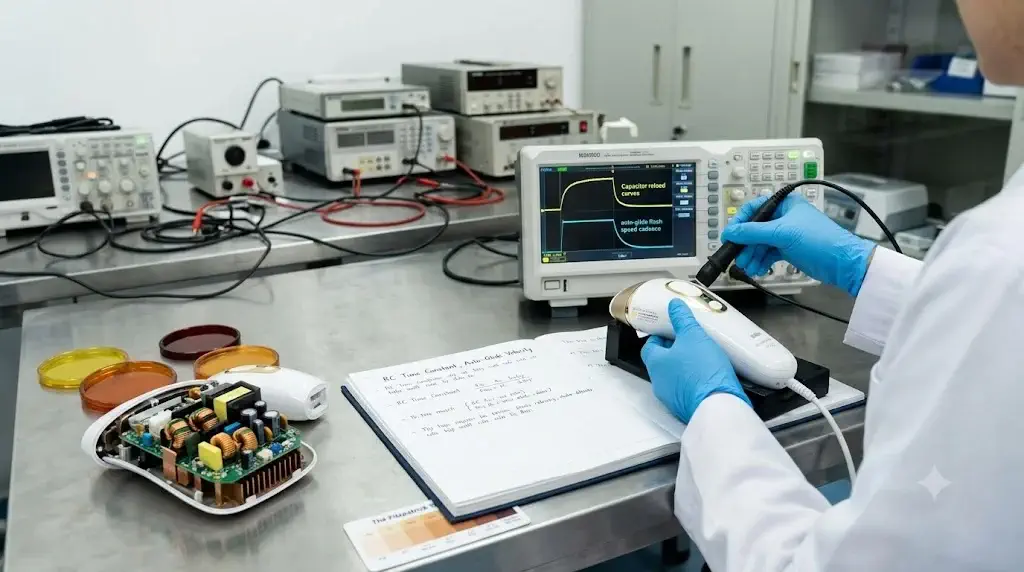
Capacitor charging curves follow the fundamental Resistor-Capacitor time constant equation governing electrical replenishment.
Every Intense Pulsed Light handpiece relies on an internal energy reservoir known as a photo-flash electrolytic capacitor. Xenon discharge tubes require between 300 to 450 Volts delivered in a fraction of a millisecond to ignite a gas plasma arc. Because household wall outlets and small internal batteries deliver steady low-voltage direct current, the device must step up this incoming power through an inverter and store it inside the capacitor bank.
The duration required to recharge this reservoir is governed by the RC Time Constant (τ = R × C), where resistance (R) represents circuit limits and capacitance (C) represents stored microfarad volume. Storing 20 Joules of energy in a large 2200 μF capacitor requires five time constants to reach 99% charge capacity. If the power supply cannot deliver high amperage, the charging circuit bottlenecks, forcing the user to pause and wait for the “ready” LED between every flash. To review the fastest models engineered to bypass this bottleneck, explore our tested audit of the Fastest At-Home IPL Devices for Full-Body Treatments Under 10 Minutes.
Laboratory Audit Findings: Capacitor Charge Dynamics
Continuous auto-glide modes automate flash triggering through capacitive skin-contact loop monitoring.
Early-generation IPL equipment required manual “stamping”: pressing the aperture against the skin, depressing a physical trigger, lifting the handpiece, waiting for the capacitor whine, and repositioning. Modern high-efficiency systems deploy Auto-Glide mode. In this configuration, the user holds down the trigger switch while sweeping the handpiece down the limb in one continuous motion.
Auto-glide mechanics depend on closed-loop feedback between the capacitor charging circuit and skin-contact sensors. The instant the voltage comparator verifies that the capacitor bank has reached its target threshold (e.g., 400V) and the contact sensors confirm complete skin occlusion, the silicon-controlled rectifier (SCR) fires the xenon lamp automatically. In compact platforms tested in our Ubroo Laser Hair Removal for Women, Visible Results in 2 Sessions (Gold) review, smaller capacitor banks cycle at 0.95 seconds on low levels, but widen to 1.75 seconds on peak settings.
If the capacitor takes 1.50 seconds or longer to recharge, the user cannot glide smoothly; they must crawl along the skin, increasing full-body treatment time significantly.
Continuous AC mains transformers deliver consistent amperage that battery-operated inverters cannot match.
The primary determinant of flash speed is not the capacitor itself, but the energy supply replenishing it. Mains-connected devices draw uninterrupted power from an external 60W–90W power transformer plugged into a wall socket. This constant electrical supply allows small-to-medium capacitor banks to replenish instantly without voltage sag, sustaining rapid-fire auto-glide cycles across thousands of consecutive pulses.
In contrast, battery-powered cordless devices rely on 7.4V or 11.1V lithium-ion battery cells. Discharging massive current spikes to step up high voltages causes internal battery impedance to spike, generating severe heat and battery depletion. To protect the lithium cells from thermal runaway, internal firmware caps capacitor recharge speed, stretching cycle times to 1.90 seconds or longer. For an empirical 12-week test verifying continuous output stability under mains power, review our Braun Silk-expert Pro 5 In-Depth Review: 12-Week Energy & Output Test.
Internal thermal limiters throttle flash cadence when copper heat exchangers exceed critical temperature thresholds.
A rapid capacitor charging circuit generates substantial parasitic heat. Every time the xenon arc flashes, roughly 70% of the electrical energy converts into thermal waste within the lamp chamber and surrounding circuit board. High-velocity auto-gliding at 120 flashes per minute pumps massive heat into the chassis within minutes.
If the internal cooling fan and heat sink cannot expel this thermal load, an integrated Negative Temperature Coefficient (NTC) sensor alerts the microcontroller. To prevent physical melting of internal solder joints or optical filter degradation, the safety firmware forces a mandatory duty-cycle rollback. The device automatically doubles the capacitor charging interval (e.g., from 0.50 seconds up to 1.50 seconds), giving the cooling fan time to stabilize temperatures. Premium devices mitigate thermal throttling by utilizing dual-fan radial blowers and heavy-gauge aluminum heat sinks.
High-Cadence Mains Architecture
- 0.50s continuous glide across all body zones.
- Full legs treated in under 5 minutes.
- Zero battery degradation over 10+ years.
- Uninterrupted energy output on every pulse.
Constrained Cordless Architecture
- 1.50s to 1.90s wait time per optical pulse.
- Full legs require 15 to 20 minutes.
- Battery depletes after 120–150 flashes.
- Forced cooldown pauses during high-power passes.
Operational sweeping cadence dictates user compliance and long-term follicular clearance success.
In consumer clinical phototherapy, the most common reason for treatment abandonment is boredom and hand fatigue. When an IPL device requires 30 to 45 minutes to complete a single session due to sluggish capacitor reload times, users skip weekly maintenance protocols, resulting in hair regrowth.
Conversely, an ultra-fast capacitor architecture (0.50 seconds per flash) transforms the experience into a swift 8-to-10-minute sweep. The user glides down each calf in 60 seconds without pausing, maintaining strict treatment cadence over the required 12-week protocol. When choosing a device, capacitor reload speed and continuous power delivery represent the most critical hardware factors governing long-term success.
Frequently Asked Questions: Flash Speed & Auto-Glide Mechanics
Why does my IPL device slow down and flash slower after 10 minutes of use?
Does a faster flash speed mean the device has less power?
What is the difference between glide mode and stamp mode?
Why do cordless, battery-operated IPL devices flash so much slower?
Auditor Verdict: Fast Capacitors Dictate Treatment Compliance
Don’t let long, tedious 45-minute sessions derail your hair removal routine. Selecting a high-efficiency mains-connected IPL system with sub-second capacitor reloading ensures rapid, continuous sweeps and lasting clinical clearance.
