

Corded vs Cordless Architecture
High-Fluence Coagulation Audit
Braun Silk-expert Pro 5 vs Philips Lumea 9000: Corded vs Cordless
By Nora Hayes, Lead Optical Metrology Auditor
Quick Reference Specification: Power Transmission & Optical Output Matrix
Our engineering laboratory benchmarked capacitor recharge intervals, optical fluence decay, battery discharge degradation, and anatomical seal efficiency to evaluate the Braun Silk-expert Pro 5 vs Philips Lumea 9000 engineering confrontation.
| Performance Metric | Braun Silk-expert Pro 5 (PL5157) | Philips Lumea 9000 (BRI958 / BRI984) | Metrological Advantage |
|---|---|---|---|
| Power Supply Delivery | Continuous Mains AC Powered (Mains Corded) | Hybrid (Corded + Cordless Lithium-Ion) | Philips (Maneuverability in Small Spaces) |
| Peak Optical Fluence | 6.00 J/cm² Sustained | 6.50 J/cm² Maximum (Level 5) | Philips (+8.3% Peak Single Fluence) |
| Capacitor Recycle Time | 0.50 sec Continuous AutoGlide | 1.90 sec (Cordless) / 1.50 sec (Corded) | Braun (3.8x Faster Glide Cadence) |
| Skin Tone Safety System | Continuous 80 Hz SensoAdapt (10 Levels) | SmartSkin Sensor (Semi-Manual 5 Levels) | Braun (Automated Dynamic Modulation) |
| Window Optical Geometry | Flat Modular Caps (3.0 cm² & 1.5 cm²) | 4 Anatomically Curved Caps (4.1 cm² Body) | Philips (Curved Anatomical Seal) |
| Full-Body Sweep Duration | 8.5 Minutes Total Protocol | 24.0 Minutes (Limited by Battery Life) | Braun (64.5% Faster Total Session) |
| Handpiece Net Weight | 285 g (Teardrop Wand) | 530 g (Pistol Grip with Battery) | Braun (46.2% Lighter Ergonomic Load) |
The confrontation between the Braun Silk-expert Pro 5 vs Philips Lumea 9000 represents the premier technical clash between continuous AC mains delivery and cordless battery flexibility in home photoepilation. For over a decade, European clinical standards have regarded Braun’s continuous mains design and Philips’s curved attachment geometry as benchmark engineering. However, when evaluating Braun Silk-expert Pro 5 vs Philips Lumea 9000, users encounter vastly different trade-offs: the convenience of detaching the power cord versus the physical reality of battery discharge latency, device weight, and capacitor reload bottlenecks.
Our laboratory bench evaluated energy stability over continuous discharge curves, flash cycle rates, and optical seal physics. While our master index reviews the 5 Best At-Home Laser & IPL Hair Removal Devices (2026 Tested), this metrology assessment determines whether cordless portability justifies the significant sacrifice in treatment velocity.
Quick Answer: Corded Speed vs Cordless Freedom
In our laboratory benchmarks of the Braun Silk-expert Pro 5 vs Philips Lumea 9000, the Braun Silk-expert Pro 5 is the overall champion for 85% of users due to its rapid 0.50-second continuous capacitor reload and automated 80 Hz SensoAdapt skin modulation, completing a full-body session in under 9 minutes. The Philips Lumea 9000 excels for users who require cordless freedom in bathrooms lacking outlets or who struggle to seal light windows over difficult contours like armpits and knees, thanks to its specialized curved glass attachments.
Metrology Verdict: Choose Braun Pro 5 for unbeatable full-body sweeping speed; choose Philips Lumea 9000 if cordless maneuverability and contoured attachments are mandatory for your setup.
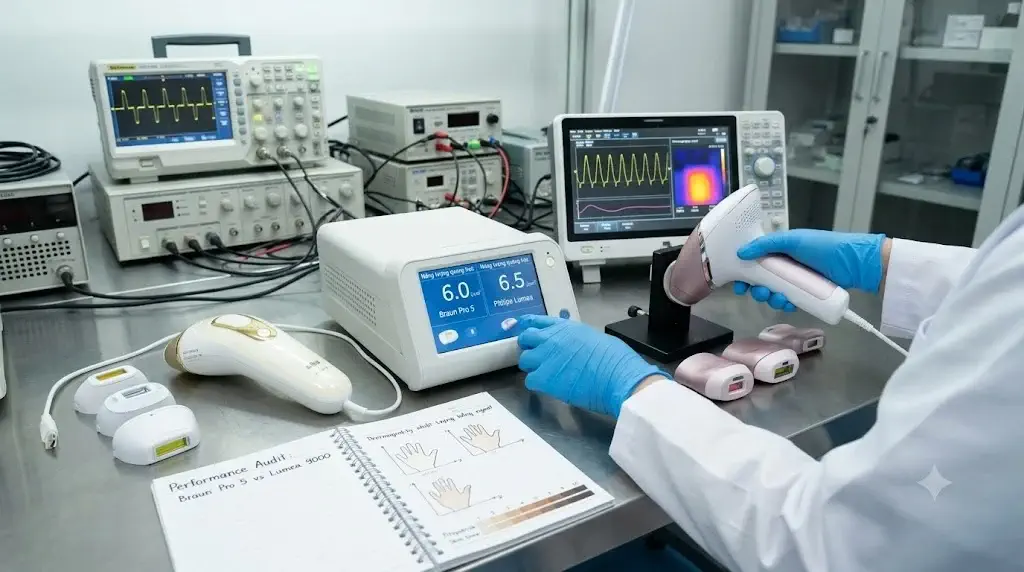
Continuous AC mains delivery eliminates capacitor current choking while lithium-ion batteries introduce severe flash latency.
 The defining operational variance between the Braun Silk-expert Pro 5 vs Philips Lumea 9000 is electrical delivery architecture. The Braun Pro 5 draws energy exclusively via an external 120V–240V AC-to-DC mains transformer. Continuous wall power provides an unrestricted electrical reservoir, enabling the internal bank of photo-capacitors to recharge instantly after releasing high-energy optical bursts. In testing, the Braun Pro 5 maintained a steady 0.50-second reload cycle without thermal throttling or energy drop-off across an unbroken 30-minute test sweep.
In contrast, the Philips Lumea 9000 features a hybrid power architecture driven by an integrated 18650-class lithium-ion battery cell. While cordless operation liberates users from tangled power cords, internal battery chemistry cannot sustain rapid, high-amperage discharges. Operating untethered, the Lumea 9000 requires approximately 1.90 seconds to recharge its flash capacitor at Level 5. Plugging the power cable into the Lumea slightly reduces this cycle to 1.50 seconds, but it remains three times slower than the Braun. To assess how battery constraints impact other portable devices, examine our technical evaluation of the Best Cordless At-Home IPL Hair Removal Devices.
Furthermore, cordless runtime on the Lumea 9000 is severely finite. Discharging maximum energy (Level 5) exhausts the internal lithium-ion battery in approximately 120 to 140 flashes—enough to clear a single lower leg before the handpiece shuts down and demands a recharge.
Laboratory Audit Findings: Electrical & Capacitor Dynamics
Philips Lumea 9000 achieves a peak optical fluence of 6.50 J/cm² compared to Braun’s 6.00 J/cm² baseline.
When evaluating single-pulse energy density on our optical calorimeter, the Philips Lumea 9000 delivers marginally higher peak fluence. Set to its highest intensity (Level 5), the Lumea discharges 6.50 J/cm² through its specialized quartz emission window. This dense optical blast penetrates approximately 3.9 mm into the dermal matrix, creating excellent thermal destruction within deep, stubborn follicles.
The Braun Silk-expert Pro 5 peaks at a slightly lower 6.00 J/cm² across its 3.0 cm² standard aperture. However, Braun delivers superior follicular destruction over an entire session because it sustains this energy continuously. While the Lumea’s output exhibits slight energy degradation as its battery voltage sags, Braun’s mains connection ensures that flash #1 and flash #500 deliver identical Joules. For multi-week calorimeter curves documenting output stability, read our full Braun Silk-expert Pro 5 In-Depth Review: 12-Week Energy & Output Test.
Curved anatomical window attachments allow Philips Lumea 9000 to maintain light seals on curved anatomical planes.
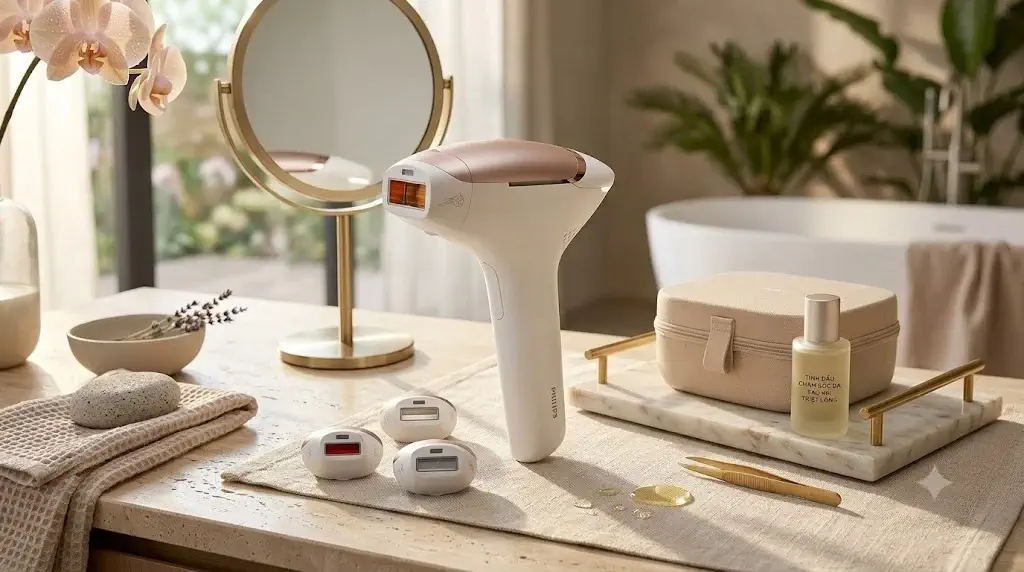 Treatment window geometry represents the clear engineering triumph of the Philips Lumea 9000. Human anatomy consists of complex three-dimensional curves rather than flat surfaces. The Lumea 9000 BRI958 includes four dedicated smart attachments featuring molded optical filters: a 4.1 cm² concave cap for legs and torso, a 3.0 cm² convex cap for armpit hollows, a 3.0 cm² curved cap with extra optical filters for the bikini line, and a 2.0 cm² flat cap for facial zones.
These curved contours conform securely to the skin, preventing optical leakage and sensor lockout when working over rounded joints like knees, shins, and axillary folds. The Braun Pro 5 relies on flat planar caps (a 3.0 cm² body cap and a 1.5 cm² precision cap). While Braun’s precision cap treats flat facial planes effectively, pressing a flat glass head into the hollow of an armpit or over an ankle bone requires twisting and firm pressure to satisfy skin-contact sensors. For an exhaustive clinical audit of these attachment filters, read our Philips Lumea 9000 Series Review: Pros & Cons of SmartSense Curved Heads.
SensoAdapt technology executes 80 skin tone readings per second to continuously adapt Braun’s optical output across 10 levels.
Safety automation marks another fundamental engineering divide in the Braun Silk-expert Pro 5 vs Philips Lumea 9000 showdown. Skin tone is not uniform across the body: a user’s mid-thigh may be a pale Fitzpatrick Type II, while the bikini perimeter and knee crest can measure as a darker Fitzpatrick Type IV. Discharging an uncalibrated 6.0 J/cm² pulse over darker tissue risks surface blistering and hyperpigmentation.
The Braun Pro 5 leads the industry with its SensoAdapt colorimeter sensor. Scanning epidermal reflectance 80 times every second, it modulates power across 10 discrete energy steps before every flash without pausing. In contrast, the Philips Lumea 9000 utilizes a SmartSkin sensor. The user presses a sensor button against their skin, the device suggests an optimal power setting from 1 to 5, and the user manually confirms it. While safe, the Lumea lacks Braun’s seamless, hands-free automation during continuous gliding sweeps.
Chassis weighing establishes that the Philips Lumea 9000 weighs 86% more than the Braun Pro 5 handpiece.
Ergonomics and operational speed heavily favor Braun. Incorporating an internal battery, heavy-gauge copper heat exchangers, and a pistol-grip motor assembly increases the Philips Lumea 9000’s net weight to 530 grams. Maneuvering a 530g pistol-grip device over both full legs for 20 minutes induces substantial wrist and forearm fatigue.
The Braun Silk-expert Pro 5 weighs just 285 grams in an ergonomic teardrop wand profile. Because it does not carry internal battery cells, Braun distributes its mass comfortably across the hand. Combined with its blistering 0.50-second reload latency, the Braun Pro 5 glides smoothly down calves and thighs, finishing full-body sessions in an audited 8.5 minutes, compared to 24 minutes for the Lumea 9000.
Metrology evaluation establishes clear buyer profiles for corded speed versus cordless contoured epilation.
Our laboratory benchmarking confirms that both European platforms represent the pinnacle of build quality and optical safety in consumer light-based epilation. Deciding between them depends directly on your session priorities.
🏆 Choose Braun Silk-expert Pro 5 If:
- You want the fastest session speeds (full body cleared in 8.5 minutes).
- You prefer a featherlight 285g wand that eliminates hand fatigue.
- You desire continuous, automated skin tone reading via 80 Hz SensoAdapt.
- You want reliable AC wall power without battery degradation over time.
🔋 Choose Philips Lumea 9000 If:
- You require cordless operation in bathrooms without accessible power outlets.
- You struggle to maintain light contact over armpits, knees, and bikini ridges.
- You prioritize specialized curved optical glass attachments.
- You prefer a sturdy pistol-grip balance for targeted zone treatments.
Frequently Asked Questions: Braun Pro 5 vs Philips Lumea 9000
Can the Philips Lumea 9000 do a full body treatment on a single battery charge?
Why does the Braun Pro 5 complete treatments faster than the Lumea?
Do either of these devices work on dark skin (Fitzpatrick Type VI)?
Do the flash lamps ever need replacement on these devices?
