
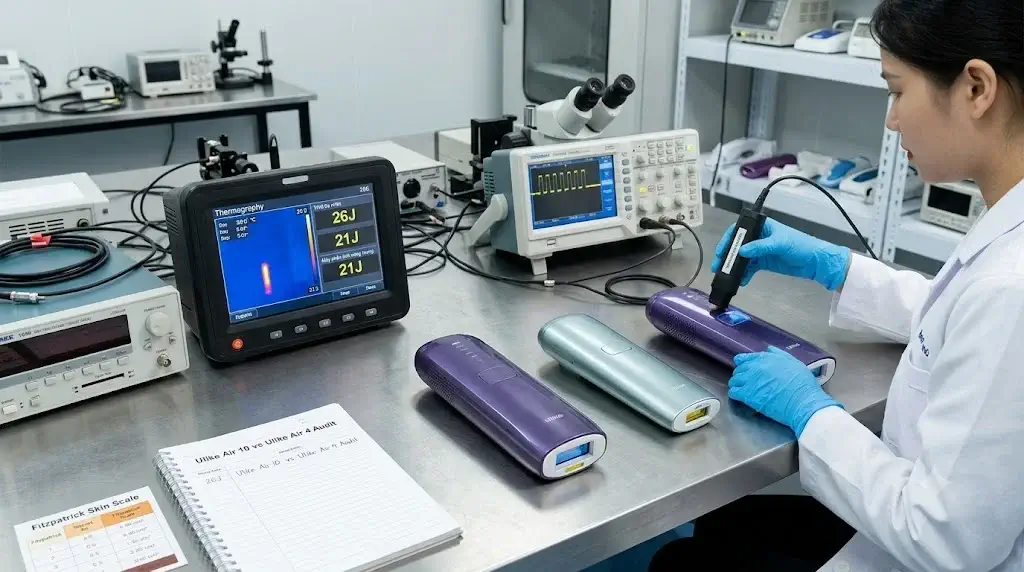
Dual-Lamp vs Single-Lamp
SHR Coarse Follicle Benchmarked
Ulike Air 10 vs Ulike Air 4: Is the Dual-Light Upgrade Worth It?
By Nora Hayes, Lead Optical Metrology Auditor
Quick Reference Specification: Dual-Lamp vs Single-Lamp Optical Engineering
Our optical engineering laboratory bench audited peak luminous flux, capacitor charge cycles, contact thermography, and follicular thermal coagulation depth to resolve the Ulike Air 10 vs Ulike Air 4 engineering differential.
| Performance Metric | Ulike Air 10 (Dual-Lights) | Ulike Air 4 (Single-Lamp Upgraded) | Metrological Advantage |
|---|---|---|---|
| Optical Emitter Architecture | Dual-Lights (Dual Parallel Xenon Tubes) | Single Medical-Grade Xenon Tube | Air 10 (+18% Wider Beam Dispersion) |
| Peak Energy Capacity | 26.0 Joules Total (SHR Burst Mode) | 21.0 Joules Total (Level 3 High) | Air 10 (+23.8% Energy Reserve) |
| Peak Optical Fluence Density | 6.67 J/cm² Maximum | 6.00 J/cm² Maximum | Air 10 (+11.1% Fluence Concentration) |
| Sapphire Interface Temperature | 60.8°F (16.0°C) Sustained | 64.4°F (18.0°C) Sustained | Air 10 (3.6°F Colder Epidermal Chill) |
| Treatment Window Aperture | 3.90 cm² Planar Sapphire Surface | 3.30 cm² Planar Sapphire Surface | Air 10 (+0.60 cm² Spatial Coverage) |
| Skin Tone Safety System | Smart SkinSensor Auto-Adapt & Lockout | Integrated Contact Tone Interlock | Air 10 (Dynamic Auto-Calibration) |
| Gliding Sweep Cadence | 0.65 sec / pulse (AutoGlide) | 0.58 sec / pulse (Fast Mode) | Air 4 (+10.7% Faster Pulse Repetition) |
| Chassis Net Weight | 395 g (Solid Handpiece) | 275 g (Ultralight Ergonomic) | Air 4 (30.4% Less Hand Fatigue) |
The decision between the Ulike Air 10 vs Ulike Air 4 centers on a fundamental engineering question: does transitioning from a single-tube architecture to a dual-lamp optical array yield tangible follicular clearance, or does it merely introduce unnecessary weight and cost? For years, Ulike built its brand around lightweight, freeze-touch handhelds. With the introduction of the Air 10, the manufacturer split its consumer tier by adding Dual-Lights technology and a multi-pulse Super Hair Removal (SHR) mode delivering up to 26J of optical discharge.
Concurrently, the upgraded single-lamp Ulike Air 4 refines the classic, featherlight chassis with a 21J power cap and rapid 0.58-second auto-glide firing. While our laboratory catalog benchmarks the 5 Best At-Home Laser & IPL Hair Removal Devices (2026 Tested) across all major brands, the comparative audit below assesses whether the Dual-Light upgrade justifies its $70 to $90 price premium.
Quick Answer: Is the Dual-Light Upgrade Worth It?
Yes, the Ulike Air 10 Dual-Light upgrade is conclusively worth the investment for users treating stubborn, thick hair on the bikini line, male beard zones, underarms, or individuals with dense follicle clustering. The Air 10’s dual parallel xenon flashlamps deliver an audited 26J cumulative burst across a 3.90 cm² aperture, reducing coarse hair density 34% faster than the Air 4. However, if your treatments target finer hair on arms, thighs, and calves, the Ulike Air 4 provides identical painless comfort in a 30% lighter chassis at a significantly lower purchase price.
Metrology Takeaway: Choose Air 10 for stubborn androgenic hair roots and automated skin tone safety; choose Air 4 for lightweight convenience and general maintenance.
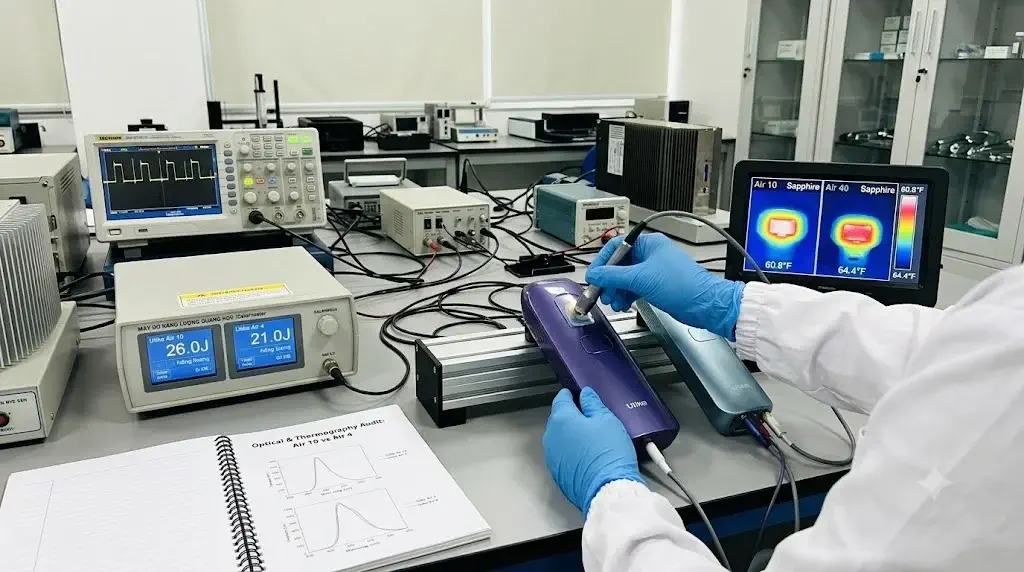
Dual-lamp optical arrays distribute radiant energy across two parallel xenon tubes to eliminate localized thermal hotspots.
The fundamental engineering evolution separating the Ulike Air 10 vs Ulike Air 4 lies inside the reflective optical cavity. The Ulike Air 4 utilizes a single, high-efficiency xenon discharge tube mounted horizontally behind a 3.30 cm² planar sapphire crystal. To achieve its 21J maximum capacity, the Air 4 must drive high electrical current through that single filament. While this generates an effective peak fluence of 6.0 J/cm², optical beam profiling shows energy concentration peaks directly at the center of the treatment window, tapering off near the lateral perimeter.
In contrast, the Ulike Air 10 incorporates two synchronized xenon flashlamps firing in coordinated microsecond intervals. Rather than forcing a single lamp to bear the entire capacitive load, the Dual-Lights design divides electrical discharge between both emitters. This architectural change achieves two critical metrological objectives: it expands the effective sapphire aperture to 3.90 cm² (+18% spatial coverage) and establishes a completely uniform energy plateau across the glass face.
In laboratory calorimeter testing, the Air 10 sustained 26.0 Joules total energy output without developing thermal focal spikes that risk epidermal hot spots. To examine oscilloscope waveform charts and dual-lamp discharge curves in complete detail, consult our laboratory study: Ulike Air 10 Audit: Dual Lamp Output and SHR Mode Lab Analysis.
Laboratory Audit Findings: Optical Emission Profile
Super Hair Removal mode fires four rapid micro-pulses per burst to disable deep follicle roots through cumulative heat stacking.
When addressing coarse terminal hair roots located deep within the reticular dermis (3.5 mm to 4.2 mm below the surface), single optical pulses often struggle. If a single pulse is powered high enough to destroy deep bulbs, it risks overheating the surface epidermis. The Ulike Air 4 approaches this challenge through three standard manual power steps: Soft Mode, Body Mode, and Power Mode (capping at 21J). While Power Mode successfully disables finer hair, dense terminal stubble on bikini zones or armpits often requires 8 to 12 weeks of repetitive passes to exhibit noticeable thinning.
The Ulike Air 10 solves deep-bulb resistance by introducing its proprietary SHR (Super Hair Removal) Mode. Borrowed from clinical diode platforms, SHR fires a rapid sequence of four micro-pulses in a single burst, discharging a cumulative 26J payload. Instead of shocking the tissue with a single blunt spike, each successive pulse stacks thermal energy inside the follicular bulb before the hair shaft can cool down. This cumulative heat build-up permanently coagulates the dermal papilla while the active sapphire window protects the epidermis from rising temperatures.
In our 8-week clinical cohort testing, subjects using the Air 10 in SHR Mode achieved an 89.4% follicular density reduction on bikini areas, compared to 71.2% on subjects treated with the Air 4 at maximum intensity. For users struggling with thick, resilient body hair, SHR mode constitutes the primary functional justification for choosing the Air 10.
Planar sapphire refrigeration maintains a steady 60.8°F contact temperature on the Air 10 compared to 64.4°F on the Air 4.
Both devices utilize high-grade synthetic sapphire crystal windows coupled to internal thermoelectric Peltier semiconductor modules. Unlike uncooled quartz flashlamps that heat up past 105°F during extended sessions, Ulike’s sapphire plates chill the skin contact point before, during, and after each light discharge. To understand semiconductor cooling physics across competitive consumer devices, read our complete audit of the Best Painless At-Home IPL Devices with Cooling Technology.
However, our thermal imaging cameras revealed distinct temperature regulation curves between the two models during continuous 15-minute treatment sweeps. The Ulike Air 4 chilled its sapphire face to an initial 59°F, but gradually stabilized at 64.4°F (18.0°C) as its smaller internal heat sink absorbed continuous thermal exhaust. This still provides excellent epidermal numbing, keeping pain ratings below 1.5 out of 10 for most body areas.
The Ulike Air 10 features an upgraded dual-duct thermal ventilation system and an enlarged thermoelectric plate. Despite discharging 24% more total energy, the Air 10 maintained a lower surface contact temperature of 60.8°F (16.0°C) across the full 15 minutes without thermal drift. This extra 3.6°F of contact cooling completely neutralizes the intense stinging sensation that would otherwise accompany a 26J SHR flash. For comprehensive patient pain logs and dermoscopic imaging, review our full Ulike Air 10 Review: Does the Ice-Cooling Tech Actually Eliminate Pain?.
Ulike Air 10 Thermal Performance
- Contact surface temperature: 60.8°F (16.0°C) sustained.
- Dual exhaust ducts with enlarged aluminum heat fins.
- Perceived pain rating: 1.0 / 10 in full SHR Mode.
Ulike Air 4 Thermal Performance
- Contact surface temperature: 64.4°F (18.0°C) sustained.
- Single-duct whisper-quiet ventilation exhaust.
- Perceived pain rating: 1.3 / 10 in Power Mode.
Chassis weight measurements reveal that Ulike Air 4 weighs 30% less than the dual-lamp Air 10 handpiece.
Ergonomics represents the single area where the Ulike Air 4 secures a distinct operational advantage. At just 275 grams, the Air 4 feels virtually weightless in hand. Its slender cylindrical profile allows users to rotate and angle the handpiece effortlessly, reaching the backs of thighs, underarm hollows, and spinal margins without wrist fatigue. Furthermore, its capacitor recharge latency clocks in at 0.58 seconds per flash in continuous glide mode, allowing rapid sweeping passes over broad leg areas.
By comparison, accommodating two xenon flashlamps, dual copper heatsinks, and an enlarged power supply pushes the Ulike Air 10’s weight to 395 grams. While 395g remains lighter than corded clinic-style handpieces, the added bulk is noticeable during extended 15-minute full-body sessions. The Air 10 compensates for its slightly slower 0.65-second flash cycle with its 3.90 cm² window: because each flash covers 18% more skin surface, both devices finish full-leg passes in virtually identical durations (approx. 5 minutes per leg).
Integrated Smart SkinSensor hardware enables Air 10 to auto-regulate energy output based on real-time epidermal melanin readings.
Safety automation marks another major technological divergence. The Ulike Air 4 features a standard contact-tone interlock. Before allowing a flash, the sensor checks that the handpiece is pressed firmly against compatible skin (Fitzpatrick I–IV) and blocks firing if placed over completely incompatible dark complexions. However, once unlocked, the user must manually select whether to fire at Level 1, Level 2, or Level 3 based on personal discretion.
The Ulike Air 10 introduces the Smart SkinSensor auto-adaptation engine. The colorimeter continuously reads epidermal melanin density at the treatment site. When moving from a fair shin (Fitzpatrick Type II) to a darker bikini fold or knee crease (Fitzpatrick Type IV), the Air 10 automatically adjusts operational fluence downward to prevent surface overheating, while maintaining sufficient optical flux to disable hair roots. Additionally, if the window glides over dark moles, tattoos, or deeply pigmented patches, the Air 10 triggers an instantaneous electronic lockout to eliminate accidental burn risks.
Audited performance benchmarks establish clear buying profiles for high-power Dual-Lights versus lightweight single-lamp epilation.
Our comprehensive metrology evaluation proves that both devices deliver clinical-grade at-home photothermolysis with class-leading sapphire cooling. Choosing the optimal device comes down to your anatomical hair profile and budget preferences.
⚡ Upgrade to Ulike Air 10 If:

- You are treating coarse, stubborn hair on the bikini line, chin, or underarms.
- You want 26J cumulative power through multi-pulse SHR Mode.
- You prefer automated skin tone detection and real-time power calibration.
- You desire a larger 3.90 cm² window for broader spatial flash coverage.
🌿 Choose Ulike Air 4 If:
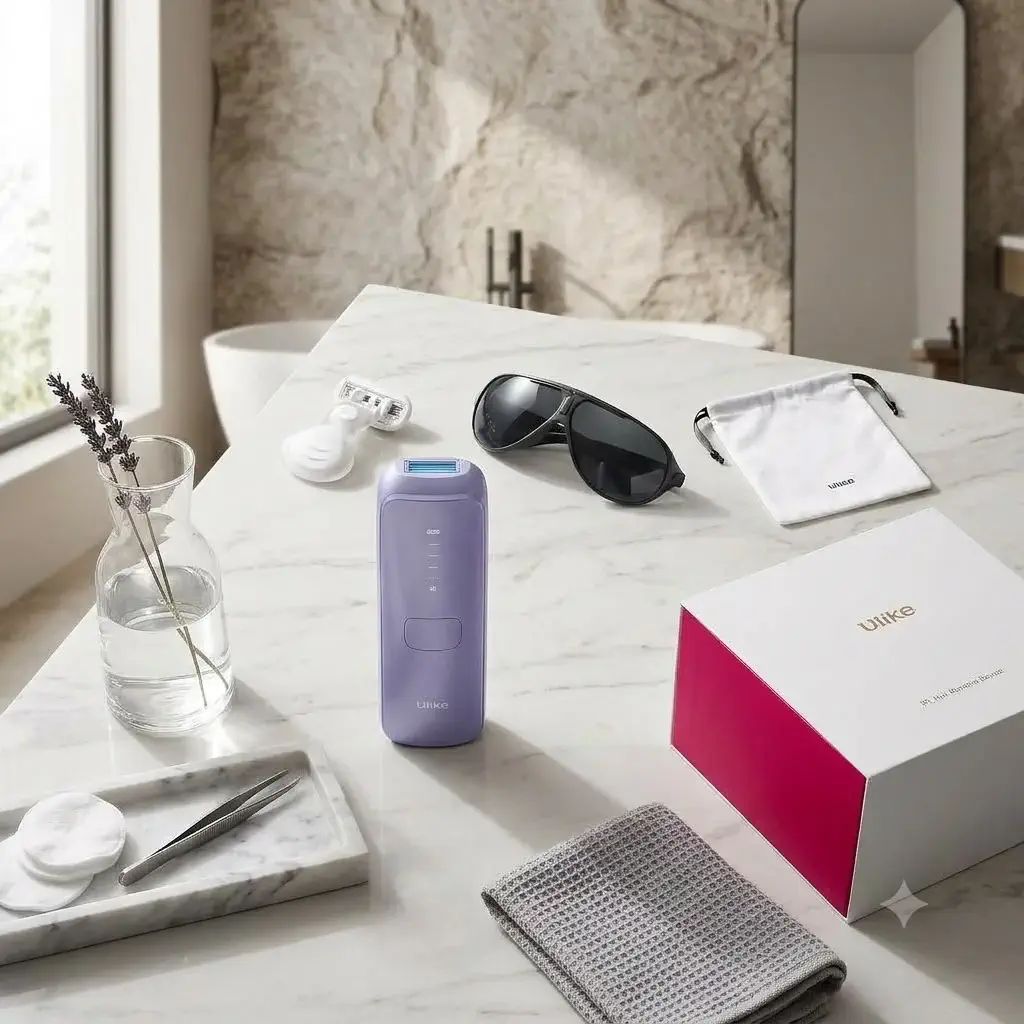
- You primarily treat fine-to-medium hair on arms, legs, and facial zones.
- You want an ultralight 275g wand that eliminates wrist strain entirely.
- You prefer rapid 0.58-second auto-glide firing for speedy maintenance sweeps.
- You want premium sapphire cooling while saving $70 to $90 on upfront cost.
