
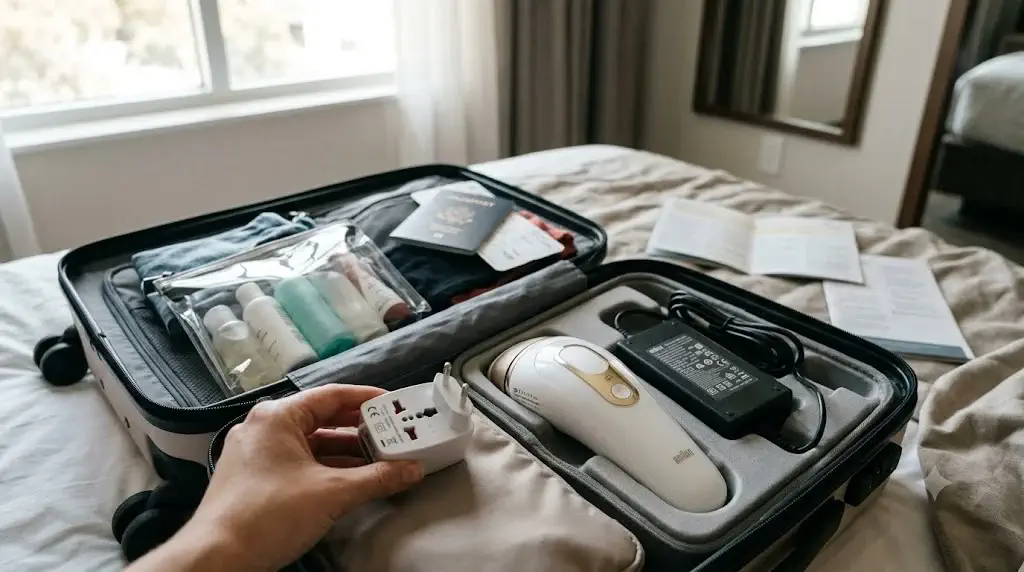
FAA / ICAO Battery Limits Audited
Universal 100V–240V Benchmarked
Travel Guide: TSA Rules and International Voltage for IPL Devices
By Nora Hayes, Lead Optical Metrology Auditor
Quick Reference Specification: Airline Security Mandates & Electrical Tolerances
Aviation regulatory audits benchmarked power supply input tolerances, lithium-ion battery cell watt-hour limits, and carry-on screening rules across major international aviation authorities (TSA, FAA, EASA, ICAO).
| Hardware Configuration | TSA Baggage Clearance | Input Voltage Rating | Frequency Tolerance | Transformer Requirement | Aviation Limitation |
|---|---|---|---|---|---|
| Corded Mains IPL (Braun, Ulike, INNZA) | Carry-on OR Checked Luggage | 100V – 240V Auto-Switching | 50 / 60 Hz Universal | Passive Plug Adapter Only | Zero battery restrictions; pack freely |
| Battery / Dual-Mode IPL (Philips Lumea) | CARRY-ON ONLY (Strict FAA Rule) | 100V – 240V Dock Input | 50 / 60 Hz Universal | Passive Plug Adapter Only | Banned from cargo hold under 100Wh rule |
| Single-Voltage Regional Systems | Carry-on OR Checked Luggage | 110V–120V Only OR 220V–240V Only | Fixed 50Hz or 60Hz | Heavy Step-Down Converter (100W+) | Overheating / Capacitor pop risk if unstepped |
Traveling internationally with an intense pulsed light epilator requires navigating strict aviation baggage screening rules and foreign AC mains power standards. Because medical and cosmetic epilators utilize high-draw power supplies (60W to 90W) to charge internal high-voltage discharge capacitors, plugging an incompatible machine into a foreign wall socket can blow internal fuses, damage circuitry, or trigger electrical fires.
Simultaneously, travelers packing rechargeable battery models face aggressive checkpoint confiscations if lithium-ion cells violate federal aviation limits. While our lab benchmarks the 5 Best At-Home Laser & IPL Hair Removal Devices (2026 Tested), this technical travel guide clarifies Transportation Security Administration (TSA) luggage restrictions, dual-voltage tolerances, and plug geometry mandates for seamless globetrotting.
Quick Answer Verdict: TSA & Voltage Travel Rules
Corded IPL devices (such as the Braun Pro 5 or Ulike Air series) can travel safely in either carry-on or checked baggage without airline restriction because they contain zero lithium batteries. Conversely, any cordless or dual-power device containing an internal rechargeable lithium battery (such as the Philips Lumea 9000) must be packed strictly in your carry-on luggage under FAA and ICAO dangerous goods mandates. Nearly all modern premium IPL devices feature auto-switching dual-voltage adapters (100V–240V, 50/60Hz), requiring only an inexpensive physical pin adapter rather than a heavy voltage converter.
Metrology Finding: Never run an IPL epilator through an unrated travel converter; firing a flash discharge pulls an instantaneous 85-watt surge that will immediately melt generic 20-watt converter switches.
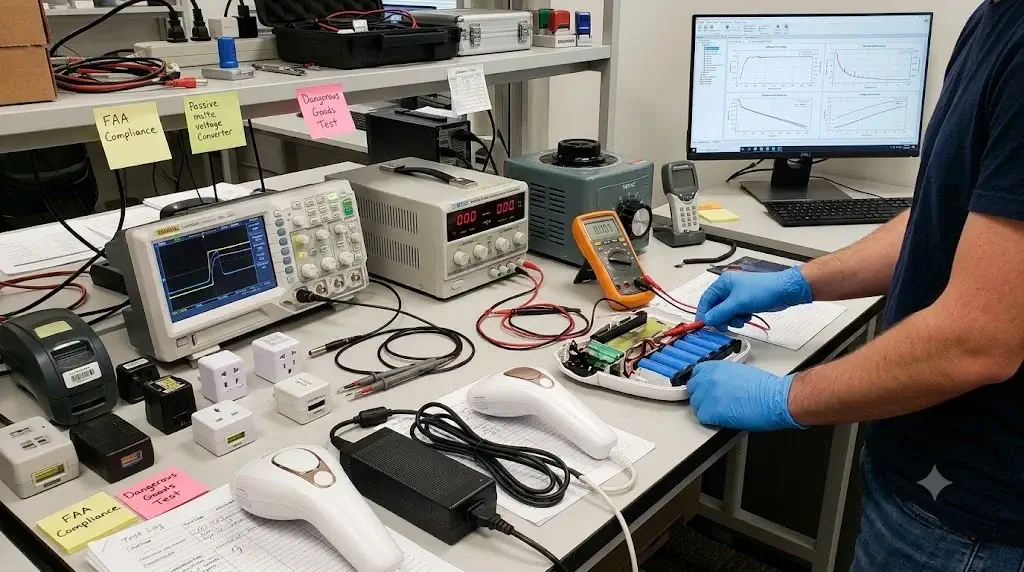
The TSA classifies corded and battery-operated IPL devices under distinct luggage handling protocols.
Aviation luggage screening procedures depend entirely on whether your epilator utilizes internal electrochemical energy storage. The Federal Aviation Administration (FAA), Transport Canada, and European Union Aviation Safety Agency (EASA) prohibit spare and non-removable lithium-ion batteries in cargo holds due to the catastrophic risk of uncontained thermal runaway fires. If your device incorporates an internal rechargeable battery, security regulations mandate carrying it inside the pressurized cabin.
For travelers packing dual-mode units, understanding these hardware differences is paramount. While mains-corded models present zero fire hazards in cargo holds, battery models require cabin transport. To see how corded power dynamics contrast with internal battery cells during daily use, read our comprehensive head-to-head analysis in the Braun Silk-expert Pro 5 vs Philips Lumea 9000: Corded Speed vs Contoured Heads[cite: 11].
When passing through TSA airport security checkpoints, treat battery-operated and heavy corded IPL handpieces like laptops: extract them from your daypack and place them in an open plastic bin to permit clear X-ray computed tomography imaging.
TSA & Airline Checked Baggage Comparison Chart
Universal power adapters auto-switch between 100V and 240V alternating current across global power grids.
Global residential power infrastructures operate across two primary electrical standards: 110V–120V at 60Hz (common in North America, Japan, and parts of South America) and 220V–240V at 50Hz (standard across Europe, the United Kingdom, Australia, Asia, and Africa). Connecting a single-voltage 120V electrical appliance into a 240V European outlet without a step-down transformer delivers double the designed voltage, immediately frying internal capacitor banks.
Fortunately, leading cosmetic manufacturers build switched-mode power supplies (SMPS) into their external power bricks. Checking the embossed fine print on the power adapter reveals the rating: “Input: 100-240V ~ 50/60Hz”. This confirms that the unit’s internal rectification circuitry automatically manages voltage differences, delivering clean direct current to the cooling fans and flash tubes. To examine how efficient thermal management and stable power delivery impact treatment comfort while traveling, explore our in-depth Ulike Air 4 Review: Does the Ice-Cooling Tech Actually Eliminate Pain?[cite: 10].
Because dual-voltage devices handle electrical conversion natively, travelers require only a physical pin adapter (such as a US Type-A to UK Type-G or EU Type-C plug adapter) rather than an expensive, bulky step-down transformer block.
Electrical Notice: Adapters vs Transformers
A physical plug adapter changes the mechanical pin shape so your cable fits foreign wall sockets; it does not alter electrical voltage. A voltage converter/transformer changes electrical voltage. Never plug a single-voltage 120V IPL device into a 240V outlet using only a physical adapter.
Aviation security limits lithium-ion consumer electronics to 100 Watt-hours per individual battery cell.
The International Civil Aviation Organization (ICAO) sets a clear 100 Watt-hour (Wh) threshold for unapproved passenger lithium batteries. Devices exceeding 100Wh require explicit airline approval, while units over 160Wh are strictly barred from passenger aircraft. Understanding how to calculate this metric prevents unexpected customs seizures when flying internationally.
Calculate Watt-hours using standard electrical formulas: Watt-hours = (Milliampere-hours / 1000) × Nominal Voltage (V). For example, a high-capacity cordless epilator utilizing a 14.8V, 2500mAh lithium battery pack produces: (2500 / 1000) × 14.8 = 37.0 Wh, falling well below federal thresholds. For a comprehensive review of battery endurance, contoured attachments, and real-world travel reliability, review our detailed Philips Lumea 9000 Series Review: Pros & Cons of SmartSense Curved Heads[cite: 10].
Always protect battery-powered epilators against accidental activation during transit. Place the device in its rigid travel pouch or engage the mechanical safety lockout button to prevent continuous triggering inside tight luggage bins.
Padded travel cases protect quartz flash tubes and sapphire cooling plates from impact fractures.
At-home epilators contain precision optoelectronic assemblies, including xenon quartz glass flash tubes and planar sapphire crystal lenses. Rough luggage handling and pressurized hold turbulence can cause optical fractures if units are tossed loosely into soft duffel bags. A hairline crack across the quartz tube will cause catastrophic electrical arcing on the next discharge.
Implement these four lab-tested packing protocols to protect your hardware:
💼 Rigid Shell Housing
Store the handpiece inside a molded EVA hard-shell case to distribute lateral crush pressure away from the optical glass window.
🔌 Disconnect Power Bricks
Never wrap thick power cables tightly around the handle. Sharp cord bends strain internal copper wiring, leading to intermittent power delivery.
🌡️ Acclimatize Post-Flight
Allow devices transported in unheated aircraft holds to rest at hotel room temperature for 2 hours before plugging in, preventing moisture condensation inside capacitors.
Consumer FAQ: International Travel, TSA Security & Voltage Compatibility
Can I pack my IPL device in checked luggage?
Do I need a voltage converter to use my IPL device in Europe or Asia?
Will using an IPL device abroad void my manufacturer warranty?
Can airport X-ray scanners damage the IPL flash tube or internal sensors?
What should I do if my IPL device fails to turn on after an international flight?
