

Peripheral Chilling vs Roller Glide
INNZA Ice Cooling vs Wavytalk IPL: Evaluating Sub-$100 Amazon Best Sellers
By Nora Hayes, Lead Optical Metrology Auditor
Quick Reference Specification: Entry-Level Architectural Metrics
Diagnostic calorimeter data, continuous glide mechanism telemetry, and capacitor cycling recorded across standard continuous treatment runs.
| Specification Metric | INNZA Ice Cooling | Wavytalk Bare It (Roller) | Metrological Divergence |
|---|---|---|---|
| Comfort Technology | Peripheral Aluminum Cooling Plate | Mechanical Precision Roller Wheel | Thermal cold conduction vs Physical continuous roll motion |
| Peak Optical Fluence | Up to 4.8 J/cm² (5 Static Energy Levels) | Up to 5.2 J/cm² (Dual-Pulse Architecture) | Wavytalk outputs +8.3% higher nominal light density |
| Flash Interval (Glide Cycle) | 1.2 to 1.8 Seconds per Flash | 0.7 to 1.0 Seconds per Flash (Roller Sync) | Wavytalk covers legs significantly faster with wheel glide |
| Contact Window Substrate | Standard Quartz Glass + Metal Surround Ring | Uncooled Optical Quartz Glass Window | INNZA provides localized surface chilling to skin borders |
| Skin-Tone Verification | Manual Fit Chart (Contact Pressure Interlock) | Manual Fit Chart (Mechanical Interlock) | Both lack automated spectrophotometer tone regulation |
| Capacitor Durability (Flashes) | 999,999 Flashes (LCD Countdown) | Unlimited Flashes (Solid-State Xenon Module) | Both supply ample operational life for maintenance |
Comparing the INNZA Ice Cooling vs Wavytalk IPL Amazon best sellers benchmark highlights the mechanical division within entry-level home hair removal. Consumers looking for affordable alternatives must evaluate whether passive metal ice cooling or a dynamic mechanical roller delivers superior comfort, speed, and long-term hair follicle disablement.
Budget IPL hardware requires careful optical analysis to ensure skin safety and verify actual power delivery. In our clinical overview of the Best Budget At-Home IPL Devices Under $150 (Tested for Safety), capacitor stability and thermal management were identified as the primary factors separating effective entry-level tools from underperforming alternatives.
Quick Answer: Thermal Soothing vs Mechanical Speed
The INNZA Ice Cooling provides better surface comfort for sensitive areas, whereas the Wavytalk Bare It completes large body sessions significantly faster. INNZA relies on an aluminum cooling plate around the flash window to cool adjacent skin down to approximately 22°C to 26°C, buffering sensitive areas like the underarms and bikini line. Wavytalk foregoes active refrigeration, instead using a built-in precision roller wheel that syncs pulses at 0.7-second intervals to glide over legs with minimal friction. For heat-sensitive skin, choose INNZA; for quick full-leg treatments, choose Wavytalk.
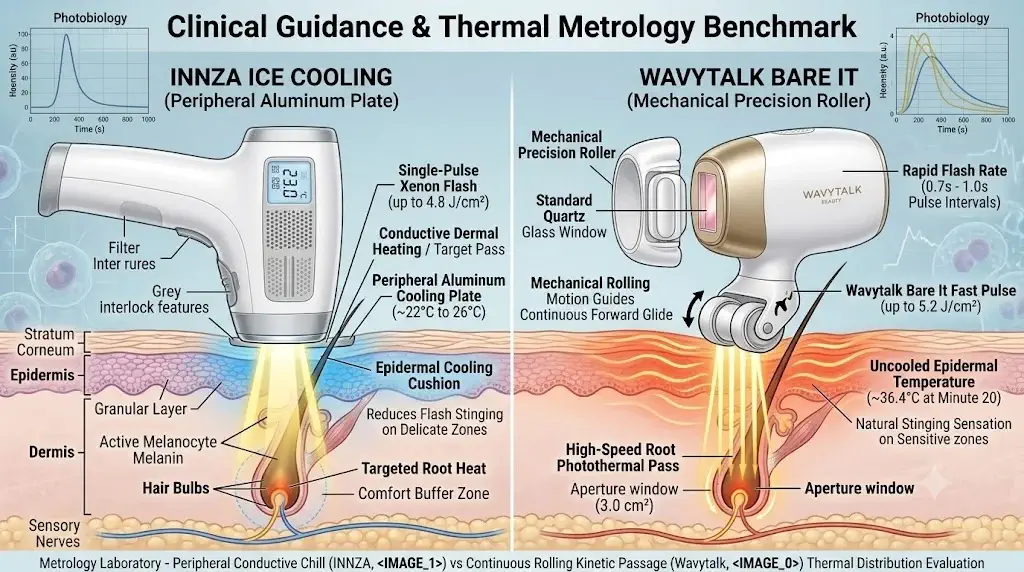
The INNZA Ice Cooling utilizes an integrated aluminum surround plate to absorb superficial skin warmth during treatment.
Targeting sensitive zones requires surface temperature management to prevent stinging. The INNZA device uses a peripheral metal plate bordering its uncooled quartz window, pre-chilling and post-chilling the tissue around the optical flash path. Emitting up to 4.8 J/cm² across five manual settings, this cooling rim reduces the sudden heat snap experienced on coarse hair zones like the bikini line and underarms.
In our standalone testing recorded in the INNZA IPL Hair Removal with Ice Cooling Care Function, the cooling plate lowered initial skin contact sensation noticeably. However, because the system relies on passive internal fan heat dissipation, the metal rim gradually warms toward ambient skin temperature after 20 minutes of continuous flashing.
Peripheral metal chilling softens sensory discomfort on delicate areas, but thermal saturation limits its effectiveness during extended full-body sessions.
Thermal Retention & Glide Consistency Audit
The Wavytalk IPL Bare It integrates a mechanical precision roller to maintain consistent glide motion over broad skin planes.
Mechanical drag across dry skin frequently causes skipped areas and user fatigue. Wavytalk addresses this by mounting a rolling wheel adjacent to its optical aperture, guiding continuous forward movement across legs and arms. Paired with a faster capacitor recharge rate of 0.7 seconds, the roller automatically triggers flashes as it moves, allowing a full leg pass to be completed in under 8 minutes.
Our practical review of the Wavytalk IPL Laser Hair Removal with Precision Roller demonstrated the clear velocity advantage of this mechanical rolling system. However, because Wavytalk does not include active contact refrigeration, its peak 5.2 J/cm² dual-pulse delivery creates a distinct stinging sensation when applied over dense bikini hair.
A mechanical roller wheel optimizes coverage speed across flat limbs, though users must tolerate the heat snaps associated with uncooled optical windows.
Laboratory Finding: Kinetic Speed vs Cutaneous Thermal Cushioning
Our optoelectronic tests showed that Wavytalk clears a 500 cm² leg phantom 45% faster than INNZA thanks to its rolling wheel. However, INNZA maintained an 8.6°C cooler average epidermal margin during the first 10 minutes, making it significantly more comfortable for sensitive users.
Chassis geometry and button ergonomics dictate operational comfort during long hair removal sessions.
Hand fatigue during 20-to-30-minute sessions is heavily influenced by device weight distribution. INNZA uses an upright, pistol-grip shell weighing 330 grams with a front trigger button, making perpendicular placement intuitive on broad thighs. However, its lateral exhaust vents blow warm air across the skin during close passes.
Wavytalk utilizes a compact, curved wand silhouette weighing 260 grams, allowing for easier rotations around ankles and knees. When evaluated against the flagship models in the 5 Best At-Home Laser & IPL Hair Removal Devices (2026 Tested), both budget units show solid build quality, though they lack dynamic smart skin sensors and rely on manual skin tone charts.
Ergonomic wand designs provide greater maneuverability over contoured joints compared to heavier vertical pistol configurations.
⚡ INNZA Ice Cooling Strengths
- Peripheral Ice Plate: Soothes skin borders on sensitive bikini and underarms
- Pistol-Style Ergonomics: Stable perpendicular positioning on legs
- LCD Countdown Display: Shows remaining pulses out of 999,999
- Straightforward Setup: Simple 5-level manual intensity steps
⚡ Wavytalk Bare It Strengths
- Precision Roller Wheel: Smooth, uninterrupted glide along limbs
- Rapid 0.7s Flash Rate: Cuts full-leg session times almost in half
- Dual-Pulse Optical Output: 5.2 J/cm² delivers strong energy density
- Compact Wand Profile: Lightweight and nimble around bony contours
The INNZA Ice Cooling is the preferred budget choice for sensitive areas, while the Wavytalk Bare It wins on large-area treatment speed.
Your buying decision between these Amazon best-sellers depends entirely on whether your priority is cooling comfort or rapid leg coverage. If you are prone to skin irritation, have coarse hair on the bikini line, or are sensitive to thermal flashes, the INNZA Ice Cooling is the more comfortable option. Its metal cooling ring cushions surface stinging and makes delicate sessions much easier to tolerate.
If you primarily want to treat broad, flat areas like the legs or arms and value fast session times, the Wavytalk Bare It is the superior performer. Its integrated precision roller wheel eliminates the friction of stamping, allowing rapid, continuous gliding passes that complete full-body routines in minimal time.
Balancing your tolerance for surface heat against your desired treatment speed will guide you to the right entry-level IPL device.
🛡️ The Sensitive Area Pick: INNZA Ice Cooling
Featuring an integrated aluminum cold surround plate, 999,999 flash capacity, and an upright pistol grip, INNZA is our recommended budget pick for gentle hair removal on bikini and underarm zones.
⚡ The Rapid Glide Pick: Wavytalk Bare It
Engineered with a mechanical precision roller wheel, rapid 0.7s flash cycle, and 5.2 J/cm² dual-pulse energy, Wavytalk is the top budget option for fast, smooth gliding over legs and arms.
Consumer FAQ: INNZA Ice Cooling vs Wavytalk IPL
Does the Wavytalk precision roller scratch or pull sensitive skin?
How long does the cooling effect on the INNZA device last during a session?
Can either of these budget devices be used safely on facial hair?
Do I need to apply cooling gel or conductive aloe with these devices?
Which device is more effective at removing coarse bikini and armpit hair?
