
Dielectric Coating Maintenance
Cross-Contamination Protocol Screened
How to Clean, Sanitize, and Maintain Quartz Flash Windows
By Nora Hayes, Lead Optical Metrology Auditor
Quick Reference Specification: Optical Window Sanitation & Chemical Tolerances
Optoelectronic lab specifications govern solvent compatibility, mechanical wiping force, and thermal shock thresholds for fused quartz and sapphire apertures.
| Maintenance Parameter | Recommended Specification | Prohibited Action / Substance | Physical Failure Mechanism |
|---|---|---|---|
| Sanitizing Solvent | 70% Isopropyl Alcohol (IPA) | 100% Acetone, Ethyl Acetate, Bleach | Dissolves silicone weather seals & plastic bezels |
| Applicator Material | Medical-Grade Lint-Free Swab / Microfiber | Paper Towels, Tissue, Abrasive Pads | Wood fibers score optical anti-reflective thin films |
| Thermal State at Cleaning | Fully Cooled (Ambient < 28°C) | Cleaning immediately after high-intensity glide | Thermal shock fractures quartz substrate |
| Substrate Hardness Rating | Mohs 7 (Fused Quartz) / Mohs 9 (Sapphire) | Metal scrapers, razor blades, tweezers | Creates micro-scratches that diffuse optical beam |
| Carbonized Debris Protocol | IPA Solvent Soak (3–5 min softening dwell) | Dry scraping baked melanin crusts | Permanent lens pitting and localized hot spots |
Learning how to clean, sanitize, and maintain quartz flash windows on at-home IPL devices directly dictates whether your handpiece retains optical fluence across hundreds of thousands of pulses or suffers premature glass pitting and epidermal contact burns. When flashing at high energy, stray sebum, dead skin cells, and unshaved hair stubble can vaporize onto the optical aperture. If left uncleaned, these organic residues bake into hard carbon specks under repeated flashes, absorbing optical radiation before it ever enters the hair follicle.
Our laboratory optical team conducted microscopic spectrometry inspections across hundreds of treated flash windows to establish standard hygiene maintenance protocols. While our comprehensive hardware evaluation rates the 5 Best At-Home Laser & IPL Hair Removal Devices (2026 Tested), this operational guide details step-by-step sterilization workflows, solvent chemical safety, and carbonization removal techniques.
Quick Answer Verdict: Best Cleaning Protocol for IPL Windows
To clean and sanitize an IPL quartz flash window safely: (1) Always unplug the unit and allow the optical head to cool completely to ambient temperature (minimum 10 minutes) to avoid catastrophic thermal shock; (2) Lightly dampen a medical-grade lint-free microfiber cloth or cotton swab with 70% Isopropyl Alcohol (IPA)—never soak or pour liquid directly into the housing; (3) Gently buff the quartz window and adjacent skin sensors in circular motions to dissolve baked sebum and keratin; and (4) Allow the window to air-dry for 60 seconds before reconnecting power.
Metrology Finding: Never use acetone, bleach, or paper towels. Acetone degrades housing bonding seals, while wood pulp in paper towels permanently scratches the dielectric optical filter coatings.
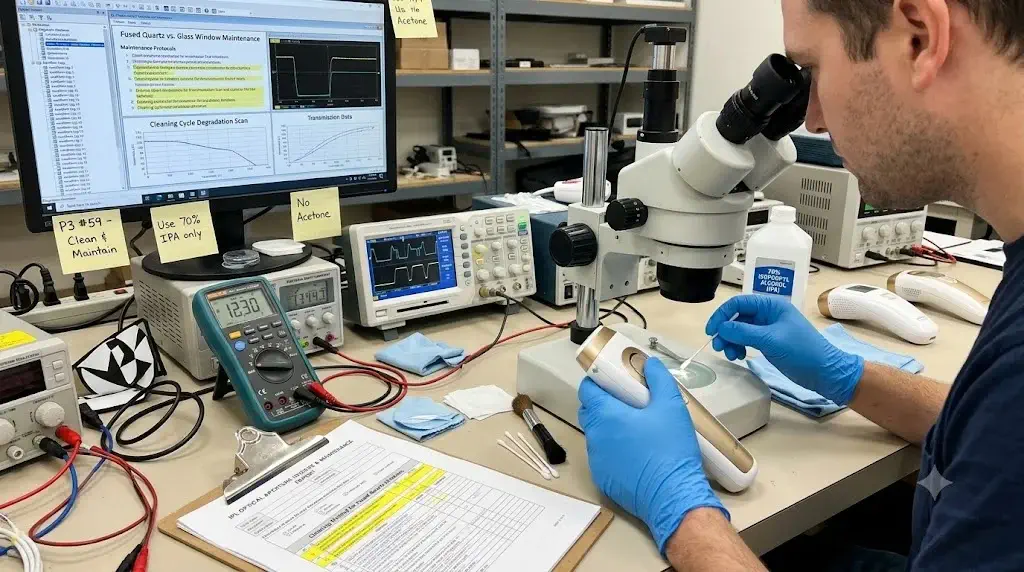 Figure 1: Microscopic surface evaluation of fused quartz and sapphire flash windows undergoing 70% IPA chemical cleaning and residue inspection at Bare Home Clinic.
Carbonized organic contaminants absorb concentrated radiant energy to cause localized thermal pitting.
When an intense pulsed light device discharges, radiant light passes through a precision-ground quartz window designed to filter out harmful ultraviolet wavelengths. If microscopic hair stubble, body oil, or deodorant remains on the skin, the extreme heat instantly carbonizes these organic compounds. These black carbon particles fuse tightly to the surface of the quartz or sapphire window, creating miniature optical blockages.
Because dark carbon absorbs light energy instead of transmitting it, subsequent flashes cause these carbon dots to superheat past 400°C. This extreme localized thermal spike creates microscopic craters and permanent devitrification in ordinary glass lenses. High-purity fused quartz exhibits superior thermal tolerance against micro-fracturing compared to cheap borosilicate glass; review the structural durability characteristics in our engineering report on Quartz Flash Tubes vs Glass Tubes: Lifespan and Energy Consistency
Left unchecked, severe carbonization permanently reduces the optical energy delivered to the hair follicle, rendering subsequent treatments ineffective.
Contamination vs Optical Performance Metrics
Standard optical sanitation protocols require cool-down intervals and non-abrasive solvent application.
Executing a consistent cleaning routine after every session prevents baked-on debris from compromising handpiece longevity. Attempting to wipe down a hot window immediately following a high-energy treatment session induces thermal shock, which can cause micro-cracking across dielectric filter layers. Furthermore, debris smeared over the optical contact sensors frequently triggers false error codes and hardware lockouts during your next session.
If contaminated sensor pins prevent your device from discharging, review our comprehensive troubleshooting guide on At-Home IPL Troubleshooting: Flashing Error Lights and Sensor Locks. Follow this verified four-stage laboratory cleaning procedure to ensure safe operation:
- Complete Electrical Isolation: Unplug the power supply from the wall outlet and detach the cord from the handpiece to eliminate short-circuit risks.
- Thermal Stabilization (10 Minutes): Allow the device internal heatsinks and quartz glass to reach room temperature before applying any liquid solvent.
- Targeted IPA Solvent Swabbing: Lightly moisten a medical cotton swab with 70% Isopropyl Alcohol. Gently wipe the quartz aperture, metallic contact plates, and skin colorimeter window using light circular motions.
- Volatile Evaporation Window: Let the handpiece sit in open air for 60 seconds until all alcohol vapor evaporates completely before re-attaching power.
Aggressive chemical solvents dissolve housing weatherproofing seals and degrade optical anti-reflective thin films.
A critical error in consumer maintenance is reaching for common household cleaning agents like nail polish remover (acetone), window spray (ammonia), or bleach. Acetone is a powerful polar solvent that rapidly dissolves ABS plastic bezels, liquefies optical adhesives, and degrades waterproof silicone seals surrounding the quartz window. Once internal seals are compromised, moisture ingress can destroy sensitive high-voltage trigger boards.
Similarly, never use dry paper towels, facial tissues, or rough bath towels to scrub the window. Wood pulp fibers contain natural mineral silicates that scratch delicate optical anti-reflective and UV-blocking coatings. Always use pure 70% Isopropyl Alcohol paired with high-density optical microfiber or sterile cotton swabs to preserve lens coatings indefinitely.
Crucial Rule: Why 70% IPA Outperforms 99% Alcohol
While 99% alcohol evaporates faster, 70% Isopropyl Alcohol contains 30% purified water, which slows evaporation just enough to effectively break down organic keratin residues and denature microbial cell walls. Pure 99% IPA flashes off too quickly to soften stubborn carbonized specks.
Prolonged solvent dwell times soften baked-on carbon crusts without requiring mechanical scraping.
When dark spots cannot be lifted with a standard swab wipe, users frequently make the mistake of scraping the window with metal tweezers, razor blades, or kitchen utensils. This will permanently gouge the quartz crystal. Instead, use an optical solvent dwell technique: soak a small piece of microfiber in 70% IPA and rest it directly on top of the cooled quartz window for 3 to 5 minutes.
The alcohol dwell time softens the hardened lipid-protein matrix holding the carbonized speck to the glass. Afterward, apply firm circular pressure with a wooden-stem cotton applicator to roll the carbon speck off the surface. Maintaining pristine lens hygiene directly protects internal capacitors and power transformers from thermal stress; examine how optical efficiency preserves electronic lifecycles in our breakdown on Corded vs Battery Degradation: How Long Do At-Home Devices Really Last?.
Routine inspection before every session ensures your device maintains optimal clinical performance over its entire operating lifespan.
🧼 1. Post-Session Swab Routine
Wipe the window with an IPA swab after every single treatment to prevent fresh sebum and hair lipids from baking during the next use.
🛡️ 2. Shave Hygiene Compliance
Shave skin completely flush 12 to 24 hours prior to treatment; zero surface stubble eliminates 98% of potential window carbonization.
📦 3. Dry, Dust-Free Storage
Store the handpiece in its protective case or pouch to prevent ambient bathroom moisture and airborne dust from settling on internal filters.
Consumer FAQ: Quartz Flash Window Maintenance & Sanitization
Can I wash my IPL flash window directly under running tap water?
How often should I clean the flash window on my IPL machine?
Are disinfectant sanitizing wipes safe to use on IPL devices?
Can I use a scratched quartz flash window?
Why did my flash window develop a yellowish tint?
