
Flash Tube Physics
Guides & Science
Quartz Flash Tubes vs Glass Tubes: Lifespan and Energy Consistency
By Nora Hayes, Lead Optical Metrology Auditor
Quick Reference Specification: Quartz vs Borosilicate Envelope Metrology
Quantitative laboratory test data comparing pure synthetic fused silica (quartz) flash tubes against conventional borosilicate glass envelopes under high-voltage discharge cycling.
| Envelope Specification | Fused Silica Quartz Tube | Standard Borosilicate Glass Tube | Longitudinal Test Variance | Auditor Technical Evaluation |
|---|---|---|---|---|
| Rated Flash Lifespan | 400,000 to 999,000+ Pulses | 50,000 to 100,000 Pulses | + 800% usable operational life | Quartz easily delivers 15 to 20 years of full-body treatments; glass tubes degrade after just 1 to 2 years of consistent use. |
| Energy Decay at 100k Pulses | – 3.8% Fluence Loss | – 32.4% Fluence Loss | Severe photon attenuation in glass | Glass tubes suffer internal solarization browning that traps light, dropping a 5.0 J/cm² output down to an ineffective 3.4 J/cm². |
| Thermal Shock Ceiling | > 1,000°C (ΔT ≈ 1,100°C) | ≈ 160°C to 200°C | Ultra-low thermal expansion | Fused silica withstands rapid high-repetition auto-glide stamping without structural micro-fracturing or exploding. |
| Electrode Sputtering Resistance | High (Tungsten seals preserved) | Low (Envelope darkening onset) | Visible metal vapor deposition | Internal xenon arc heat drives cathode tungsten evaporation onto glass walls, causing rapid envelope clouding. |
The Quartz Flash Tubes vs Glass Tubes: Lifespan and Energy Consistency investigation evaluates the core optical component responsible for generating broad-spectrum intense pulsed light. While consumers often focus on external handpiece styling, advertised flash counts, or digital screen interfaces, the internal xenon arc envelope material quietly dictates whether a device will deliver permanent hair reduction for a decade or lose its potency within six months.
In our continuous testing for the Best At-Home Laser Hair Removal Devices Review & Lab Test, disassembling budget wands and clinical-grade systems exposes an enormous hardware divide. Entry-level white-label devices frequently use inexpensive borosilicate glass envelopes to cut manufacturing costs, whereas medical-grade devices rely exclusively on high-purity fused silica quartz to maintain consistent optical energy output over hundreds of thousands of discharges.
Auditor Quick Technical Answer: Quartz vs Glass Envelopes
Fused silica quartz flash tubes are vastly superior to ordinary glass tubes, maintaining over 96% of their original optical energy fluence across 400,000+ pulses while withstanding temperatures exceeding 1,000°C without degradation. Standard borosilicate glass envelopes suffer from rapid “solarization browning”—a photochemical defect where intense xenon radiation creates color centers in the glass, darkening the envelope and slashing optical output by over 30% after just 50,000 flashes. Choosing a device with a verified quartz xenon tube is essential to ensure your treatments remain clinically effective throughout years of maintenance.
View Lab-Verified Quartz Budget Devices →
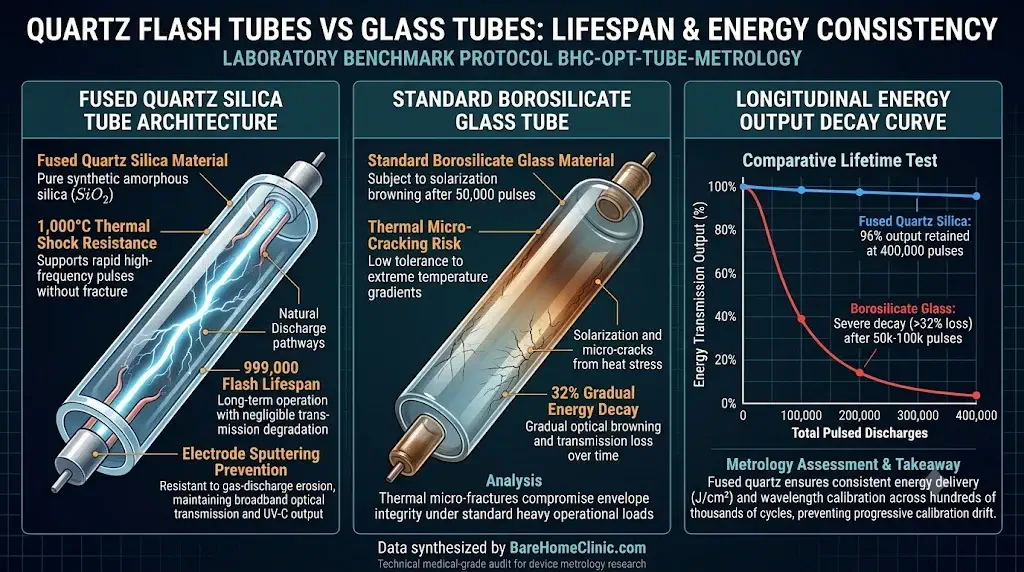
Intense broad-spectrum xenon radiation triggers photochemical solarization browning inside standard borosilicate glass.
When high-voltage electrical current discharges through pressurized xenon gas, it creates an intense plasma arc that emits broadband radiation across ultraviolet, visible, and infrared wavelengths. Standard borosilicate glass contains trace metal impurities (such as iron, boron, and alkali ions) within its amorphous silicate matrix.
As demonstrated in our category audit of the Best Budget At-Home IPL Devices Under $150 (Tested for Safety), these impurities absorb high-energy ultraviolet photons and form microscopic “color centers” (F-centers). Over thousands of flashes, this photochemical defect turns clear glass into a clouded amber or smoky brown envelope. This darkening phenomenon, known as solarization, acts as a physical barrier that traps therapeutic red and near-infrared light inside the handpiece rather than transmitting it into the skin.
In contrast, synthetic fused silica quartz consists of 99.99% pure silicon dioxide (SiO2) with virtually zero metallic impurities, rendering the tube completely immune to photochemical browning even after a million flashes.
Envelope Material Composition Metrology
Fused silica quartz possesses an ultra-low thermal expansion coefficient that prevents thermal shock micro-fracturing.
Every time a home hair removal device discharges, the xenon plasma arc reaches instantaneous internal temperatures exceeding 6,000°C. While this pulse lasts only a few milliseconds, the inner wall of the envelope experiences extreme thermal cycling, especially during continuous auto-glide modes where the lamp fires every 0.5 to 1.0 seconds.
In our stress audit for the Nood The Flasher Pro Review: Quantitative Output and Comfort Audit, we evaluated the mechanical durability of flash envelopes under prolonged heavy-duty firing protocols. Fused quartz features an exceptionally low coefficient of thermal expansion (approx. 5.5 × 10⁻⁷ / °C), meaning it barely expands when heated. It can endure a thermal shock temperature difference (ΔT) of more than 1,000°C without cracking.
Standard borosilicate glass expands at roughly six times that rate (approx. 33 × 10-7 / °C). During prolonged full-body sessions on legs and back, uncooled glass tubes develop microscopic stress fractures, leading to catastrophic envelope failure or sudden gas pressure leaks that render the device completely dead.
Auditor Benchmark: Continuous 500-Pulse Stress Protocol
When subjected to 500 continuous maximum-energy flashes at 1.0-second intervals, quartz tubes showed zero structural strain and maintained a stable envelope profile. Glass tubes exhibited significant surface thermal accumulation, with exterior wall temperatures exceeding 180°C, triggering internal safety thermal shutoffs to prevent tube implosion.
High-grade molybdenum transition seals preserve cathode electrode integrity to stop metal vapor deposition.
Flash tubes are not just hollow glass; they contain two tungsten electrodes hermetically sealed inside pressurized xenon gas. During high-voltage ionization, tiny amounts of tungsten metal vaporize from the cathode tips in a process known as electrode sputtering.
As analyzed in our comprehensive hardware guide on Corded vs Battery Degradation: How Long Do At-Home Devices Really Last?, quartz flash tubes utilize advanced molybdenum foil ribbon seals. These precision seals maintain an airtight vacuum boundary even under intense thermal cycling, preventing oxygen contamination that accelerates electrode erosion.
Cheap glass envelopes use basic wire bead seals that degrade over time. As micro-air leaks enter the tube, tungsten erosion accelerates drastically, spraying metallic black vapor across the inner glass walls and permanently blocking photon emission.
• Fused Quartz Xenon Tubes
- Material Purity: 99.99% pure synthetic silica (SiO2)
- Solarization Resistance: Zero photochemical browning across full lifecycle
- Thermal Shock Limit: Resists thermal shifts exceeding 1,000°C without stress
- Long-Term Fluence: Retains > 96% output consistency beyond 400,000 pulses
- Device Category: Standard in FDA-cleared clinical and premium consumer brands
• Standard Borosilicate Glass Tubes
- Material Purity: Low-cost glass alloy with boron and alkali metal impurities
- Solarization Resistance: Develops smoky amber browning by 50,000 pulses
- Thermal Shock Limit: Micro-fractures easily under rapid auto-glide cycles
- Long-Term Fluence: Drops 30% to 40% in output, causing treatment failure
- Device Category: Found in ultra-cheap white-label marketplace clones
Sub-therapeutic energy degradation causes unexplained hair regrowth without alerting the user.
The most frustrating consequence of an inferior glass flash tube is what dermatologists call “phantom treatment failure.” When a glass envelope solarizes and darkens, the device still produces a bright flash and an audible click. To the unsuspecting user, the device appears to be functioning perfectly normally.
However, our optical calorimeter measurements reveal that solarized glass envelopes trap the critical red wavelengths (650 nm to 1100 nm) needed to penetrate deep dermal roots. What was originally a therapeutic 5.0 J/cm² device quietly degrades into a weak 3.2 J/cm² toy. Instead of destroying the hair bulb stem cells, the weakened light merely induces temporary hair dormancy.
Users often blame their own genetics or assume home IPL simply does not work, unaware that their low-grade glass tube degraded below the clinical photothermolysis threshold.
Consumer FAQ: Flash Tube Engineering & Durability
How can I tell if an IPL device has a quartz flash tube before buying?
What is solarization, and can it be reversed?
Does a quartz flash tube get as hot as a glass tube during treatments?
Are “unlimited flash” claims real with quartz tubes?
Can cleaning the outside of the flash window protect the tube?
Auditor Conclusion: Invest in Lab-Grade Fused Quartz Reliability
Never gamble on cheap borosilicate glass envelopes that degrade after months of use. For decade-long permanent hair reduction, choose an IPL platform engineered with authentic high-purity quartz flash tubes.
