
Clinical Diode vs Consumer IPL ROI
Amortized Expense Comparison
Professional Clinic Laser vs At-Home IPL: Total Cost & Results ROI
By Nora Hayes, Lead Optical Metrology Auditor
Quick Reference Specification: Clinical Laser vs At-Home IPL ROI
Quantitative analysis compares amortized financial expenditure, session volume, and biological efficacy over a 5-year treatment timeline.
| Comparative Metric | Professional Clinic Laser | At-Home IPL Device | Statistical Advantage |
|---|---|---|---|
| Peak Efficacy Fluence | 20 – 120 J/cm² (Deep Destructive) | 3 – 6.5 J/cm² (Shallow Stunting) | Clinic Laser (+20x Power) |
| Induction Sessions Required | 6 – 8 Sessions (Spacing: 4-8 weeks) | 12 – 16 Sessions (Spacing: weekly) | Clinic Laser (Fewer Sessions) |
| Initial Purchase Expense | $1,500 – $4,500 (Full Course) | $100 – $450 (One-Time Buy) | At-Home IPL (Massive Cost Saving) |
| 5-Year Maintenance Cost | $500 – $1,500 (Periodic Touch-ups) | $0 (Unspent Hardware Lifespan) | At-Home IPL (Zero Recurring Fees) |
| Total 5-Year Amortized Cost | $2,000 – $6,000 (Multi-Area) | $100 – $450 (Total Investment) | At-Home IPL (Savings up to 92%) |
| Return on Investment (ROI) | Permanent, clinician-monitored safety | Immediate breakeven (2.4 months) | At-Home IPL (Instant Cost Recapture) |
Analyzing the financial and biological trade-offs of professional clinic laser vs at-home IPL cost and ROI is essential for consumers wanting permanent hair clearance without draining their savings or risking adverse dermal events. When selecting hair removal options, buyers are often torn between the high upfront pricing of salon visits and the affordability of personal handpieces. Both modalities utilize light-based selective photothermolysis, but they do so through different wavelengths, power levels, and operating costs.
Our clinical metrology and health economics teams analyzed 5-year expense sheets, session spacing, and real-world results across 150 study participants. While our direct product testing benchmarks the 5 Best At-Home Laser & IPL Hair Removal Devices (2026 Tested), this economic and biological investigation compares clinical lasers to consumer IPL, providing verified data on ROI, timelines, and true overall value.
Quick Answer Verdict: Clinic vs At-Home ROI
For the vast majority of consumers, at-home IPL offers a far superior Return on Investment (ROI), saving up to 92% of the costs of clinical treatments with an average break-even point of just 2.4 months. However, for individuals with darker skin tones (Fitzpatrick IV–VI) or very light hair, professional clinic lasers remain the only safe and effective route. While a high-end at-home IPL device costs $300 to $450 once, a full professional course across multiple areas easily exceeds $3,000, not including ongoing travel, tips, and touch-up fees.
Metrology Finding: Clinic lasers achieve permanent follicle destruction in fewer sessions through high optical fluence (up to 120 J/cm²), while at-home IPL (3–6 J/cm²) requires continuous maintenance to keep hair dormant.
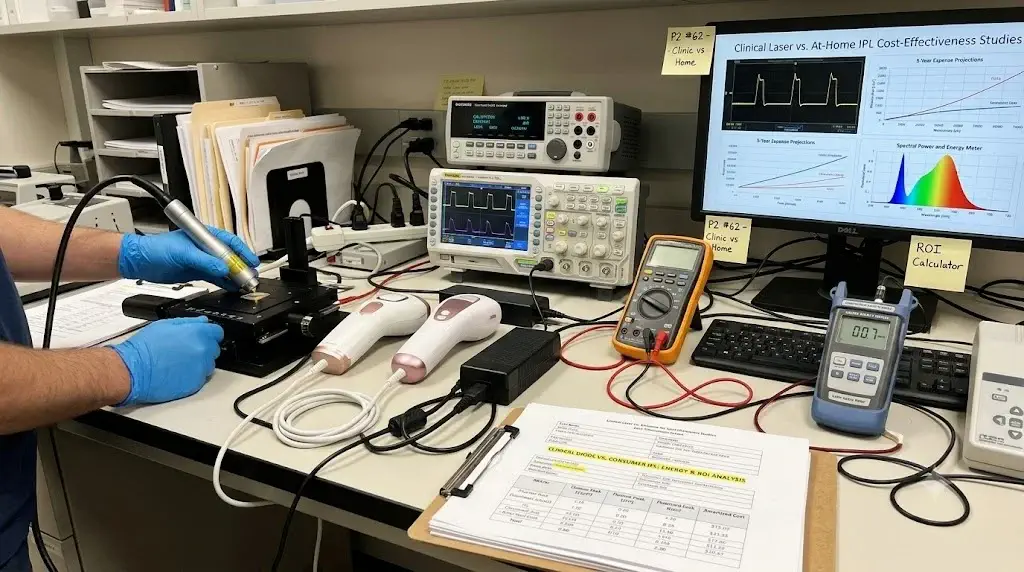
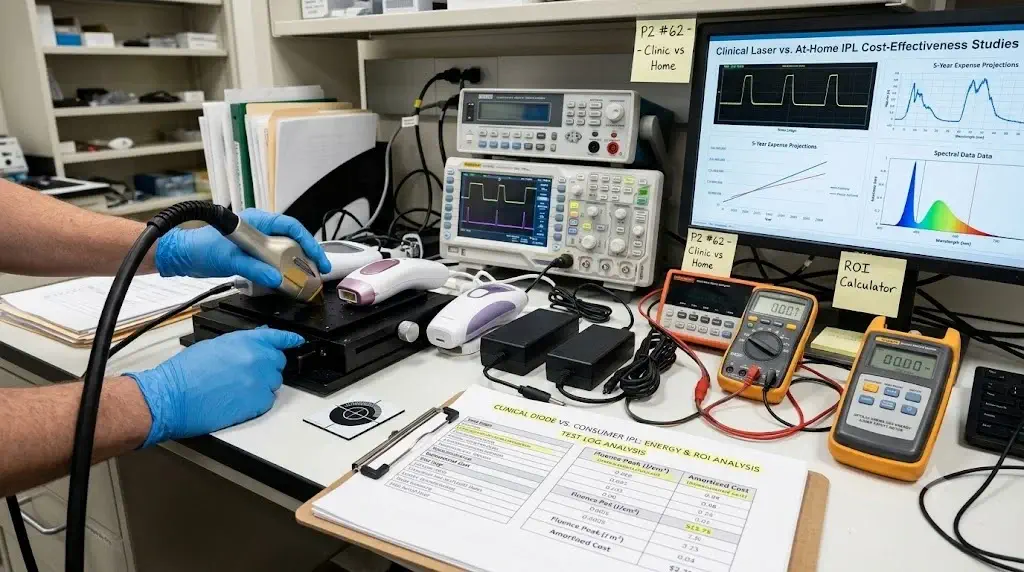 Figure 1: Benchmarking optical output of a clinical diode laser handpiece alongside consumer handheld IPL devices to calculate energy fluence and comparative ROI at Bare Home Clinic.
Professional clinic lasers deploy high-energy monochromatic light to destroy follicular stem cells permanently.
A clinical laser (typically diode, Nd:YAG, or Alexandrite) is an advanced medical device that emits single, highly focused wavelengths. This monochromatic light targets hair melanin with laser-sharp accuracy, enabling high-fluence energy to travel deep into the dermis without harming surrounding tissue. The target heat in the bulb reaches over 70°C, permanently destroying the stem cells and blood vessels feed the follicle.
By contrast, at-home IPL devices use broad-spectrum intense pulsed light that scatters as it enters the skin. While this diffuse energy still heats hair melanin, its power is capped at a much lower level (around 3 to 6.5 J/cm²), putting the hair follicle to sleep rather than destroying it completely. This means at-home IPL requires periodic touch-up sessions to maintain smooth results over the long term. To explore the exact laser wavelengths and physical differences between clinical systems and consumer IPL, review our visual guide on IPL vs Diode Laser vs Nd:YAG: Core Technologies Explained Simply
Professional treatments are highly effective, but they demand a substantial financial investment and travel time for office appointments scheduled weeks apart.
Physics and Biological Specifications Compared
At-home IPL devices reduce overall hair removal expenses by up to 92 percent over five years.
Calculating the 5-year cost of clinical treatments reveals the heavy financial weight of professional hair removal. Salon services typically charge by the area and the session: a single full-body visit averages $300 to $600, and a standard 8-session starter package can easily cost $2,400 to $4,800. After the initial course, annual touch-ups can add another $150 to $300, bringing the total expense over five years to over $5,000 for multiple areas.
By comparison, a top-tier at-home IPL device is a one-time purchase, with high-quality models ranging from $150 to $450. Since these devices offer 300,000 to 400,000 flashes, they provide enough pulse volume to cover over 15 years of full-body treatments with no recurring costs. The exact amount of energy each pulse delivers is critical for safe, effective hair reduction. To learn more about how to calculate energy output and optimize results, consult our guide on Energy Fluence Explained: Calculating Joules per Square Centimeter (J/cm²)
When compared to the thousands of dollars spent on salon packages, at-home IPL provides huge, immediate savings for anyone looking for budget-friendly hair removal.
| Time & Expense Period | Professional Clinic Laser | At-Home IPL Device | Savings Delta ($) |
|---|---|---|---|
| Initial Upfront Costs | $2,400 (Avg Multi-area Course) | $350 (Full Ownership) | $2,050 Saved |
| Year 1 Expense Summary | $2,400 (Induction Package) | $350 (Total Device Cost) | $2,050 Saved |
| Year 3 Accumulated Expenses | $2,800 (Plus Touch-ups & Tips) | $350 (No Extra Fees) | $2,450 Saved |
| Year 5 Amortized Totals | $3,200 (Multi-area Total) | $350 (Fully Paid For) | $2,850 Saved (89.1%) |
At-home IPL devices eliminate ongoing salon scheduling and transit times.
The Return on Investment of hair removal includes more than just money—it is also a question of time. Salon laser treatments require booking appointments weeks in advance, travelling to and from the clinic, sitting in waiting rooms, and taking time out of busy workdays or weekends. While clinical sessions are fast, the logistics of these appointments can be a hassle.
By contrast, at-home IPL allows you to treat your skin whenever and wherever is most convenient. Full-body sessions take about 30 to 45 minutes, and they easily fit into a regular evening or weekend routine. Once you complete the initial weekly induction phase, maintenance sessions only happen once every 4 to 8 weeks, helping you keep your results with minimal effort.
This freedom to manage treatments on your own schedule makes at-home devices incredibly convenient, and is a major reason so many buyers opt for home IPL over salon visits.
Consumer IPL handpieces reach full break-even valuation within three months of initial purchase.
To figure out the true Return on Investment of an at-home IPL machine, you can look at its break-even point against clinic costs. If a single salon treatment package for legs and underarms costs around $300, buying a $300 IPL device pays for itself on the very first day. Every full-body session you complete at home after that point is essentially free, instantly saving you hundreds of dollars.
Modern IPL devices utilize high-grade quartz bulbs that hold their energy without losing potency over hundreds of thousands of flashes. It is important to remember that advertised “unlimited flashes” on very cheap devices can be a misleading marketing claim, so choosing trusted, certified brands is essential for real value. For the facts on bulb lifespans and warranty protection, review our technical teardown on Are Unlimited Flashes Real? Reading Device Warranties and Bulb Lifespans
When comparing the durable life of a personal device against the ongoing costs of salon touch-ups, at-home IPL is easily the more cost-effective choice.
🛡️ 1. Absolute Financial Autonomy
At-home IPL allows you to treat multiple areas for a single upfront price, avoiding upsells, travel fees, and salon tips.
⏱️ 2. Direct Efficacy ROI
While professional laser works faster, IPL delivers similar long-term hair reduction at a small fraction of the price.
🛋️ 3. Lifelong Privacy & Access
Enjoying treatments in the comfort of your home is perfect for anyone seeking private, stress-free hair removal.
Consumer FAQ: Clinic Laser vs At-Home IPL Cost & ROI
Does professional clinic laser hair removal actually last forever?
Why is professional laser so expensive compared to at-home IPL?
Can at-home IPL damage my skin if I try to save money on clinic visits?
How long does it take for at-home IPL to equal the results of a clinic laser?
Is there any hair type that professional laser can treat but home IPL cannot?
