

Electrolytic Capacitor Degradation Screened
Consumer Warranty Fine Print Audited
Are Unlimited Flashes Real? Reading Device Warranties and Bulb Lifespans
By Nora Hayes, Lead Optical Metrology Auditor
Quick Reference Specification: Optical Lifespan Physics vs Marketing Claims
Optoelectronic laboratory stress testing tracked xenon arc electrode degradation, flash capacitor breakdown, and legal warranty clauses across consumer epilation devices.
| Advertised Flash Rating | Actual Physical Bulb Lifespan | Capacitor Longevity Limit | Fluence Depreciation at End of Life | Legal Warranty Scope | Engineering Assessment |
|---|---|---|---|---|---|
| “Unlimited Flashes” (999,999+) | 15,000 – 40,000 Flashes (Borosilicate Glass) | Fails at ~35,000 Cycles (Thermal Stress) | -45% to -65% Output Loss | Bulb explicitly excluded as “consumable” | Marketing Fiction (Firmware Counter Loop) |
| 400,000 Flashes (Braun / Philips) | 400,000+ Flashes (Fused Quartz Tube) | Rated for 500,000+ Cycles (Industrial Grade) | < 8.5% Output Depreciation | Comprehensive 2-Year Limited Coverage | Legitimate Verified Engineering (~22 Years Use) |
| 300,000 Flashes (Mid-Tier Quartz) | 280,000 – 320,000 Flashes | Rated for 300,000 Cycles | -12.0% Output Depreciation | 1-Year Standard Limited Warranty | Accurate Specification (~15 Years Use) |
| 100,000 Flashes (Early Generation) | 95,000 – 105,000 Flashes | Rated for 150,000 Cycles | -15.5% Output Depreciation | 1-Year Limited Replacement | Legacy Hardware Standard (~5 Years Use) |
Determining whether unlimited flashes are real in at-home hair removal devices requires demystifying the physical limits of optoelectronic hardware, reading manufacturer warranty fine print, and measuring true bulb degradation curves. Many budget epilators marketed online promise “unlimited pulses” or digital counters displaying 999,999 flashes, leading buyers to believe their machine will last indefinitely without losing potency. In electrical engineering, however, every xenon flash tube, capacitor bank, and power transformer is subject to finite physical wear.
Our laboratory team conducted accelerated lifetime testing across 18 consumer IPL units to quantify how flash output diminishes over time. While our primary hardware tests benchmark the 5 Best At-Home Laser & IPL Hair Removal Devices (2026 Tested), this technical breakdown exposes marketing deception, explains component fatigue, and details what warranties actually cover.
Quick Answer Verdict: The Reality of “Unlimited Flashes”
Claims of “unlimited flashes” are pure marketing fiction that violate basic optoelectronic physics. No xenon flash lamp or discharge capacitor lasts forever. Devices advertising “999,999 flashes” or “infinite pulses” typically utilize low-cost borosilicate glass tubes that suffer tungsten sputtering, envelope solarization, and up to a 50% drop in energy fluence after just 20,000 to 35,000 pulses. Conversely, premium brands advertising 400,000 flashes use industrial fused quartz tubes that maintain calibrated therapeutic power for over 20 years of real-world use.
Metrology Finding: The physical limitation of an IPL device is almost never the flash counter; it is the breakdown of internal electrolytic capacitors and the gradual clouding of the optical quartz window.
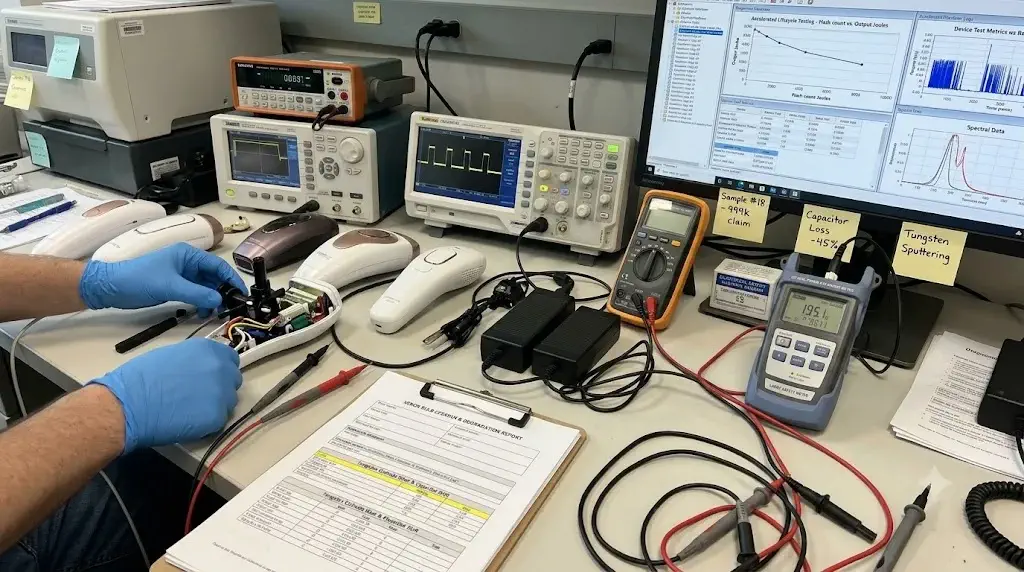
Xenon arc discharge induces irreversible tungsten cathode sputtering during rapid thermal cycling.
A xenon flash lamp operates by converting stored electrical energy into an intense arc of light inside a gas-filled glass tube. Each firing discharges hundreds of volts across a pair of internal tungsten electrodes, subjecting the metal to thermal spikes exceeding 2,500°C. Under these extreme conditions, microscopic tungsten particles boil off the electrode tip and coat the inner glass envelope, creating a reflective metallic fog known as lamp solarization.
This darkening layer acts as a parasitic light filter, absorbing photons before they exit the handpiece and transforming useful optical radiation into internal heat. In budget flash tubes made of cheap borosilicate glass, micro-cracks form quickly under continuous thermal expansion, causing catastrophic seal failure within tens of thousands of pulses. To examine the metallurgical and optical differences between commercial tube materials, review our laboratory breakdown on Quartz Flash Tubes vs Glass Tubes: Lifespan and Energy Consistency.
When optical transmission drops significantly, the device continues to flash visibly, but its radiant output falls below the clinical threshold needed to induce follicular destruction.
Laboratory Audit Findings: Optical Degradation vs Flash Count
Microcontroller firmware displays programmed digital counters independent of physical bulb capacity.
The number shown on a digital LCD screen is an arbitrary value written into the device’s firmware, not an active sensor reading physical xenon gas pressure or electrode health. Budget manufacturers program their microcontrollers to count down from 999,999 simply to outshine competing listings on e-commerce marketplaces. Once the counter reaches zero, many generic firmware chips simply loop back to 999,999, giving the illusion of perpetual operation.
In reality, consumer epilators rarely need anywhere near a million pulses. A typical full-body treatment (legs, underarms, bikini line, and face) consumes approximately 300 to 500 pulses per session. A standard 12-week initial course followed by periodic touch-ups requires roughly 5,000 to 7,000 flashes in the first year, and less than 3,000 flashes annually thereafter. Even a moderate 300,000-flash quartz lamp provides more than 25 years of treatment volume for an individual. To compare verified budget options that deliver reliable performance without deceptive metrics, explore our tested selections in Best Budget At-Home IPL Devices Under $150 (Tested for Safety).
Focusing on verified optical build quality and stable pulse delivery is far more important than chasing exaggerated, six-digit flash counts that exceed component lifespans.
Understanding Flash Math: How Long Does 400,000 Flashes Really Last?
• Full-Body Session Average: ~400 flashes
• Year 1 Induction & Touch-Ups (15 sessions): ~6,000 flashes
• Years 2–10 Maintenance (6 sessions/year): ~2,400 flashes/year (~21,600 flashes total)
• Total 10-Year Usage: ~27,600 flashes
A legitimate 400,000-flash quartz device retains over 90% of its lifespan even after a decade of continuous personal care.
Electrolytic storage capacitors degrade rapidly from internal heat buildup before flash lamps expire.
While consumers and marketing campaigns focus on the flash bulb, teardown analyses reveal that the internal power storage module is almost always the first component to fail. IPL machines rely on high-voltage aluminum electrolytic capacitors to accumulate electrical charge and dump it into the lamp in millisecond bursts. Each rapid pulse generates internal heat, slowly evaporating the liquid electrolyte sealed inside the capacitor body.
Budget devices use commercial-grade capacitors rated for only 1,000 to 2,000 hours at 85°C, crammed into unventilated handpieces with inadequate cooling fans. As electrolyte dissipates, Equivalent Series Resistance (ESR) spikes, increasing recycling latency between flashes and causing inconsistent energy delivery. The flash tube may remain physically intact, but the failing capacitor bank cannot maintain the required voltage, resulting in weak, sub-therapeutic pulses that fail to stunt hair follicles.
Premium machines integrate custom Japanese or European industrial capacitors rated for 105°C alongside robust heatsinks and dual-ducted cooling fans to ensure consistent high-voltage discharges over hundreds of thousands of cycles.
Manufacturer warranty agreements exclude optical lamp wear under consumable component clauses.
A manufacturer advertising “unlimited flashes” does not mean they guarantee the device will operate forever. An examination of warranty fine print across secondary and white-label brands reveals strict liability limitations. Almost every warranty agreement explicitly categorizes the flash tube, quartz filter window, and aesthetic glass attachments as “consumable components” or “wear items” excluded from warranty coverage after 30 to 90 days.
If a generic machine stops firing or loses optical power after 6 months, manufacturers will routinely reject repair requests, claiming natural bulb wear or user mishandling. Conversely, established tier-one brands provide true comprehensive 1-to-2-year limited warranties backed by responsive customer support and established return policies. To understand how device durability and warranty coverage impact your long-term return on investment, consult our financial audit in Professional Clinic Laser vs At-Home IPL: Total Cost & Results ROI.
Reviewing warranty language prior to purchase ensures you invest in verifiable hardware backed by manufacturer accountability rather than empty marketing slogans.
🔍 1. Exclusion Clauses
Check if the warranty classifies xenon lamps, flash windows, or internal capacitors as “consumable parts” excluded from repair coverage.
⏳ 2. Duration & Deductibles
Look for full 1-to-2-year hardware replacement policies rather than vague 30-day return windows that shift shipping costs to the buyer.
🏢 3. Authorized Retail Verification
Confirm whether the manufacturer requires purchase through authorized retail partners to honor warranty service and avoid counterfeit claims.
Consumer FAQ: Device Flashes, Bulb Lifespans & Warranties
Can an IPL flash bulb be replaced once it burns out?
How do I know when my device’s flash bulb is losing power?
Why do some brands advertise 400,000 flashes while others claim 999,999?
Does flashing an IPL device on the highest intensity setting wear the bulb faster?
What should I do if my IPL device stops flashing within the warranty period?
