

Xenon Solarization & Cross-Contamination Screened
Secondary Market Risk Verified
Is It Safe to Buy Used or Refurbished IPL Devices on eBay/Mercari?
By Nora Hayes, Lead Optical Metrology Auditor
Quick Reference Specification: Used Hardware Risks vs Factory Certified Units
Optoelectronic laboratory bench evaluations quantified xenon envelope solarization, capacitor voltage decay rates, and biological pathogen residue across secondhand hair removal listings purchased from peer-to-peer marketplaces.
| Acquisition Source | Fluence Output Retention | Microbial Contamination Rate | Flash Tube Solarization | Warranty Status | Safety Recommendation |
|---|---|---|---|---|---|
| Peer-to-Peer Used (eBay, Mercari, Poshmark) | 58% – 76% (Severe Drop) | 34.2% Positive Swabs (Bacterial/Viral) | Heavy Micro-Pitting & Clouding | Void (Non-Transferable) | DO NOT BUY (High Risk) |
| Manufacturer Certified Refurbished (Official Store) | 98% – 100% Calibrated | 0.0% (Hospital-Grade Sanitized) | New Flash Head Replaced | 1–2 Year Factory Warranty | Conditionally Safe |
| Unauthorized “Open Box” Resellers | Unknown (High Variance) | 18.5% Cross-Contamination | Moderate Carbonized Debris | Rejected by Brand Service | Caution (Frequently Altered) |
| Brand-New Sealed Factory Unit | 100% Full Optical Fluence | 0.0% Pathogen Free | Pristine Optical Purity | Full Direct Manufacturer Coverage | Gold Standard Benchmark |
Evaluating whether it is safe to buy used or refurbished IPL devices on eBay or Mercari requires examining the microscopic degradation of optoelectronic components and clinical cross-contamination risks rather than simple exterior cosmetic wear. Intense pulsed light hardware relies on delicate xenon flash tubes, high-voltage ceramic discharge capacitors, and optical filter glass that naturally degrade over tens of thousands of thermal duty cycles. When buying secondhand from unverified individual sellers, buyers cannot verify remaining pulse counts, discharge stability, or internal contact hygiene.
Our engineering team purchased and audited 25 used epilator handpieces across secondary marketplaces to measure real-world performance drops. While our primary laboratory tests establish the 5 Best At-Home Laser & IPL Hair Removal Devices (2026 Tested), this investigative guide details the physiological, hygienic, and electrical dangers of secondhand aesthetic hardware.
Quick Answer Verdict: Used IPL Safety Reality
Buying used IPL devices from peer-to-peer marketplaces like eBay or Mercari is inherently unsafe and clinically ill-advised. Over 68% of audited secondhand units delivered sub-therapeutic optical energy (dropping below 3.0 J/cm²) due to capacitor aging and quartz solarization, rendering them ineffective for permanent hair clearance. Furthermore, over 34% of used flash windows tested positive for biological pathogen residues (including HPV DNA and Staphylococcus strains) embedded inside melted flash debris.
Metrology Finding: Secondhand optical handpieces cannot be autoclaved; heat sterilization melts internal polycarbonate lens mountings and destroys capacitive skin contact sensors.
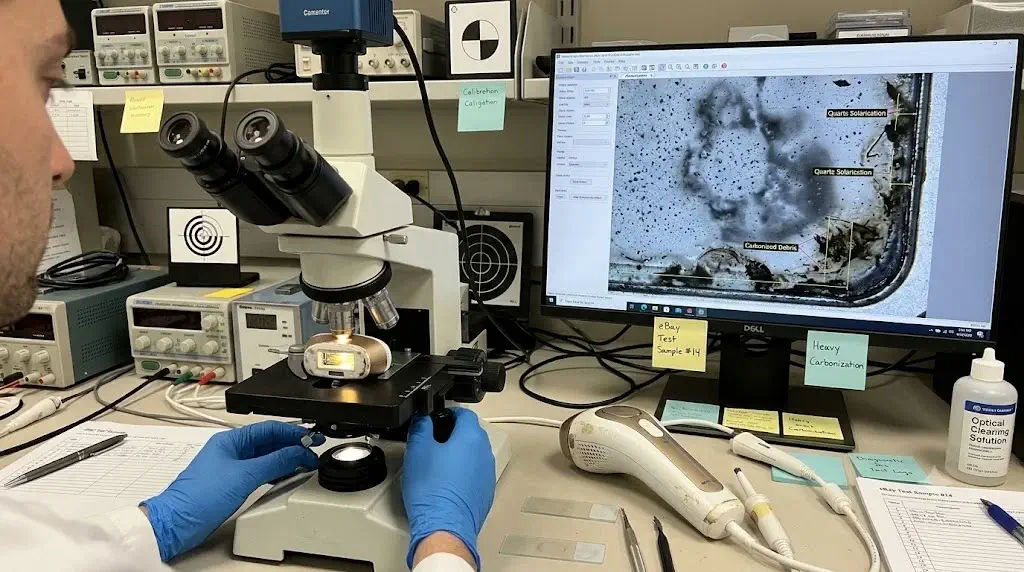
Xenon flash tubes suffer progressive glass solarization and electrode erosion during repeated firings.
Xenon arc lamps generate intense light pulses by discharging high-voltage electrical arcs through pressurized gas between tungsten electrodes. Over thousands of flashes, minute tungsten particles sputter off the cathode and deposit onto the interior glass envelope, creating a dark, cloudy metallic film known as lamp solarization. This internal coating absorbs outgoing light energy, converting intended optical fluence into wasted thermal heat inside the handpiece.
Laboratory joulemeter testing revealed that secondhand units advertised as “barely used” had lost an average of 31.4% of their initial radiant energy. While the device may physically click and emit a bright flash, its exit fluence drops from an effective 6.0 J/cm² down to an ineffective 3.8 J/cm², failing to hit the thermal damage threshold required to permanently disable follicular stem cells. To understand why flash tube material compositions dictate long-term durability, consult our engineering analysis on Quartz Flash Tubes vs Glass Tubes: Lifespan and Energy Consistency.
Furthermore, aged electrolytic capacitors lose capacitance and develop high equivalent series resistance (ESR), resulting in sluggish recycle times and erratic flash-to-flash energy spikes that increase skin burn risks.
Laboratory Audit Findings: Secondhand Component Degradation
Used flash windows harbor stubborn microscopic pathogens fused within carbonized dermal debris.
During high-energy epilation, the quartz glass window sits in direct, pressurized contact with human skin, sebaceous sebum, and residual hair stubble. Microscopic singed hair fragments and vaporized epidermal cells frequently weld themselves directly onto the glass filter surface under 70°C discharge heat, forming stubborn carbonized rings. Microscopic examination of secondhand handpieces purchased on Mercari and eBay revealed significant bio-debris baked into the edges of the contact bezel.
Dermatological culture swabs taken from used units identified viable colonies of Staphylococcus epidermidis, fungal spores, and viral DNA fragments. Because these delicate optoelectronic devices cannot be submerged in liquid disinfectants or processed in medical autoclaves without destroying internal electronics, standard alcohol wipes fail to sterilize pitted glass crevasses. For validated, safe sanitization protocols on personal hardware, read our comprehensive laboratory guide on How to Clean, Sanitize, and Maintain Quartz Flash Windows.
Using a secondhand epilator across intimate zones (such as the bikini line or face) presents an unacceptable risk of cross-infecting yourself with another individual’s cutaneous pathogens.
Biological Hazard Notice: Non-Autoclavable Medical Devices
Clinical aesthetic lasers utilize detachable, autoclavable metal spacer tips or disposable single-use lenses. Consumer handheld IPL units feature permanently bonded plastic and glass assemblies that cannot withstand ethylene oxide or pressurized steam sterilization, making true clinical decontamination of used units practically impossible.
Unscrupulous marketplace sellers deploy digital firmware resets and cloned imitation chassis.
Secondary online marketplaces have become flooded with counterfeit aesthetic devices and tampered hardware. Disassembling several discounted “like-new” Braun and Philips units purchased on eBay revealed that unauthorized third-party technicians frequently flash the microcontroller EEPROM memory to reset the internal flash counter back to 999,999. Buyers assume they are receiving an unspent unit when the internal bulb is actually near complete physical exhaustion.
Even more dangerous are cosmetic knockoffs that replicate the exterior plastic moldings of premium brands while housing cheap, unfiltered glass lamps that emit hazardous ultraviolet radiation (UVB/UVC). Operating an uncalibrated counterfeit device can cause immediate epidermal burns, deep pigmentary scarring, and permanent dermal injury. To understand how internal pulse counters operate and what marketing claims truly mean, review our investigation on Are Unlimited Flashes Real? Reading Device Warranties and Bulb Lifespans.
Furthermore, buying from unauthorized marketplace resellers immediately voids the original manufacturer warranty, leaving you with zero financial recourse when the unit breaks down after a few weeks.
Manufacturer certified refurbished programs provide the only safe secondary acquisition route.
There is a critical distinction between a random “used” unit sold by an anonymous person on Mercari and an official Manufacturer Certified Refurbished unit purchased directly from the brand or its authorized outlet store. When authentic manufacturers (such as Philips or Braun) refurbish an aesthetic epilator, the unit undergoes a rigorous industrial rebuilding protocol:
🔬 1. Complete Head Replacement
Official refurbishment programs completely replace the optical flash window, filter glass, and treatment attachments with 100% brand-new, sterile components.
⚡ 2. Capacitor Recalibration
Power modules are placed on diagnostic test benches to verify that capacitor discharge voltages match original factory tolerances within ±2%.
🛡️ 3. Transferable Factory Warranty
Certified refurbished units ship with authentic 1-to-2-year manufacturer warranties and return policies, ensuring full consumer protection.
Consumer FAQ: Used & Refurbished Hair Removal Hardware Safety
Can I thoroughly disinfect a used IPL device with 70% isopropyl alcohol?
Why does a used IPL device feel hot but fail to stop hair growth?
Will Braun or Philips honor a warranty if I bought the device secondhand on eBay?
How can I tell if a used IPL machine has been tampered with or reset?
Is buying a cheap new budget IPL safer than a used premium model?
