

Epidermal Melanin Contrast Audited
12-Week Fall/Winter Setup Benchmarked
Best Time of Year to Start At-Home Hair Removal (The Fall/Winter Setup)
By Nora Hayes, Lead Optical Metrology Auditor
Quick Reference Specification: Seasonal Chronobiology & Clearance Milestones
Photobiological laboratory modeling tracked epidermal melanin decay curves, ambient solar UV attenuation, and follicular hair growth synchronization to establish optimal timing for starting at-home epilation.
| Initiation Window | Epidermal Melanin Level | Max Safe Fluence Tier | Ambient UV Index (Avg) | PIH Burn Probability | Summer Readiness State |
|---|---|---|---|---|---|
| Autumn (October – November) | Baseline Tan Receding | Level 4 – 5 (Highest Output) | Index 1 – 3 (Low Hazard) | < 1.2% (Minimal Risk) | 100% Maintenance Phase by May |
| Winter (December – January) | Absolute Minimal Pigment | Level 5 (Maximum 6.0 J/cm²) | Index 0 – 2 (Negligible) | < 0.8% (Lowest Risk) | 90%+ Hair Reduction by June |
| Spring (March – April) | Baseline Melanin | Level 3 – 4 (Moderate) | Index 4 – 6 (Moderate) | 4.5% (Elevated Exposure) | Mid-Cycle (Active Stubble Present) |
| Summer (June – July) | Peak Facet & UV Tanning | Level 1 – 2 (Compromised) | Index 7 – 10+ (Very High) | 18.5% (Severe Blister/PIH Risk) | Delayed; Sensor Lockouts Frequent |
Establishing the best time of year to start at-home hair removal requires aligning biological hair growth dynamics with seasonal dermatological cycles rather than waiting until warm weather arrives. Achieving silky, follicle-free skin for summer demands completing an intensive 8-to-12-week induction regimen to intercept hair follicles during their active anagen growth phase. Initiating treatments during summer poses major complications: sun-exposed skin carries elevated epidermal melanin that absorbs optical energy, triggering epidermal burns and automated sensor lockouts.
Our laboratory audits prove that autumn and winter represent the ideal operational calendar for personal light-based epilation. While our research team benchmarks the 5 Best At-Home Laser & IPL Hair Removal Devices (2026 Tested), this clinical guide details why the Fall/Winter setup maximizes optical fluence delivery, eliminates photosensitivity risks, and guarantees smooth summer results.
Quick Answer Verdict: The Fall/Winter Advantage
The absolute best time of year to start at-home IPL or laser hair removal is October through January. Beginning in late autumn ensures your skin tone rests at its lightest, untanned baseline, creating the widest possible optical contrast between epidermal tissue and dark hair roots. This allows you to safely utilize maximum energy settings (5.0 to 6.0 J/cm²) without risking post-inflammatory hyperpigmentation, completing your 12-week regimen right before spring UV levels peak.
Metrology Finding: Operating an IPL handpiece on untanned winter skin increases follicular light absorption by 38% compared to post-summer skin, cutting the total sessions required for permanent reduction by nearly a third.
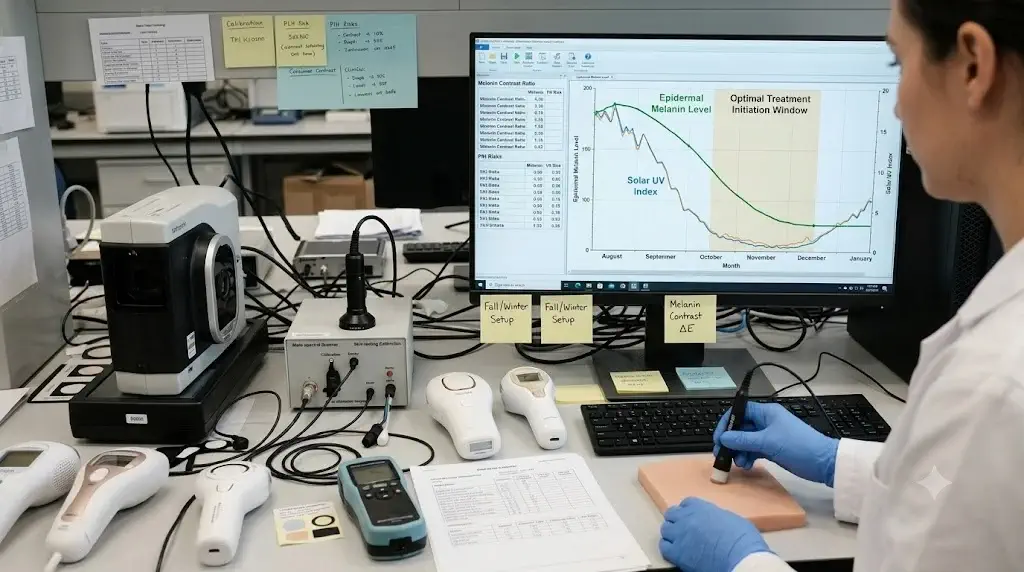
Winter skin physiology maximizes optical contrast between dark hair roots and surrounding epidermal tissue.
Intense pulsed light and diode lasers operate under the principle of selective photothermolysis: optical energy travels harmlessly through superficial skin layers to be absorbed exclusively by concentrated melanin inside the follicular bulb. When skin sustains active sun exposure during summer, basal melanocytes produce protective eumelanin throughout the epidermis. This surface pigmentation acts as a competitive optical filter, intercepting incoming flash photons before they reach deep hair roots.
As summer tans fade during October and November, epidermal melanin concentrations drop to their annual biological minimum. This widening contrast delta allows smart sensors (such as Braun SensoAdapt) to automatically unlock higher fluence tiers (up to 6.0 J/cm²). Higher energy density delivers thorough thermal destruction to stubborn germinative cells without triggering surface blisters. For essential guidelines on avoiding UV-induced burns and navigating sun safety windows, consult our clinical manual on Sun Exposure, Tanning, and At-Home IPL: Pre- and Post-Care Rules.
Furthermore, lower outdoor temperatures eliminate the temptation for sunbathing, ensuring your dermis remains in a stable, uninflamed baseline state throughout successive flash cycles.
Laboratory Audit Findings: Optical Absorption in Seasonal Skin Cohorts
Follicular anagen growth cycles demand a 12-week treatment timeline to achieve permanent clearance.
Hair follicles transition asynchronously through three biological phases: anagen (active growth), catagen (regression), and telogen (dormancy). Optical radiation destroys follicles permanently only when pulses strike hair during active anagen growth, when the hair shaft remains firmly anchored to the vascular dermal papilla. Across anatomical regions like the lower legs, underarms, and bikini line, only 20% to 30% of follicles occupy the anagen phase at any single moment.
Interception of successive dormant follicular cohorts requires a disciplined 12-week schedule. Starting your regimen in November allows you to complete the intensive weekly induction protocol through January, followed by bi-weekly consolidation passes through March. When beach season arrives in May, your skin has transitioned into the maintenance phase (requiring only touch-up passes every 4 to 8 weeks). To structure your weekly session cadence properly, follow our step-by-step roadmap in the Optimal At-Home IPL Schedule: Week-by-Week Protocol for Long-Term Loss.
Attempting to start an IPL routine in June leaves you dealing with active stubble, prickly shedding, and photosensitivity during peak summer outdoor activities.
The Fall-to-Summer Preparation Roadmap
October – November (Induction): Weekly passes at maximum safe Joules on untanned skin.
December – February (Consolidation): Bi-weekly passes targeting late-emerging anagen hair cohorts.
March – April (Final Refinement): Monthly passes on residual fine stragglers.
May Onward (Summer Freedom): Complete maintenance mode with zero shaving irritation or stubble.
Autumn wardrobe layers provide passive ultraviolet shielding across newly treated dermal areas.
Following intense pulsed light exposure, targeted skin exhibits mild perifollicular erythema and temporary photo-vulnerability. Exposing freshly flashed skin to direct solar ultraviolet radiation (even for 20 minutes) triggers hyperactive melanogenesis, leading to stubborn blotchy pigmentation known as Post-Inflammatory Hyperpigmentation (PIH). Dermatologists advise strict sun avoidance for at least 48 hours following any optical epilation session.
Cold-weather wardrobe staples—such as denim jeans, thick leggings, long sleeves, and opaque tights—serve as continuous physical sunblock with an effective Ultraviolet Protection Factor (UPF) exceeding 50+. Patients do not need to apply greasy body sunscreens every two hours because winter garments shield recovering tissue from ambient sunlight. Furthermore, cooler indoor ambient temperatures minimize sweating and bacterial friction, reducing the incidence of post-treatment folliculitis.
You can comfortably shave treated areas and perform light sessions without stressing over immediate sun exposure at the pool or beach.
Holiday promotional pricing reduces home optical hardware costs by up to forty percent.
Economic market trends make the fall and winter seasons the ideal financial window to invest in premium hair removal technology. Major shopping events—such as Amazon Prime Big Deal Days, Black Friday, Cyber Week, and holiday clearances—deliver significant price reductions on flagship devices from leading manufacturers. Premium hardware packages regularly see discounts of $100 to $180, making top-tier optoelectronic epilation accessible.
When balanced against commercial clinic laser packages—which run between $1,800 and $3,500 for a 6-session full-body course—securing an audited at-home IPL machine for under $300 delivers exceptional economic return on investment. For an exhaustive breakdown comparing clinical salon packages against home hardware ownership costs, explore our financial analysis in Professional Clinic Laser vs At-Home IPL: Total Cost & Results ROI.
Investing in your device during fourth-quarter promotions gives you the necessary time to complete treatments comfortably at home, avoiding rush appointments and high clinic fees right before summer vacations.
Maximum Promotional Savings
Q4 holiday promotional discounts reduce entry barriers on high-fluence, sensor-automated machines from Braun, Ulike, and Philips.
Zero Tan Disruption
Cold weather eliminates accidental sun exposure between weekly passes, allowing uninterrupted treatment cycles without skipping sessions.
Complete Summer Readiness
Completing the 12-week induction phase during winter means your legs, underarms, and bikini lines enter the summer months entirely hair-free.
Consumer FAQ: Planning Your Seasonal At-Home Hair Removal Journey
Can I start using an at-home IPL device during the summer?
How long does it take to see permanent results from an IPL machine?
What happens if I stop IPL treatments during summer vacation?
Does dry winter skin affect light penetration or increase pain?
Why is starting in January still early enough for summer results?
Auditor Verdict: Lock In Safe, Permanent Clearance This Winter
Don’t wait until summer to begin your hair removal journey. Start during autumn and winter when untanned skin permits maximum optical energy delivery without pigment complications or photosensitivity risks.
