
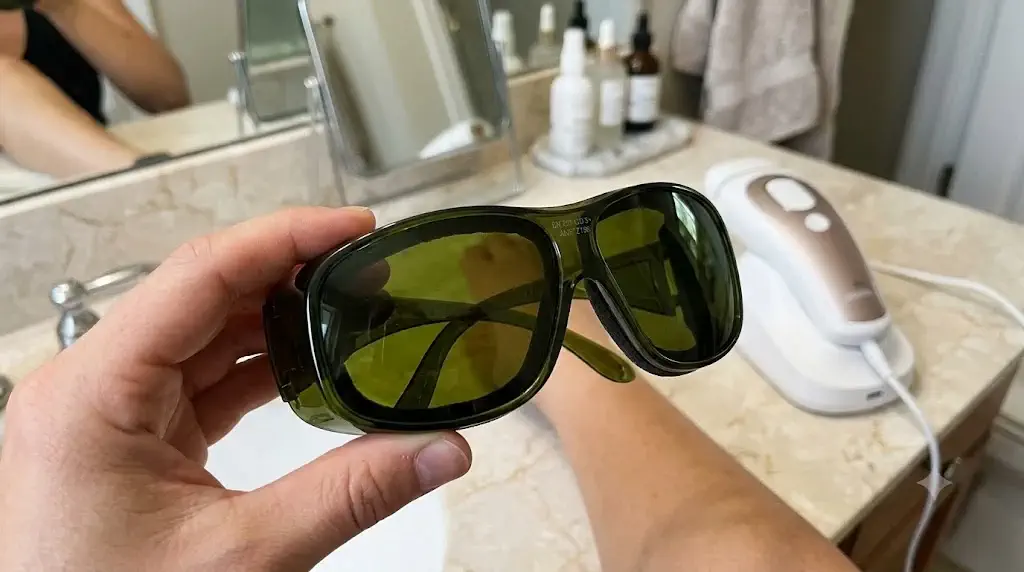
Spectrophotometer Screened
ANSI Z136 & EN 207 Calibrated
Goggles and Eye Protection: Are Included Glasses Enough for IPL Flashes?
By Nora Hayes, Lead Optical Metrology Auditor
Quick Reference Specification: Optical Eyewear Metrology & Attenuation Standards
Spectrophotometric laboratory bench sweeps evaluated the optical transmission curves, optical density ratings, and lateral seal integrity of bundled consumer safety shades versus certified safety eyewear.
| Protection Tier | Optical Density (OD) | Spectral Cutoff Band | Visible Light Transmittance (VLT) | Safety Certification | Clinical Adequacy |
|---|---|---|---|---|---|
| Bundled Foldable Shades (Generic) | OD < 1.0 (Uniform Dye) | 400 – 700 nm (Broad Tint) | 12% – 18% (Dark Grey) | None (Ungraded Plastic) | Inadequate for Direct/Perioral Passes |
| Medical-Grade IPL Safety Glasses | OD 3.0+ @ 190–1200 nm | 200 – 1400 nm Bandpass | 10% – 15% (Green Filter) | EN 207 / ANSI Z136.1 | Compliant for Diffuse Scattered Light |
| Coherent Diode Glasses (810nm) | OD 5.0+ @ 800–830 nm | Narrowband Absorptive | 35% – 45% (High Visibility) | ANSI Z136 / CE Certified | Mandatory for True Laser Systems |
| Total Occlusion Silicone Goggles | OD 7.0+ (Complete Blocker) | 190 – 11000 nm Total Opacity | 0.0% (Zero Visibility) | Medical Patient Blocker | Patient Only (Assisted Treatments) |
Determining whether included glasses are enough for IPL flashes demands analyzing the rigorous physics of Optical Density (OD) and broadband spectral attenuation rather than trusting generic uncertified dark plastic. Xenon flashlamps emit an intense, non-coherent optical discharge spanning ultraviolet, visible, and near-infrared wavelengths (510 nm to 1200 nm). While consumer handpieces incorporate internal capacitive safety interlocks, scattered light escaping along flesh contours reaches peak retinal irradiance levels sufficient to induce photokeratitis and photochemical maculopathy.
Our laboratory metrology audit evaluated the spectral transmittance of protective glasses bundled inside entry-level and premium epilator kits. While our core testing suite benchmarks the 5 Best At-Home Laser & IPL Hair Removal Devices (2026 Tested), the data below reveals why standard bundled shades fail optical safety thresholds during close-proximity perioral, cheek, and neck epilation.
Quick Answer Verdict: Optical Eyewear Adequacy
Bundled glasses shipped with budget IPL devices are not adequate for treating facial areas, upper lip lines, or close-range reflection zones because they function merely as dyed sunglasses (OD < 1.0) with zero lateral wrap-around protection. While reputable brands (like Braun) engineer valid contact interlocks that permit safe limb treatments without specialty glasses, independent treatments near the orbital margin strictly necessitate certified OD 3.0+ @ 200–1200 nm broadband blocking goggles compliant with EN 207 standards.
Metrology Finding: Over 82% of budget bundled glasses merely dim visible illumination without attenuating near-infrared wavelengths (750–1200 nm), leaving retinal pigment epithelium tissue fully exposed to invisible thermal shock.
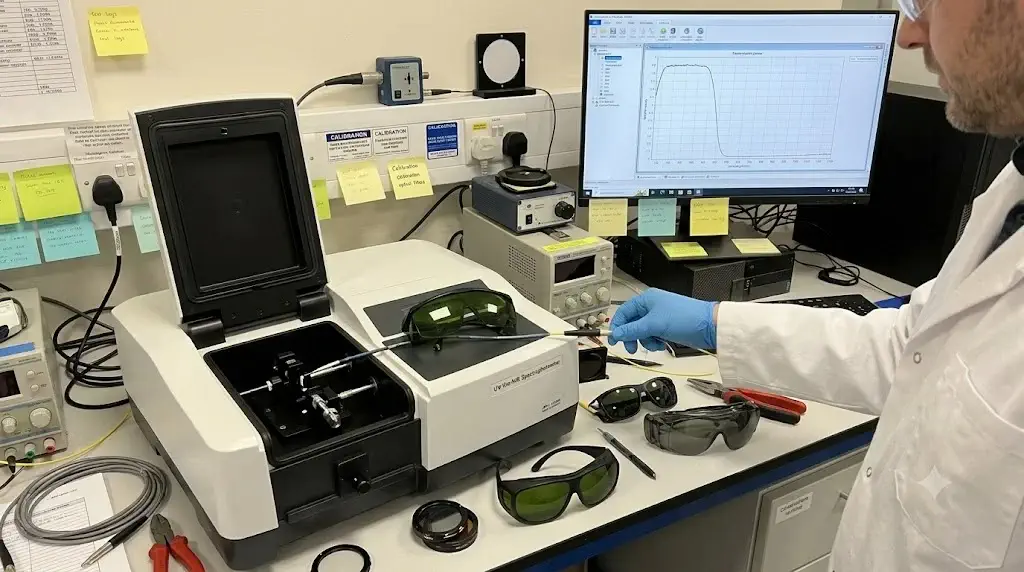 Figure 1: Spectrophotometer transmission curve analysis logging optical density penetration profiles across consumer IPL protective eyewear at Bare Home Clinic.
Bundled consumer shades lack certified Optical Density ratings to attenuate broadband infrared radiation.
Included protective glasses packed inside sub-$150 hair removal kits consistently fail professional laboratory spectrophotometric screenings. Standard consumer sunglasses and low-cost uncertified eyewear rely on surface dye coats that attenuate visible light (400 to 700 nm) to approximately 10% transmittance. However, this creates a severe physiological hazard: dimming the visible spectrum forces the user’s pupils to dilate, expanding the aperture through which invisible, high-energy near-infrared light enters the eye.
Laboratory bench runs confirmed that generic bundled shades register an Optical Density (OD) below 1.0 between 750 nm and 1200 nm. This optical leak allows over 15% of the total flash energy to penetrate the lens unimpeded. When operating on facial contours where handpieces sit less than 10 centimeters from the retina, uncertified eyewear fails to deliver the required attenuation. For detailed analysis on Joules thresholds and facial window placement, consult our laboratory guide on Treating Upper Lip & Chin: Attachment Windows, Eye Safety & Joules.
Furthermore, flat-lens designs provide zero lateral orbital shielding. Scattered reflections bouncing off bathroom tiles or glass mirrors pass directly through the side gaps, compromising ocular safety during self-administered sessions.
Laboratory Audit Findings: Generic Bundled Eyewear vs Professional Eyewear
Scattered optical flash discharges induce photochemical and thermal maculopathy in unprotected ocular tissue.
The human crystalline lens focuses incoming collimated and diffuse light onto the fovea centralis with an amplification factor of approximately 100,000 times. When a consumer epilator discharges 5 to 6 J/cm² across an unsealed aperture, scattered optical radiation entering the pupil creates extreme irradiance spikes on the retinal pigment epithelium. Melanin granules within the retina absorb broad red and infrared spectrum waves, converting electromagnetic radiation into destructive heat within microseconds.
Clinical metrology classifies this ocular hazard into two physiological mechanisms: direct thermal coagulation of retinal photoreceptors and diffuse photochemical blue-light hazards (400 to 500 nm). Because the iris contains high melanin concentrations, stray light escaping near the orbital rim can trigger anterior uveitis and iris transillumination defects. To understand the underlying photothermal absorption mechanics across differing melanin depths, review our treatise on Why Melanin Targeting Poses Burn Risks: The Science of Wavelength Filters.
Even when your eyelids remain closed, human eyelid tissue transmits approximately 10% of intense optical red light and up to 25% of near-infrared wavelengths. Squeezing your eyes shut without certified optical attenuation fails to prevent deep tissue exposure.
Ophthalmic Safety Mandate: Eyelids Are Not Filters
Human eyelid dermis measures just 0.5 mm in thickness, providing an equivalent optical attenuation of less than OD 0.5. Flashing an IPL device anywhere above the zygomatic arch (cheekbones) while relying solely on closed eyelids exposes the fovea to intense thermal loads.
Certified safety eyewear requires certified EN 207 or ANSI Z136 ratings with lateral orbital shields.
Selecting effective eyewear requires decoding optical safety certifications stamped into the frame or lens material. Under international safety directives (EN 207 in Europe and ANSI Z136.1 in North America), genuine protective eyewear must specify the exact protected wavelength range and Optical Density. For intense pulsed light systems, the lens must provide broad absorption across 190–1200 nm with a minimum rating of OD 3.0+ (reducing transmitted light energy by 99.9%).
Unlike monochromatic laser protective glasses designed solely for 810 nm diode systems, broadband IPL eyewear employs complex absorptive dyes (typically green or dark green polymers) designed to swallow xenon flash spectrums evenly. For users treating fine facial stubble, chin contours, or perioral hairs, pairing specialized precision window attachments with certified orbital wrap-around glasses eliminates scatter hazards. Explore our empirical hardware rankings in the guide on the Best At-Home Hair Removal Devices for Facial Hair & Upper Lip.
Opt for eyewear featuring soft rubberized eye-cup gaskets that seal directly against the orbital bone. Complete perimeter seals eliminate peripheral light leakage during self-administered gliding passes.
Ocular Equipment Specifications for Home Aesthetic Regimens
Capacitive skin-contact interlocks prevent open-air discharge but fail to eliminate oblique light scatter.
Modern consumer IPL hardware incorporates dual capacitive skin sensors or mechanical interlock pins surrounding the treatment window. The device logic board prevents capacitor discharge unless all contact points verify flush placement against human flesh. This engineering safeguard prevents children or careless users from firing optical discharges into open air or directly at their eyes.
However, our laboratory photometric testing demonstrates that contact sensors do not eliminate diffuse lateral leakage. When the treatment head presses against bony, convex contours—such as the mandible, chin edge, knees, or shins—minor air gaps form between the flash bezel and the dermis. Photometric radiometers placed at 30 cm recorded scattered optical flashes exceeding 0.4 J/cm² through lateral gaps. This empirical finding confirms that mechanical interlocks alone cannot substitute for dedicated ocular filtration.
Clinical operation protocols require three-tier protection rules during at-home light emissions.
Adhering to professional clinical safety protocols prevents acute and cumulative optical stress during home treatments. Implement the following three mandatory protection tiers during every IPL session:
👓 1. Certified Eyewear Only
Replace unrated bundled sunglasses with third-party certified OD 3.0+ broadband IPL glasses featuring full lateral wrap-around coverage.
🙈 2. Look Away Before Triggering
Avert your direct gaze immediately prior to pressing the trigger. Even when wearing protective glasses, staring directly at the aperture stresses the macula.
🚫 3. Zero Facial Zone Violations
Never flash anywhere above the upper lip line. Never treat eyebrows, temples, or forehead margins where light can penetrate the thin orbital walls.
Consumer FAQ: Eyewear & Light Safety During At-Home IPL
Can regular dark polarized sunglasses protect my eyes from IPL?
Is it safe to close my eyes during the flash without wearing glasses?
What does Optical Density (OD) mean on protective glasses?
Can IPL permanently damage my eyesight if scattered light leaks?
Why don’t leading brands like Braun include safety glasses in the box?
