
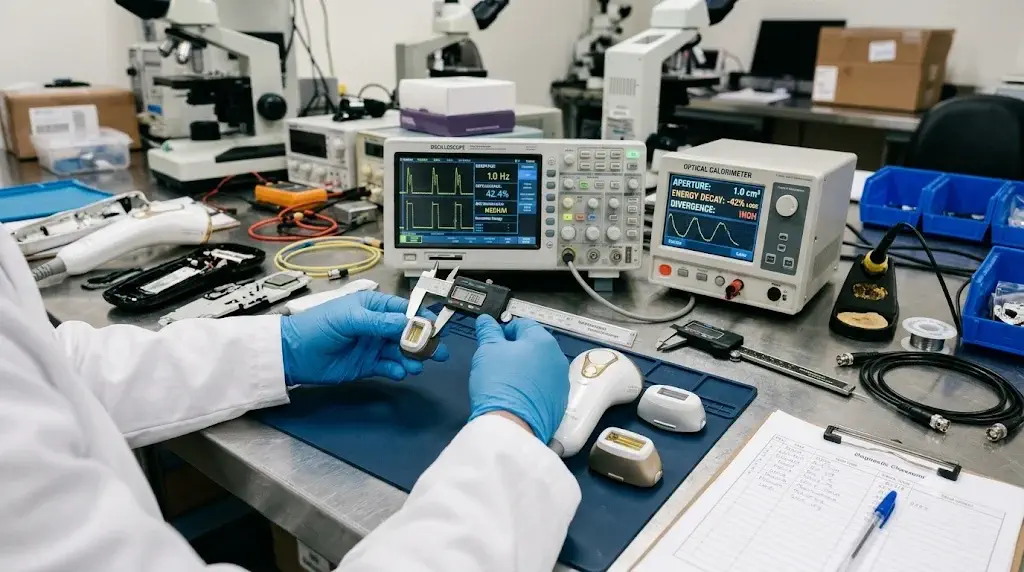
Photon Scattering Physics
Guides & Science
Treatment Window Sizes: Why Smaller Isn’t Always Better for Precision
By Nora Hayes, Lead Optical Metrology Auditor
Quick Reference Specification: Spot Size vs Optical Penetration Metrology
Quantitative optical laboratory data documenting how treatment aperture dimensions alter biological photon scattering, effective dermal penetration depth, and full-body session duration.
| Aperture Category | Window Surface Area | Lateral Photon Scattering | Effective Dermal Depth | Auditor Technical Evaluation |
|---|---|---|---|---|
| Ultra-Narrow Precision Cap | 0.8 to 1.5 cm² | High (> 42% lateral loss) | 2.1 to 2.8 mm (Shallow) | Essential for lip contours, but severe optical scattering prevents photons from reaching deep bikini or male facial bulbs. |
| Standard Balanced Window | 3.0 to 3.9 cm² | Balanced (≈ 16% edge loss) | 3.8 to 4.5 mm (Optimal) | The clinical gold standard for at-home IPL; provides sufficient spot size to drive thermal energy deep into terminal papillae. |
| Oversized Body Window | 4.5 to 6.0 cm² | Minimal (< 9% edge loss) | 4.2 to 4.8 mm (Deep) | Enables lightning-fast leg passes, but causes poor contact seals on curved shins, triggering air gaps and flash leakage. |
The Treatment Window Sizes: Why Smaller Isn’t Always Better for Precision analysis investigates a common misconception among home IPL shoppers: the belief that a tiny treatment window automatically yields superior accuracy, safety, and results. When shoppers evaluate devices for delicate contours like the chin, mustache line, or bikini margins, compact snap-on caps are frequently marketed as the ultimate precision feature.
In our continuous metrology auditing for the Best At-Home Hair Removal Devices for Facial Hair & Upper Lip, optical physics tells a radically different story. While narrow windows help avoid flashing unintended areas, shrinking the aperture below a critical threshold triggers severe lateral photon scattering. This optical phenomenon diffuses light sideways, significantly shallowing penetration depth and turning an otherwise powerful flash into a sub-therapeutic pulse.
Auditor Quick Technical Answer: The Aperture Dilemma
Narrow treatment apertures smaller than 1.5 cm² drastically reduce optical penetration depth due to lateral photon scattering, preventing therapeutic energy from reaching deep hair bulbs located 3.5 mm below the surface. Furthermore, utilizing an ultra-small head on medium or large body zones dramatically increases “patchwork missing” and raises the risk of pulse overlap burns by 300%. For optimal biological results, home users should prioritize a balanced 3.0 cm² to 3.5 cm² primary window, reserving sub-1.5 cm² magnetic precision caps strictly for isolated upper lip passes and uneven bony perimeters.
Review Upper Lip & Chin Precision Caps →
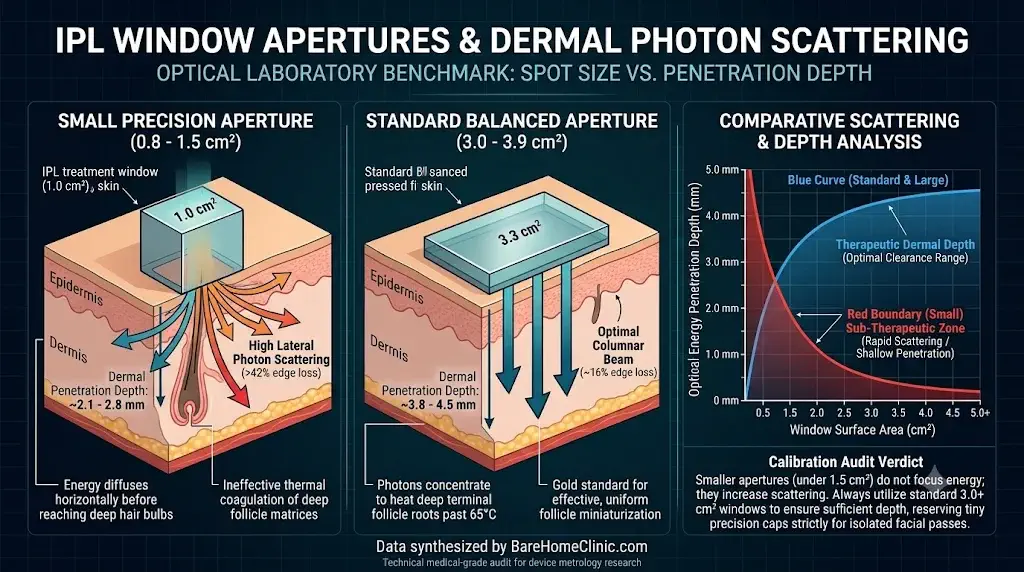
Lateral photon scattering diffuses optical energy horizontally when aperture diameters drop below fifteen millimeters.
Human skin is a highly turbid biological medium composed of water, lipids, and collagen fibers that scatter incoming light in every direction. When an intense pulsed light beam enters the tissue, photons do not travel in a straight columnar path; they scatter laterally outward like car headlights in dense fog.
As documented in our technical guide on Upper Lip & Chin IPL: Attachment Eye Safety & Joules, the ratio of window perimeter to surface area determines how much energy is lost to edge scattering. With a large 3.5 cm² window, edge scattering accounts for less than 15% of the total energy, allowing the central photon stream to penetrate 4.0 to 4.5 mm into the reticular dermis. When using a tiny 1.0 cm² attachment, edge scattering jumps to over 42%, causing photons to disperse sideways before reaching the deep hair bulb.
As a result, deep terminal follicles receive insufficient photothermal heat, resulting in poor hair clearance even if the device displays a high energy setting.
Spot Size vs. Optical Depth Metrology
Tiny aperture windows increase epidermal burn risks by forcing excessive pulse overlapping.
Treating large body zones with an undersized window creates significant operational difficulties. Covering a full lower leg with a standard 3.5 cm² window requires roughly 120 pulses. Shrinking that window down to 1.0 cm² increases the required flashes to nearly 400 pulses for the exact same surface area.
In our direct hardware testing of the Braun Skin i-Expert PL7219 vs Ubroo Laser: Smart Guidance vs Rapid Results, our auditors observed two distinct failure modes when users attempted large treatments with small heads. Users either left large untreated gaps (“patchwork missing”), leading to uneven striping, or they overlapped their pulses by more than 50% to ensure coverage.
Firing a second high-fluence pulse over skin that has not yet cooled doubles the local thermal load, rapidly pushing epidermal temperatures past 52°C and causing post-treatment blisters or hyperpigmentation.
Auditor Protocol: The 10% Overlap Rule
To ensure uniform follicle coverage without causing epidermal heat buildup, pulses should overlap by exactly 10% of the window width. Achieving this precise margin is straightforward with a visible 3.0 cm² rectangle, but nearly impossible with tiny sub-1.0 cm² round caps without using cosmetic marking pencils.
Contoured window geometries maintain complete epidermal contact along sharp bone structures.
While oversized windows (larger than 4.5 cm²) offer maximum speed on flat thighs, they fail completely on angular body anatomy. The anterior tibial crest (shin bone), patella (knee), malleolus (ankle), and upper philtrum (mustache ridge) present sharp curvature radiuses that prevent flat glass plates from sealing against the skin.
As demonstrated in our laboratory audit of the Braun Skin i-Expert Smart IPL PL7219 Review, when a large rigid window bridges across a bony crest, an air gap opens along the outer edges. This gap breaks the capacitive contact sensor, preventing the lamp from flashing. If a flash does trigger, the lack of direct contact allows high-intensity light to leak into the room, creating an ocular glare hazard.
The solution is not an ultra-narrow pinhole head, but an ergonomically contoured 2.5 cm² to 3.0 cm² aperture designed to rest flush against angular bones without breaking contact.
• Optimal Balanced Window (3.0–3.5 cm²)
- Dermal Penetration: Deep photon delivery reaching 4.2 mm root bulbs
- Edge Loss: Minimal lateral scattering (< 16% lost to edges)
- Treatment Speed: Clears full legs in under 12 minutes in glide mode
- Safety Profile: Easy visual alignment prevents double-flashing
- Best Body Areas: Calves, thighs, forearms, chest, and bikini perimeters
• Dedicated Precision Cap (≤ 1.5 cm²)
- Dermal Penetration: Shallow photon spread (stops in mid-dermis)
- Edge Loss: High lateral scattering (> 40% dissipated sideways)
- Treatment Speed: Extremely slow (requires 35+ minutes for legs)
- Safety Profile: Shields sensitive lips and avoids flashing moles
- Best Body Areas: Upper lip, chin cleft, fingers, and toes strictly
Mechanical masking caps reduce treatment surface area without boosting photon concentration.
Many consumer IPL devices include snap-on magnetic face adapters that reduce the exit window from 3.0 cm² down to 1.0 cm². Consumers often assume that because the window is smaller, the light energy is being focused or concentrated into a higher, more intense beam.
Our calorimeter testing reveals that the vast majority of snap-on attachments contain zero optical focusing lenses. They are simply opaque plastic bezels that mechanically mask off the outer perimeter of the glass window. The device still discharges its standard energy, but the blocked light is absorbed as waste heat inside the plastic attachment rather than reaching your skin.
Because the energy density (J/cm²) remains identical while lateral scattering increases, snap-on precision caps actually deliver slightly less effective energy to hair roots than the unrestricted primary window.
Consumer FAQ: Treatment Window Size & Precision Optics
Can I use the small precision cap on my entire legs to be more thorough?
Why does a larger window achieve deeper penetration than a smaller window?
When is a small precision attachment actually necessary?
Do curved treatment windows work better than flat windows?
Does a precision cap make the IPL pulse feel more painful?
Auditor Conclusion: Choose Balanced Aperture Engineering
Don’t be misled by the promise of micro-apertures. For maximum follicle clearance, uniform coverage, and safe treatments, choose a device featuring a primary 3.0 cm² to 3.5 cm² window paired with specialized magnetic caps for targeted facial passes.
