
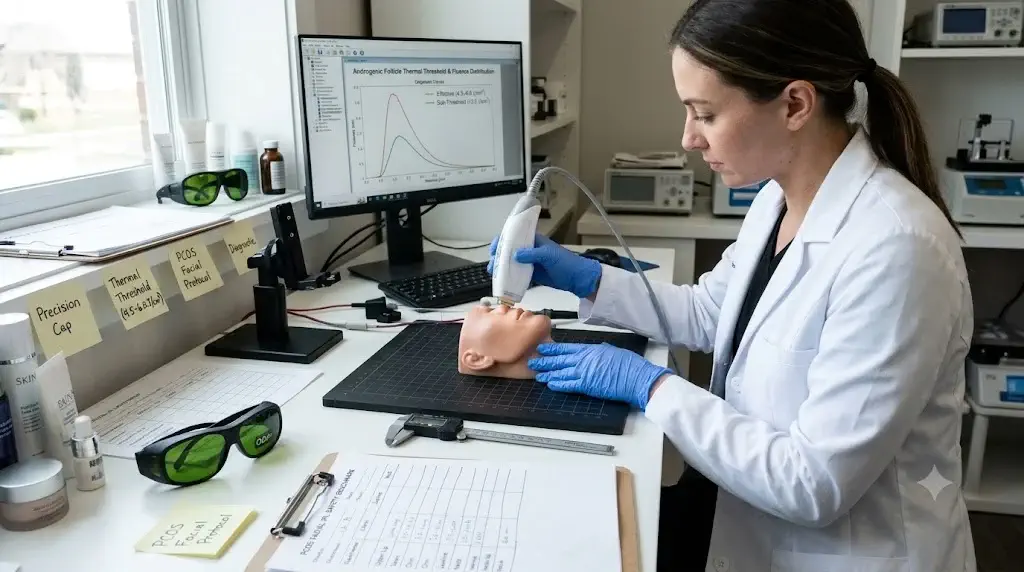
PCOS Facial Protocol
Guides & Science
How to Safely Use At-Home IPL for PCOS Facial Hair
By Nora Hayes, Lead Optical Metrology Auditor
Quick Reference Specification: PCOS Facial Treatment Parameters
Quantitative clinical thresholds, biological androgenic constraints, pulse safety parameters, and optical risk barriers for managing hirsutism at home.
| Clinical Parameter | PCOS Facial Protocol Recommendation | Biological / Optical Rationale |
|---|---|---|
| Therapeutic Fluence Target | 4.5 J/cm² to 6.0 J/cm² (Highest Tolerated Safe Setting) | Sufficient thermal heat is required to disable deep androgenic roots without triggering paradoxical stimulation. |
| Aperture Window Size | 1.0 cm² to 2.0 cm² (Dedicated Precision Attachment) | Guarantees full optical seal on jawline, chin, and upper lip while preventing ocular scatter. |
| Treatment Regimen Frequency | 1 to 2 Sessions Weekly (Induction Phase: Weeks 1–12) | Synchronizes with accelerated androgen-driven anagen hair recruitment cycles. |
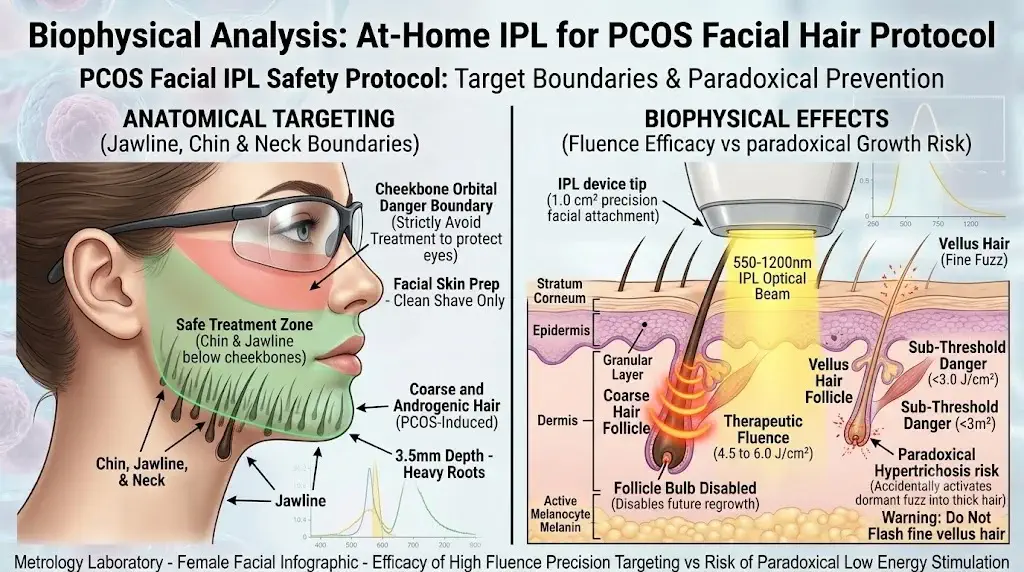
| Sub-Threshold Energy Warning | Strictly Avoid Sustained Low Fluence (<3.0 J/cm²) | Sub-therapeutic heating can trigger paradoxical hypertrichosis (stimulating vellus fuzz into terminal hair). |
| Pre-Flash Shaving Rule | Clean Facial Razor Only (No Plucking, Waxing, or Threading) | Root melanin must remain intact inside the follicle bed to absorb light energy. |
| Ocular Safety Threshold | Cheekbone Boundary Line (Wear OD4+ Filter Goggles) | Prevents intense pulsed optical energy from penetrating orbital structures or iris pigment. |
Learning how to safely use at-home IPL for PCOS facial hair requires understanding the unique endocrine dynamics of androgenic hirsutism. Polycystic Ovary Syndrome (PCOS) elevates circulating free testosterone and dihydrotestosterone (DHT), driving dormant facial follicles into producing thick, deeply anchored terminal hairs across the chin, neck, and jawline.
Treating hormonally stimulated facial hair requires higher precision and different protocols than treating standard body hair. In our clinical guide to the Best At-Home Hair Removal Devices for Facial Hair & Upper Lip, selecting a device with high optical fluence and dedicated precision attachments emerged as the essential standard for safe, long-term hair suppression.
Quick Protocol: Safe At-Home Management for PCOS Facial Hair
At-home IPL can significantly reduce PCOS facial hair when operated at high fluence (4.5 to 6.0 J/cm²), using a dedicated small precision head, and maintained through consistent bi-weekly sessions. Because PCOS continuously stimulates new hair follicles via circulating androgens, IPL functions as an ongoing management therapy rather than a one-time permanent cure. Users must shave instead of pluck, avoid sub-threshold low energy to prevent triggering finer hairs into thick growth, keep the treatment window strictly below the cheekbones, and commit to maintenance sessions every 2 to 4 weeks indefinitely.
Elevated circulating androgens continuously recruit new facial hair follicles throughout an adult’s life.
Understanding why PCOS hair behaves differently is essential for managing expectations. In typical genetic hair patterns, once a follicle is thermally disabled by intense pulsed light, it remains dormant for months or years. In women with PCOS, elevated levels of DHT continuously stimulate surrounding dormant follicles into new anagen (active growth) phases, producing a continuous stream of new coarse hairs across the chin and jawline.
As detailed in our clinical analysis on Treating Upper Lip & Chin: Attachment Windows, Eye Safety & Joules, facial hair follicles sit up to 3.5 millimeters deep in the dermis. Delivering adequate optical energy to these deeper structures requires high fluence and complete optical contact, making specialized small apertures essential for navigating curved facial contours.
Hormone-driven follicle recruitment means at-home IPL must be viewed as an ongoing maintenance tool rather than a permanent one-time fix.
Clinical Parameters for Androgenic Follicle Disablement
Sub-therapeutic light energy can paradoxically stimulate surrounding vellus fuzz into coarse terminal hair.
The most significant technical risk when using IPL for facial hair is paradoxical hypertrichosis—a biological response where low-level light energy inadvertently warms and activates dormant vellus follicles instead of disabling them. This occurs when an IPL device is operated on an excessively low energy setting, delivering just enough heat to stimulate blood flow and cellular activity in the follicle without reaching the destructive threshold.
We analyze this phenomenon in detail in Paradoxical Hypertrichosis: Can Low-Energy IPL Trigger Hair Growth?. To prevent this stimulation, PCOS patients must use the highest energy level safely compatible with their Fitzpatrick skin tone (ideally 4.5 to 6.0 J/cm²), treat only areas with genuine coarse terminal hair, and avoid flashing fine vellus fuzz on the upper cheeks or forehead.
Operating at adequate therapeutic energy levels prevents the accidental conversion of fine facial fuzz into dark, coarse hair.
Safety Rule: Target Coarse Hair Exclusively
Never use IPL across your entire face as a blanket treatment. Only flash discrete patches of dark, thick terminal hairs on the chin, neck, and jawline. Flashing translucent or fine blonde “peach fuzz” risks stimulating those hairs into becoming darker and coarser over time.
A standardized preparation protocol protects the skin barrier and maximizes light absorption in the follicle.
Achieving safe results on sensitive facial skin requires a disciplined routine. Plucking, tweezing, waxing, or threading must be completely discontinued at least four weeks prior to starting IPL, as these methods remove the hair bulb that the light needs to target. Patients must shave the treatment area flush with a clean, single-blade facial razor directly before each session to eliminate surface hair that could singe the skin.
Selecting a device engineered with solid output stability, such as the Nood™ Flasher Pro, ensures consistent energy delivery across irregular jaw contours. Always wear certified protective eyewear and verify that the treatment window is completely flat against the skin before releasing each flash.
Careful surface preparation and perpendicular window alignment ensure effective follicle heating while protecting the delicate facial epidermis.
Clinical Step-by-Step Checklist for PCOS Sessions
- Stop All Root Extraction: Cease tweezing, waxing, and threading completely. The root must remain present inside the follicle.
- Clean and Shave: Wash face with a gentle cleanser. Shave the chin, jawline, or neck cleanly using a fresh dermaplaning tool or razor.
- Perform Skin Patch Test: Wait 24 hours on a test spot along the jawline to confirm zero adverse swelling or pigment changes.
- Attach Precision Head: Install the smallest available aperture cap (1.0 to 1.5 cm²) to ensure complete optical seal.
- Apply Perpendicular Stamping: Press the window flush against the skin at a 90-degree angle. Stamp one flash per spot with 10% overlap; never glide rapidly over facial curves.
- Post-Care Cooling: Apply pure aloe vera gel or a hypochlorous acid mist immediately after flashing. Avoid active retinoids and direct sun exposure for 48 hours.
At-home IPL functions as an ongoing management tool rather than a permanent cure for PCOS hirsutism.
Establishing realistic biological expectations is vital for anyone managing PCOS. While IPL can dramatically reduce hair thickness, eliminate five o’clock shadow, and slow regrowth from daily shaving down to bi-weekly maintenance, it cannot alter underlying ovarian or adrenal androgen production. When hormone levels fluctuate, new follicles will periodically activate and require maintenance sessions.
Many endocrinologists and dermatologists recommend combining at-home IPL with medical treatments—such as oral spironolactone, metformin, or topical eflornithine cream—under physician supervision. Addressing internal androgen levels while using IPL to clear surface hair produces the highest rates of long-term satisfaction.
Combining hormonal management with consistent IPL sessions provides the most reliable long-term control over androgenic facial hair.
✅ What At-Home IPL Can Achieve
- Transforms thick, coarse chin stubble into finer, slower-growing hair
- Reduces shaving frequency from twice daily to once every 1–2 weeks
- Eliminates painful razor bumps, ingrown hairs, and folliculitis
- Provides private, cost-effective maintenance in your own home
❌ What At-Home IPL Cannot Do
- It cannot permanently cure or stop internal androgen production
- It will not eliminate hair after a single 8-week cycle without ongoing upkeep
- It cannot treat blonde, red, white, or grey facial hairs
- It cannot safely treat skin areas above the cheekbone or near the eyes
Consumer FAQ: Using At-Home IPL for PCOS Facial Hair
How often should I use an IPL device on my face for PCOS?
Why is tweezing or waxing my chin hair bad while doing IPL?
Can IPL make my PCOS facial hair worse or thicker?
Is at-home IPL safe if I have darker skin and PCOS facial hair?
Should I stop using my retinol or acne treatments when using IPL on my face?
